Showing posts with label feta. Show all posts

Sunday, January 15, 2017

Za’atar Twists

Bread baking books get me every time. I always want to jump in and bake everything. It was no different with Breaking Breads: A New World of Israeli Baking--Flatbreads, Stuffed Breads, Challahs, Cookies, and the Legendary Chocolate Babka by Uri Scheft, and I received a review copy. He brings an international perspective to his baking as an Israeli who has worked in Denmark, Italy, and France and has learned from Moroccan, Yemenite, and Turkish family and friends. He opened his own bakery, Lehamim Bakery which means “breads” bakery, in Tel Aviv in 2002, and expanded the business by opening Breads Bakery in New York City in 2013. His babka is famous, and the various recipes for that dough in the book all look delicious. There are careful instructions for filling, rolling, twisting, and shaping all the different flavors and types of loaves. And, the chapter for Challah shows some beautiful creativity. The dough is fashioned into braided, twisted, and stacked shapes, and there are even some loaves with cups baked into them for holding dipping sauces. The Black Tie Challah has a small braid covered in black sesame seeds along the length, on top of the larger braided loaf. Some of the flavors of challah include Chocolate and Orange Confit Challah, Marzipan Challah, and Sticky Pull-Apart Cinnamon Challah Braid. It’s inspiring to see a basic bread recipe taken in so many directions, and the reader is encouraged to experiment and try whatever shapes you fancy. Other breads include Brioche, Ciabatta, Pan de Mie, and an incredible Dill Bread that’s formed into a coil and snipped with scissors to make a flower shape before baking. There are cookies in the book too. I have the page marked for Chocolate-Dipped Vanilla Krembos which are made with a coconut macaroon base topped with a stable meringue that gets dipped into chocolate. I also marked the page for Parmesan Cookies that are a slice-and-bake savory snack with sesame seeds on the outside edge. Before baking those cookies, I had to try the Za’atar Twists first. 

The twists are made with babka dough, and there is a Basic Babka Dough recipe and an Advanced Babka Dough recipe. Both start the same way with a rich dough made with eggs and butter. The advanced version becomes even richer with a process of layering in more butter in the way puff pastry is made. I opted for the leaner, basic option here. The dough was mixed and then left to chill in the refrigerator for at least an hour before proceeding with the rest of the recipe. These savory twists are filled with a buffet of delicious things. And, now that I look more closely at a photo in the book, I realize that I probably left my filling a bit too chunky. In the photo, it appears that the feta was very finely crumbled to make a smoother, flatter layer. After the dough chilled, it was rolled out into a large rectangle. Labne was spread across the surface followed by finely chopped fresno chiles, a drizzle of olive oil, crumbled feta, toasted sesame seeds and pine nuts, chopped fresh oregano, and za’atar. I was delighted to find my oregano plants hadn’t been affected by our below freezing weather, and I was able to harvest plenty for the whole cup of leaves needed. The dough was then cut horizontally to make two long pieces. Each piece was rolled up as tightly as possible the same way cinnamon rolls are made. Then, each roll was pulled to tighten and lengthen. The rolls each ended up about 35 inches long. Those long rolls were then cut in half along the length and then cut crosswise to make seven pieces from each of the four long strips. Those cut strips were then joined in pairs and twisted. The twists were left to proof for a few hours before being brushed with egg wash and baked. 

My twists are a bit less tidy than the ones pictured in the book since my filling wasn’t quite as smooth. But, as the author points out, no matter how your results look, they will taste great—and they did. These are kind of a meal unto themselves due to all the flavor from the feta, oregano, and za’atar and the added texture from the nuts and seeds. And, the dough was a lot of fun to work with and form into twists. As always with bread books, I’m going to be baking more things from this.  

Za’atar Twists 
Excerpted with publisher's permission from Breaking Breads by Uri Scheft (Artisan Books). Copyright 2016. 

Makes 14 twists 

A savory babka? And why not? I got the idea to make a za’atar babka when I was making a za’atar-seasoned bread. To fill the babka, I use labne, which is ultra-rich strained yogurt that has a wonderfully creamy texture and tangy flavor—not unlike sour cream. Chiles, feta cheese, and pine nuts add to the savory appeal. Here you take the babka dough and instead of twisting it and placing it in a loaf pan, you bake it free-form for individual twists or sticks. (You can follow the twist-shaping method for just about any of the babkas—some of the filling may ooze out onto the sheet pan, but those crispy bits are often the best.) 

Sesame seeds 30 grams (3 tablespoons) 
1 recipe Basic Babka Dough, chilled 24 hours 
All-purpose flour - for rolling and shaping 
Labne - 400 grams (11/3 cups) 
Red jalapeno or Fresno chile - 1, finely chopped (seeded for less heat) 
Extra-virgin olive oil - 20 grams (1 tablespoon plus 1 teaspoon), plus extra for finishing 
Feta cheese - 110 grams (1 cup), crumbled 
Pine nuts - 60 grams (1/2 cup) 
Fresh oregano leaves 50 grams (1 cup) 
Za’atar - 25 grams (2 1/2 tablespoons), plus extra for finishing 
Egg Wash Large egg - 1 
Water - 1 tablespoon 
Fine salt - Pinch 

1. Toast the sesame seeds: Place the sesame seeds in a small skillet over medium-high heat and toast them, shaking the pan often, until they are golden brown, 2 to 3 minutes. Transfer the seeds to a small plate and set aside. 

2. Roll the cold babka dough: Unwrap the cold babka dough and set it on a lightly floured work surface. Roll the dough into a 12-by-28-inch rectangle (it should be just a little shy of ¼ inch thick) with a long side facing you. Pull and shape the corners into a rectangle. 

 3. Fill and roll the dough: Spread the labne over the dough in a thin, even layer. Sprinkle it with the jalapeño, olive oil, feta, toasted sesame seeds, pine nuts, oregano, and za’atar. Divide the dough in half horizontally so you now have two 6-by-28-inch pieces. Working from the long bottom edge of one of the pieces, roll the dough up into a tight cylinder, pushing back on the cylinder with each roll to make it even tighter. Lift the cylinder, holding one end in each hand, and gently stretch and pull to tighten it even more (it will stretch to about 35 inches long). Repeat with the second piece of dough. 

4. Divide the dough into strips and make the twists: Use a bread knife to slice each cylinder in half lengthwise so you have 4 long pieces, and then slice those pieces crosswise into 7 equal sections (about 5 inches each) to make a total of 28 strips. Cross 2 equal-size pieces to create an X, keeping the exposed filling facing up. Twist the ends together like the threads on a screw so you have at least 1 twist on each side of the X (3 twists total). Repeat with the remaining pieces. Set 7 twists on one parchment paper–lined rimmed sheet pan and 7 twists on a second parchment paper–lined sheet pan. 

5. Let the twists proof: Cover the sheet pans with plastic wrap and set aside in a warm, draft-free spot until the twists have doubled in volume and are very soft and jiggly to the touch, 2 to 3 hours, depending on how warm your room is. 

6. Preheat the oven to 350°F. 

7. Bake the twists: Make the egg wash by whisking the egg, water, and salt together in a small bowl. Brush egg wash over each twist, and bake until they are dark brown and baked through, about 20 minutes; check the twists after 15 minutes, and if they are getting too dark, tent them loosely with a piece of parchment paper. Remove the twists from the oven and, while they are still warm, brush with more olive oil and sprinkle with a little za’atar. Serve warm or at room temperature. 

Basic Babka Dough 

Whole milk (at room temperature) - 120 grams (1/2 cup) 
Fresh yeast - 20 grams (2 1/2 tablespoons) or active dry yeast - 6 grams (2 teaspoons) 
All-purpose flour (sifted, 11.7%) - 280 grams (2 1/4 cups), plus extra for dusting and kneading 
Pastry or cake flour (sifted, 8.5 to 9%) - 220 grams (2 cups plus 2 tablespoons) 
Large eggs - 2 Granulated sugar - 75 grams (1/3 cup) 
Fine salt - Large pinch 
Unsalted butter (at room temperature) - 80 grams (5 tablespoons plus 1 teaspoon) 

1. Make the dough: Whisk the vanilla into the milk in the bowl of a stand mixer fitted with the dough hook. Use a fork or your fingers to lightly mix the yeast into the milk. Then, in this order, add the flours, eggs, sugar, salt, and finally the butter in small pinches. 

2. Mix on the lowest speed, stopping the mixer to scrape down the sides and bottom of the bowl as needed, and to pull the dough off the hook as it accumulates there and break it apart so it mixes evenly, until the dough is well combined, about 2 minutes. If the dough is very dry, add more milk, 1 tablespoon at a time; if the dough looks wet, add more all-purpose flour, 1 table-spoon at a time, until the dough comes together. Increase the mixer speed to medium, and mix until the dough is smooth and has good elasticity, 4 minutes. 

3. Stretch and fold the dough: Lightly dust your work surface with flour and turn the dough out on top; lightly dust the top of the dough and the interior of a large bowl with flour. Grab the top portion of the dough and stretch it away from you, tearing the dough. Then fold it on top of the middle of the dough. Give the dough a quarter turn and repeat the stretch, tear, and fold. Continue to do this until you can stretch a small piece of dough very thin without it tearing, about 5 minutes. Then use your hands to push and pull the dough against the work surface and in a circular motion to create a nice round of dough. Set the ball in the floured bowl, cover the bowl with plastic wrap, and set it aside at room temperature for 30 minutes. 

4. Chill the dough: Set the dough on a piece of plastic wrap and press it into a 1-inch-thick rectangle. Wrap the dough in plastic wrap and refrigerate it for at least 1 hour or up to 24 hours.

I am a member of the Amazon Affiliate Program. 

Thursday, September 22, 2016

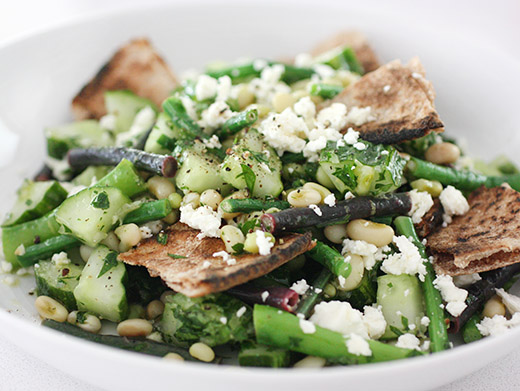
Green Bean and Shell Bean Fattoush

A new book from Martha Stewart always gets my attention and so do books focused on vegetables. I was delighted to receive a review copy of the latest, Martha Stewart's Vegetables. This brings together dishes for every season with all sorts of vegetables, but it’s not a vegetarian cookbook. The recipes highlight what’s great about the vegetables, and in some cases the star vegetable isn’t the only player in the dish. The chapters group types of vegetables like Bulbs, Roots, Greens, Pods, Fruits, etc. In this case, Fruits refers to tomatoes, eggplants, peppers, and cucumber because they are technically fruits due to the seeds held within the flesh. Each chapter begins with an introduction to its type of vegetable with good information about how the plants are grown, their growing season, and some general tips for buying, storing, and preparing. This book is a little breezier about the vegetable information and doesn’t go quite as deep into the taxonomy of the plants as does Vegetable Literacy by Deborah Madison, but it offers a very good overview of the different kinds of plants we include in our meals. And, page after page reveals beautiful dishes ranging from stir-fries to sandwiches to soups, salads, and pasta with inspiration from several types of cuisine. The Herb-and-Scallion Bread Pudding would be perfect for Thanksgiving, Beet Risotto with Beet Greens would brighten a winter table, and Twice-Cooked Potato and Leek Casserole looks like a comfort food dish no one could resist. I want to try the Fried Rice with Collard Greens, Fennel and Smoked Salmon Salad, and Moroccan Vegetable Soup. Right away, I was intrigued by the Green Bean and Shell Bean Fattoush, and all the main ingredients are in season here right now. 

In the book, the recipe name is Green Bean, Shell Bean, and Sweet Onion Fattoush. But, I have an onion thing. I only use onion if it’s minced or if it’s in pieces large enough that I can easily scoot them out of my way on the plate. So, in my version, the onion was minced and whisked into the dressing for this salad. But, the important parts of this dish were the green beans, shell beans, and cucumber. I found all of those at Boggy Creek Farm. For green beans, I used purple and green long beans that I cut into two-inch lengths before blanching. The shell beans were fresh, golden creamer peas that cooked quickly with just about 15 minutes of simmering. Both kinds of beans were shocked with cold water after cooking and left to drain. The dressing, in my case, was made with minced onion, lemon zest, lemon juice, and garlic. Olive oil was whisked into the mixture. Pita was grilled and broken into shards. The cooled and drained beans were tossed with chopped cucumber, parsley, and homegrown basil rather than mint. Crumbled feta was added along with the dressing, and the pita pieces were added to each serving. 

This was a light and fresh take on using shell beans for me. Each year when their season arrives, I usually add them to a summery stew with chunks of summer squash and tomato. This herby, lemony salad was a delicious way to highlight their mild, buttery flavor. I know I’ll be reaching for this book often as different vegetables appear throughout the coming months. 

Green Bean, Shell Bean, and Sweet Onion Fattoush 
Recipe courtesy of Clarkson Potter/Publishers, a division of Penguin Random House, LLC. Copyright 2016 by Martha Stewart Living Omnimedia, Inc. Photographs copyright 2016 by Ngoc Ming Ngo. 

In late summer, fresh green beans and shell beans make a wonderful pair, one sharp and crisp-tender, the other buttery and plump. They’re the beginnings of our version of fattoush, a Middle Eastern bread salad that’s a fine way to enjoy summer produce. You can blanch the beans in the same pot: first the green beans, and then the shell (and not the other way around, since shell beans release a lot of starch). 

Serves 4 

2 lemons, 1 zested and both juiced 
2 garlic cloves, crushed 
Coarse salt and freshly ground pepper 
1/2 cup extra-virgin olive oil, plus more for brushing 
1/2 pound haricots verts, trimmed 
3/4 cup shelled fresh shell beans, such as limas 
3 pita breads (6-inch) 
1/2 large Vidalia onion, coarsely chopped 
1 English cucumber, quartered and cut into 1- inch pieces 
4 ounces feta cheese, crumbled 
1/2 cup coarsely chopped fresh mint, plus more for garnish  
1/3 cup coarsely chopped fresh flat-leaf parsley 

1. Whisk together lemon zest, lemon juice, and garlic, and season with salt. Whisking constantly, pour in oil in a slow, steady stream and whisk until emulsified. Season with pepper. Let stand 15 minutes; discard garlic. 

2. Blanch haricots verts in a pot of salted boiling water until crisp-tender and bright green, about 1 minute. Transfer beans to an ice-water bath (reserve pot of water); let cool, then drain and pat dry. Place in a large bowl. 

3. Return water to a boil. Blanch shell beans until just tender, 18 to 20 minutes. Transfer to ice bath; let cool, then drain in a colander and pat dry. Combine with haricots verts. 

4. Heat a grill (or grill pan) to medium. Split each pita in half. Brush both sides of pita halves with oil; season with salt and pepper. Grill pita, turning once, until golden and crisp, about 1 minute per side. Let cool, then tear into 1-inch pieces. 

5. Add onion, cucumber, feta, herbs, and pita to the beans; drizzle with ½ cup vinaigrette; toss well to combine. Season with salt and pepper; garnish with mint. Let stand at least 10 minutes and up to 1 hour before serving. 

TIP The pita is charred on the grill (or under the broiler) to make it sturdy enough to soak up the vinaigrette without falling apart. The longer the salad sits before serving (up to an hour), the better the flavors and textures will be. 

I am a member of the Amazon Affiliate Program. 

Sunday, February 15, 2015

Fatayer with Cheese and Spinach

If I’d been asked a few weeks ago what I knew about Lebanese food, I would have said that I didn’t really know anything. It turns out, I’ve been enjoying the flavors of Lebanese cooking for years without even realizing it. I received a review copy of the new book Comptoir Libanais: A Feast of Lebanese-Style Home Cooking by Tony Kitous and Dan Lepard and started learning a thing or two about this wonderful food. Kitous opened the London restaurants Comptoir Libanais to share Lebanese culture through the food, the look and feel of the dining rooms, and the design of every item seen throughout. He set out to create “something that wasn’t pretentious but inviting, simple, and that had something for everyone.” I’d love to visit one or several of the locations. A mix of mezze dishes like Tabbouleh, Fattoush, Labneh with Black Olives and Mint, Sambusak turnovers, and Falafel might be found on the tables. Some of my favorite ingredients like halloumi and feta cheeses, pomegranate seeds and pomegranate molasses, and sumac and za’atar figure prominently in many of the recipes. I can’t wait for ripe, summer tomatoes to use in the Comptoir Tomato and Halloumi Salad and zucchini to turn into crispy fritters. So far, I’ve tried the Bulgur Salad with Peas and Mint which is a good choice for winter since it’s topped with pomegranate seeds and can be made with frozen peas. Like classic tabbouleh, this salad is as much or more so about the mint and parsley as it is the bulgur. Next, I tried the Fatayer with Cheese and Spinach which are filled, savory pastries. They’re made with Sambusak Pastry that’s like pizza dough minus the yeast. The dough is very easy to work with, and it’s used for a few different recipes in the book. 

To start, water, flour, olive oil, honey, and salt were stirred together in a bowl. It was set aside to rest for about 10 minutes, and then it was kneaded until smooth. The dough easily goes from ragged to smooth while kneading. At this point, the dough can be refrigerated until you’re ready to make the pastries, or it needs to be set aside for an hour to rest before using. Next, spinach was cooked in olive oil until wilted and then drained, cooled, and squeezed to remove excess moisture. The cooked spinach was chopped and then combined with toasted chopped walnuts and pomegranate molasses. The dough was divided into small pieces, and I aimed for 20 pieces which was the number this recipe was intended to make. The dough pieces were rolled into balls and left on an oiled plate. One piece of dough at a time was rolled into a circle, and a spoonful of spinach filling was placed in the center. The edges of the dough circle were rubbed with water, and the dough was pinched up around the filling forming three points with the center left open. Once all the dough circles were filled and crimped, the cheese was added on top. I used a mix of grated halloumi and crumbled feta. The cheese mixture was spooned into the opening of each pastry, and then they were topped with black onion, or nigella, seeds. The pastries baked for about 30 minutes until golden and crisp on the edges. 

As an option, mozzarella can be used in place of the halloumi. That would have made the filling more melty and gooey in a delicious way, but I can never resist the salty flavor of halloumi. These little savory pastries were crunchy with crisp edges on the outside and the nuts in the filling. The pomegranate molasses added just the right amount of tanginess and interest. Like all of the dishes in the book, this was perfect for sharing with a group or serving at a party. And, since the Breakfast chapter has caught my eye, it might be time to plan a brunch party.

Fatayer with Cheese and Spinach 
Recipes reprinted with publisher’s permission from Comptoir Libanais: A Feast of Lebanese-Style Home Cooking by Tony Kitous and Dan Lepard. Copyright © Tony Kitous and Dan Lepard, 2013. Published on November 19, 2014 by The Overlook Press, Peter Mayer Publishers, Inc. www.overlookpress.com. All rights reserved. 

Fatayer are usually triangular-shaped pastries, either sealed at the top or left open. Sealing the edges of the pastry at the top protects the filling so it’s perfect or you can leave the top open the way we do at Comptoir and pinch the edges of the filled fatayer to form a triangular shape as in the photo here. If you sprinkle a deep layer of cheese on top before baking, any filling underneath is protected from the heat of the oven, allowing the pastry to be crisp but the filling soft. 

Makes about 20 small fatayer 

1 recipe Sambusak Pastry 
flour or oil, for rolling the dough 

for the filling: 
2 tbsp olive oil 
1 pound (500g) baby spinach 
1/2 cup (50g) walnuts, chopped 
2 tbsp pomegranate molasses 
5 ounces (150g) halloumi or mozzarella, drained and grated or finely chopped 
5 ounces (150g) feta cheese, crumbled 
small bunch fresh mint, leaves only, chopped 
black onion (nigella) seeds or za’atar, to finish 

Start by preparing and resting your dough (see p. 82). Preheat the oven to 350°F (180°C/160°C fan/gas 4). Line a few baking sheets with parchment paper. 

Make the filling by heating the olive oil in a large frying pan until smoking hot, then add the spinach and fry quickly until it just begins to wilt. Tip the spinach into a colander and set aside to cool, then squeeze the cooked spinach as hard as you can to remove the liquid. Chop the spinach, then place it in a bowl with the walnuts and pomegranate molasses, and mix well. 

Chop the dough into small pieces, about the size of an unshelled walnut, then shape these into balls and set aside to rest on an oiled plate, covered, for 15 minutes (this makes rolling easier). Roll out each dough ball on a lightly floured or oiled surface to about 3 inches (8cm) wide. Place a heaping teaspoon of the spinach filling in the center of one, then with the tips of your fingers rub a little water around the bare edges of the dough. At 3 equal points, pull the dough up 1/2 to 3/4 inch (1 to 2cm) and pinch the dough together to seal — you should have created a protruding edge around the filling. 

Spread the cheese over the filling, then top with a pinch of mint, sprinkle with the black onion seeds or za’atar, and place on the lined baking sheets. Repeat with the remaining dough and filling, then bake for about 30 minutes, until crisp and golden, rotating the baking sheets if one batch looks like it is browning more quickly.

Sambusak or fatayer pastry 
Little pastries filled with a variety of ingredients, from chopped herbs and soft cheese to meat, walnuts, or chicken, can be found throughout the Arab world, under different names. These cheeky little savory parcels have a delicious filling tucked inside and can be served either hot or cold. They freeze well, and because they’re so small they can be reheated easily. You want a flour that produces a dough that stretches easily, and bread flour will do that. However, this can make the pastries a little tough and not as tender as the ones we have at Comptoir. If you want to experiment, use half bread flour and half all-purpose flour or half Italian pasta flour, as this will give a more tender result. 

Makes 12 ounces (350g) dough 

1/2 cup (125ml) warm water 
1 1/2 cups (200g) bread flour, plus extra for kneading 
1 1/2 tbsp (25ml) olive oil 
1 tbsp superfine sugar or clear honey 
1 tsp salt 

Pour the water into a bowl, then add the flour, olive oil, sugar or honey, and salt and mix everything together well. Aim for a firm-ish dough, adding more water or flour to get the texture you want. Cover the bowl with plastic wrap, set aside for 10 minutes, and then lightly knead the dough. Return it to the bowl, cover again, then set aside for about 1 hour at room temperature and it’s ready to use. If you want to make the dough ahead of time, you chill it at this point, then leave it at room temperature for 1 hour before shaping. 

Some basic tips for making the best pastries: roll the dough very thin, otherwise you end up with too much pastry surrounding the filling. I use a little flour, as oil sometimes stops the edges from sealing firmly, but figure out what works best for you. The dough will keep well in the fridge for a few days, and gets easier to roll, but it will change color and go slightly gray. This is just the flour oxidizing and it won’t affect the flavor. You can also freeze the dough. Simply thaw it and return it to room temperature before using.


I am a member of the Amazon Affiliate Program.

Friday, July 12, 2013

Peach and Radish Salad with French Feta and Almonds

It’s not often that the first word I’d use to describe a collection of chefs’ recipes is “practical,” but that’s just what came to mind as I started reading a review copy I received of The Chefs Collaborative Cookbook. The Chefs Collaborative is a group of chefs, food professionals, and producers who have been fostering sustainable cooking through advocacy and education for 20 years. They inspire others to “embrace seasonality, preserve diversity and traditional practices, and support local economies.” The book is a collection of dishes from the member chefs that take you through the seasons with vegetables and fruits, meat and poultry, fish and seafood, and dairy and eggs. The recipes immediately seemed practical because of the many suggestions throughout for making use of what’s in season at the same time, what you may be growing yourself or finding at your farmers’ markets, or what you may have on hand to use as substitutes. There are ideas for using as much of harvested plants as possible like by saving your chard stems for a gratin, pickling watermelon rind, and adding squash leaves to a curry. I like those kinds of reminders especially when the end results look so delicious in the photos. There are also great bits of information throughout the book about reducing waste, choosing well as you shop, and cooking with different sustainably-produced ingredients. The Rainbow Chard Stem Gratin is from Chef Monica Pope; the Broccoli Hushpuppies made with broccoli stems comes from John and Julie Stehling; the beautiful Grilled Eggplant with Roasted Red Pepper and Black Olive Salad is by Nora Pouillon; Southwest Heritage Bean Soup using heirloom beans is from Kim Muller; and Chestnut Waffles with Roasted Apples and Cream is by Jennifer McCoy. It’s exciting to see a book full of such smart ideas, making use of sustainable ingredients so well, and bringing together interesting flavors. At the height of peach season, I love adding them to as many meals as I can, so I was delighted to see the Peach and Radish Salad with French Feta and Almonds by Michael Schwartz. That was my first stop in the book. 

To make the salad, red onion was thinly sliced on a Benriner mandoline and then left to soak in cold water to take off some sharpness and to make them extra crisp. I also sliced the radishes on the mandolin and soaked them in cold water. The peaches were pitted and cut into thin wedges. An easy vinaigrette was made with champagne vinegar, olive oil, and salt and pepper. The drained vegetables, peach wedges, and some chopped basil were tossed with the vinaigrette and placed on platter. The salad was topped with crumbled feta, more chiffonade of basil, and toasted almonds. 

It’s a crunchy, savory, tangy, and sweet kind of salad, and I loved the mix of flavors. It was a perfect match for some grilled, Gulf shrimp. I’m deciding what to make next and thinking about the Farmstead Cheese Strata with Roasted Tomato Wine Butter. There’s also a Vanilla Carrot Cream Tart that I can’t wait to taste. There’s a lot to like about this book, and I predict its pages will be food-splattered from frequent use. 

Peach and Radish Salad with French Feta and Almonds 
Recipe reprinted with publisher’s permission from The Chefs Collaborative Cookbook by Chefs Collaborative and Ellen Jackson published by The Taunton Press in 2013. 

Michael Schwartz, Michael’s Genuine Food and Drink | Miami, Florida 

French feta cheese is typically made with sheep milk and tends to be milder and creamier than Greek feta. Its understated flavor nicely complements the sweetness of the peaches and the bright, peppery notes of the basil and radishes. Cheesemakers across the country are making a wide range of sheep milk cheeses, including French-style feta. Look for your own local source. 

Serves 6 

1/2 small red onion 
3 to 4 Easter Egg or French Breakfast radishes 
4 or 5 ripe peaches (about 2 pounds) 
1/4 cup extra-virgin olive oil 
2 tablespoons champagne vinegar 
Kosher salt and freshly ground black pepper 
1/2 cup fresh basil leaves, torn 
1 cup French feta cheese, crumbled 
1/4 cup sliced almonds, lightly toasted 

Thinly slice the onions on a mandoline or with a very sharp knife. You should end up with about 1⁄4 cup. Fill a small bowl with cold water and a few ice cubes and soak the onions for 5 minutes; this mellows the sharp bite typical of raw onions and makes them crisp. Drain the onions and pat dry with paper towels. Thinly slice the radishes on the mandoline. 

Halve and pit the peaches. Cut each half into quarters and slice the quarters into thin wedges. Combine the oil and vinegar in a bowl with some salt and black pepper and whisk to combine. Add the peaches, onions, radishes, and basil, tossing gently to evenly coat the ingredients. Season to taste with additional salt and pepper if desired. 

Divide the salad equally among six plates and top with the crumbled feta and toasted almonds. 

I am a member of the Amazon Affiliate Program.

Monday, February 4, 2013

Carrot Pancakes with Hummus and Feta Salad

I keep a pretty close watch on new cookbooks that are published, but once in a while something slips by me. The hard cover version of The Modern Vegetarian by Maria Elia came out in 2009, and I didn’t realize what I was missing until the new paperback just appeared late last year. I received a review copy, and started making up for lost time. The book is full of pretty dishes with great flavors that are fun to serve. The Dukkah-Rolled Soft-Boiled Eggs with Chickpea puree served on crostini would be a showstopper at a party. The Chile and Rosemary Eggplant Parcels are stuffed with buffalo mozzarella and nestled into a mash that mixes more eggplant with potatoes. Elia makes suggestions throughout the book for substituting various vegetables and herbs depending on the season. I couldn’t wait to try the Capri Lemon Pasta with mascarpone and parmesan cream sauce, but rather than using peas, fava beans, and asparagus, I made it with spinach. It was delightful. There’s also a chapter full of sweets with stunning things to make like Stuffed Fig Pastries with Honey and Nuts and Cafe Latte Ice Cream with shards of Coffee Tuilles. Before I get too distracted by the desserts, I need to tell you about these Carrot Pancakes. The spicy, little cakes are made with chickpea flour and grated carrots and are topped with a carrot hummus and a fresh tangle of sprouts with sliced almonds, orange chunks, and feta. 

This is the kind of dish that can easily be done in stages. The carrot hummus can be made a day or two in advance, and the pancakes can be mixed and formed and refrigerated until you’re ready to cook them. The feta salad is optional if you’d rather just serve the pancakes with the humus, or you could even sprinkle the hummus with crumbled feta by itself rather than make the salad. I started by making the hummus. I chopped some carrots into small pieces and boiled them until tender. The carrot pieces were drained and added to the blender with olive oil, rinsed and drained canned chickpeas, some chopped garlic, lemon juice, tahini, ground cumin, and salt and pepper. The mixture was blended until smooth, and I added just a bit of water for a softer consistency. With the hummus done, I moved on to the pancakes. Grated carrots were mixed with finely chopped onion, green chile, and I used one red chile as well, crushed cumin and fennel seeds, ground coriander, chopped cilantro, baking powder, chickpea flour, semolina, salt, and some water. Olive oil was heated in a skillet, and the thick batter was spooned into it in little cakes which cooked for a few minutes on each side. The recipe is written for making four to six cakes, but I made smaller cakes. For the salad, a dressing was whisked together with sherry vinegar, water, extra virgin olive oil, Dijon, and minced garlic. A mix of watercress, shiso, and sprouts is suggested, but I used pea shoots, onion sprouts, and cilantro leaves. Those were tossed together with chopped, segmented orange slices, sliced almonds, and crumbled feta. The dressing was added, and the salad crowned the dollop of hummus on each carrot pancake. 

There was a lot to like about this from the crispy, little pancakes to the pretty color of the hummus with carrots and the mix of added flavor from the salad on top. I would have enjoyed each of the three parts separately, but all together, they made a special dish. With so many interesting flavor combinations and ways to adapt the recipes for what’s in season, I’ll be reaching for this book often. 

Carrot Pancakes with Hummus and Feta Salad 
Recipe reprinted with publisher's permission from The Modern Vegetarian.

This recipe is perfect as a light lunch, snack or starter. It also makes great party canapés, as it can be prepared in advance. The salad is entirely optional. 

serves 4–6 

For the pancakes 
1 1/2 cups / 150g carrots, grated 
1 small onion, finely chopped 
2 green chillies, seeded and finely chopped 
2 teaspoons cumin seeds 
1 teaspoon fennel seeds 
2 teaspoons ground coriander 
2 tablespoons chopped coriander 
1 teaspoon baking powder 
1 cup / 100g chickpea flour (or besan or gram flour) 
1/4 cup / 50g semolina 
2 teaspoons salt 
2/3 - 3/4 cup / 150–200ml water 
3 tablespoons olive oil, for frying 

For the hummus 
6 large / 400g carrots, peeled 
4 tablespoons olive oil 
pinch of sea salt and freshly ground black pepper 
1 1/4 cups / 200g chickpeas, cooked (canned will do) 
1 garlic clove, finely chopped 
juice of half a lemon 
2 tablespoons tahini 
1 teaspoon ground cumin 

For the salad 
a bunch of watercress, thick stems removed 
1 orange, peel and pith removed, cut into segments 
1 bunch shiso (or any micro) sprouts 
1 bunch coriander sprouts (or coriander leaf) 
12 mint leaves, torn 
1 1/2 cups / 50g alfalfa sprouts 
1/4 cup / 25g sliced almonds, toasted 
pinch of ground cinnamon 
1/3 cup / 50g feta cheese, crumbled 

For the dressing 
5 teaspoons / 25ml sherry vinegar 
5 teaspoons / 25ml water 
2 tablespoons extra virgin olive oil 
1 teaspoon Dijon mustard 
pinch of sugar 
1 garlic clove, crushed 

 Preheat the oven to 200°C/400°F/Gas Mark 6. To make the pancakes, mix all the ingredients, except the olive oil, together to form a thick batter. Heat the oil in a small non-stick frying pan until hot, then spoon in about a quarter of the batter and fry until golden on both sides. Repeat with the remaining mixture to make 4–6 pancakes in total. Leave to drain on a wire rack, and then keep warm in the oven. 

Cut the carrots into thin slices, drizzle with olive oil and season with salt and pepper. Place in a roasting tin, add 200ml water and roast for 20–30 minutes until softened. While still hot, put them in a blender with the remaining ingredients and whizz to a smooth puree, adding a little water if too thick. Season again if necessary and refrigerate until needed. If you prefer, you can boil the carrots instead; just cook until tender and follow the recipe as above. 

To make the salad, mix all of the salad ingredients and toss together well. Whisk the dressing ingredients together and season to taste. To assemble the dish, reheat the pancakes in a warm oven, place on individual plates and top with the carrot hummus. Dress the salad with the sherry dressing and place on top of the hummus. 

I am a member of the Amazon Affiliate Program.

Sunday, December 23, 2012

Scuttlebutt Sandwich with Pickled Beets and Hard-Boiled Egg

The list of restaurants I’d like to visit in Brooklyn keeps growing, and I just added one more to it. Saltie is a sandwich shop that specializes in putting classic combinations of things that might not have been thought of as sandwiches before between pieces of bread. They rely on local and seasonal ingredients and make their breads, mayonnaise, vinaigrettes, pickles, yogurt, sweets, and soups from scratch. The new book from the shop is Saltie: A Cookbook, and I received a review copy. The recipes include the focaccia and naan they use for sandwiches as well as all the condiments, pickles, and other items they prepare. A few of the sandwiches that jumped out at me were the Curried Rabbit which is a play on Welsh rarebit with cheddar, curried mayonnaise, apple salad, and currant pickle; the Spanish Armada with potato tortilla and pimenton aioli; and the Henry Hudson with fried green tomatoes, bacon, mayonnaise, and fresh basil. Then, from the Soups section, there’s a Cauliflower, Leek, and Gruyere Soup and a Curried Squash and Red Lentil Soup I want to try. There are also salads with greens, grains, and bread in some cases. Every dish offers a fresh, savory mix of things you know will taste great together. For instance, I already had a thing for the combination of beets and hard-boiled eggs. So, the Scuttlebutt sandwich had to be my first stop in the book. It’s built on freshly-baked focaccia and layered with pimenton aioli, feta, and black olives. I couldn’t wait to taste it.

First, I followed the recipe from the book for focaccia with an easy, no-knead process. The dough was mixed, then transferred to an oiled bowl, and then refrigerated for anywhere from eight hours to two days. The dough was spread on a baking sheet and left to come to room temperature before being dimpled, sprinkled with salt, and baked. Up next, I made the pimenton aioli. As usual, I’m not capable of making a mayonnaise or aioli in a food processor or blender. I only seem to have luck with a hand mixer. I eventually got a good emulsion. A day in advance, I roasted and pickled some beets, and the pickled beets will last in the refrigerator for up to two months. For the hard-boiled eggs, the authors offer an interesting technique. They suggest poking a hole in the big end of each egg with a thumbtack. The tack should be twisted into the shell and pushed all the way in until the flat part of the tack touches the shell and then removed. Then, the eggs were placed in boiling water and left for ten minutes before being transferred to ice water. I was using very fresh, local eggs, and the shells did come off more easily than they usually do. So, I’ve been repeating this for all the eggs I’ve boiled since. To make the sandwich, the focaccia was cut into squares and sliced in half horizontally. On the cut sides, the pimenton aioli was spread on each piece. Then, sliced hard-boiled egg was added followed by a mix of black olives, capers, herbs, sliced green onion, and sliced radishes. I added the sliced pickled beets last with sliced feta.

This was one of those deliciously messy sandwiches in which everything wants to squish out the sides and you try to keep things intact since you don’t want to lose a single bit of it. You could give up and attack it with a fork and knife, but where’s the fun in that? Until I can plan a food tour of Brooklyn, I’ll keep sampling more things from this book.

Scuttlebutt
Hard-boiled egg, pimentón aioli, feta, black olive, capers, fresh herbs, pickled beets
Recipe re-printed with publisher's permission from Saltie: A Cookbook.

“I’m English, and the Scuttlebutt is really a sandwich my sister used to make for me of salad on white bread with salad cream. . . . It’s obviously tweaked a bit, but when we said, ‘Oh, we’re going to make sandwiches; what was your favorite sandwich?’ I’d say I had this really awesome sandwich of hard- boiled eggs and whatever was in the fridge—a Dagwood Bumstead. It was really delicious.” —RC

Makes 1 Sandwich

There is so much to say about the Scuttlebutt. It really has earned its gossipy title. It’s the sandwich that is most likely to change, as the ingredients rotate with the seasons and with what’s in the refrigerator. In summer, it has tomatoes and arugula; in winter, squash and a chiffonade of Tuscan kale. There is a rotating cast of pickles, the most popular being the beet. Some people order the Scuttlebutt as “the sandwich with the beets,” which never fails to disappoint when those particular pickles are off the menu. The staple ingredients remain pimentón aioli, hard-boiled egg, feta, capers, and olives. The rest is a free-for-all that for some can end in tears. The Scuttlebutt makes people emotional. It is an exercise in impermanence.

1 sandwich-size piece of Focaccia (see separate recipe)
2 tablespoons Pimentón Aioli
1 hard-boiled egg, peeled and sliced
1 tablespoon pitted oil-cured olives, chopped
1/2 tablespoon capers
1/4 cup Fresh Herb Mix
2 tablespoons chopped pickles, ideally Pickled Beets (see separate recipe)
1 radish, thinly sliced (optional but nice)
Extra-virgin olive oil
1 ounce sheep’s milk feta

Cut the focaccia in half horizontally and put on a plate, cutsides up. Spread both cut sides with aioli. Arrange the egg slices evenly on the bottom half of the bread. Set aside.

In a bowl, toss the olives, capers, herbs, pickles, and radish (if using) with just enough olive oil to coat lightly. Mound the salad on top of the egg. If you can, slice the feta and arrange on top of the salad. If you can’t get a nice even slice of feta, you can either crumble it on top of the salad (although it will tend to roll off the top of pile), or you can toss the feta with the salad. Quickly replace the top of the bread before the sandwich falls apart, pressing gently to help it hold together, and serve right away.

Focaccia

Focaccia is the bread that we use for most of the sandwiches at Saltie. The reasons for choosing this soft-but-chewy Italian yeast bread were equally pragmatic and delicious. We considered what we could reasonably produce and decided a bread that we could make on a baking sheet would be much more economical in terms of time and space than one that required more individual attention. As has been the case with many of our choices at Saltie, landing on focaccia at first may have seemed the solution to how to do something in the best and most efficient way, but it quickly became the fact-of-the-matter only possible choice that it is today. Now I can’t imagine life without focaccia. Its fluffy, oily welcome greets me daily.

Enough for 8-10 sandwiches

6 1/4 cups all-purpose flour
2 tablespoons kosher salt
1 teaspoon active dry yeast
3 1/2 cups warm water
1/4 cup extra-virgin olive oil, plus more for greasing and drizzling
Coarse sea salt

Preheat the oven to 450°F. In a large bowl, whisk together the flour, salt, and yeast. Add the warm water to the flour mixture and stir with a wooden spoon until all the flour is incorporated and a sticky dough forms (no kneading required). Pour the 1/4 cup olive oil into a 6-quart plastic food container with a tight-fitting lid (see Note). Transfer the focaccia dough to the plastic container, turn to coat, and cover tightly. Place in the refrigerator to rise for at least 8 hours or for up to 2 days.

When you’re ready to bake, oil an 18-by-13-inch baking sheet. Remove the focaccia dough from the refrigerator and transfer to the prepared pan. Using your hands spread the dough out on the prepared pan much as possible, adding oil to the dough as needed to keep it from sticking. Place the dough in a warm place and let rise until about doubled in bulk. The rising time will vary considerably depending on the season. (In the summer, it may take only 20 minutes for the dough to warm up and rise; in the winter it can take an hour or more.)

When the dough is ready, it should be room temperature, spread out on the sheet, and fluffy feeling. Pat down the focaccia to an even thickness of about 1 inch on the baking sheet tray and begin to make indentations in the dough with your fingertips. Dimple the entire dough and then drizzle the whole thing again with olive oil. Sprinkle the entire surface of the focaccia evenly with sea salt.

Bake, rotating once front to back, until the top is uniformly golden brown, about 15 minutes. Transfer to a wire rack to cool, then slide out of the pan. Use the same day.

Note : This easy recipe calls for a large plastic food-storage container, about a 6-quart capacity, with a tight-fitting lid. Otherwise, you can use a large mixing bowl and cover the dough with plastic wrap. Unfortunately, focaccia suffers a rapid and significant deterioration in quality after the first day. It is also impossible to make bread crumbs with focaccia. Ideally, bake and eat focaccia on the same day. If there is some left over, wrap it tightly in plastic and store at room temperature for one day more. Day-old focaccia is delicious in soup.

Pickled Beets

These are the pickles that have caused our customers to ask for the Scuttlebutt not by name but as “the sandwich with the beets on it.” People love beets! Go figure. Here’s what they are talking about.

Makes 2 Quarts

2 bunches beets (about 10 beets, or 5 pounds total weight), scrubbed and trimmed
1/4 cup olive oil
1 tablespoon kosher salt
2 cups red wine vinegar
2 cups water
1 cup sugar
1/2 tablespoon kosher salt
1 tablespoon whole black peppercorns
1 tablespoon coriander seeds
1 tablespoon mustard seeds
2 whole star anise, broken up
8 whole allspice berries

Preheat the oven to 400°F. Put the beets in a roasting pan. Add just enough water to the pan to evenly cover the bottom. Salt the beets and drizzle with olive oil. Cover with aluminum foil and roast until tender when pierced with a knife, about an hour, depending on the size. Let cool until you can handle them, then peel the beets, slipping the skins off with your fingers or a kitchen towel and using a paring knife where they stick. Cut into slices 1/4 inch thick and put in a large, heatproof bowl. In a saucepan, combine the vinegar, water, sugar, salt, and spices and bring to a boil over medium-high heat, stirring to dissolve the sugar and salt. When the sugar and salt have dissolved, pour the pickle over the beets. Let the pickles cool at room temperature and then put them into a plastic or glass container, cover, and refrigerate. The pickled beets will be ready to eat the next day and will keep for up to 2 months.

Variation: Pickled Red Onions
Follow the main recipe, substituting 4 large red onions, thinly sliced, for the beets.

I am a member of the Amazon Affiliate Program.

Sunday, August 19, 2012

Grilled Aubergine with Creamed Feta

I like eggplant and have liked it for a long time, but I don’t think I really got what eggplant is all about until a few years ago. I used to saute it or roast it or puree the cooked flesh, and ya, it was good. But, eggplant can be better than just good. The wonders of eggplant have been best described by Nigel Slater in Tender Vol. 1. If only that book had been available back when I first started cooking eggplant, I would have had a better understanding of the vegetable from the beginning. I highly recommend it for anyone in need of vegetable understanding or inspiration. First, he uses the term aubergine for eggplant which is so much prettier sounding, and I wish it would take off here in the States. Then, he fondly mentions the different varieties and their shapes, sizes, and colors. He writes of the ivory ones: “their pale skins blushed with lilac or rose as if someone had taken an artist’s brush to them.” He goes on to poetically discuss cooking aubergines: “The aubergine is at its most sensuous in a haze of olive oil and garlic, onion and sultanas, pine kernels, yoghurt and fresh mint. The fragrance is beguiling, sumptuous, heady. The flesh of Solanum melongena loves the muskier spices such as cumin and saffron, the piercing sharpness of pomegranate seeds, the faintest breath of rosewater. But nothing does quite so much for it as being grilled over charcoal. Smoke seeps into the spongy flesh, lending a note of intrigue and exposing an altogether darker undertone.” Now, that’s what eggplant is about. When a nice, big aubergine appeared in our CSA box, it was most certainly going to be cooked over charcoal.

There are eighteen recipes for aubergines in this section of the book, and every one of them sounds lovely. I was already determined to grill mine, and creamed feta sounded perfect with it. The aubergine was cut into thick slices which were sprinkled with salt and left to stand for up to an hour. Nigel does mention that salting isn’t really necessary to remove bitterness in the varieties of aubergine that are common these days, but salting does tighten up the surface of the cut pieces. After being salted, rinsed, and dried, the pieces absorb less oil. The slices were brushed with olive oil and then grilled for a few minutes per side until completely tender and just slightly charred in spots. The creamed feta was a mix of sheep’s yogurt, crumbled feta, and chopped parsley and mint. To serve, the grilled aubergine slices were drizzled with olive oil and topped with the creamed feta. I added a pinch or two of crushed red pepper for garnish.

By grilling over high heat, the texture of the slices was barely crisp and charred from the grates on the surface and completely yielding inside. A little smoky flavor is indeed a fabulous quality in an aubergine dish, and it paired well with the herby, tangy, savory creamed feta. Now, I’m wondering if I really know all the other vegetables out there as well as I should.

I am a member of the Amazon Affiliate Program.

Saturday, July 16, 2011

Roasted Shrimp with Feta

It happened again. I was watching an episode of Barefoot Contessa, oddly enough it was one I hadn’t seen before, and as usual, right away, I was compelled to make the thing that she had just made. She was preparing lunch for a friend. There was sauteed fennel and a splash of white wine and a little Pernod, diced tomatoes, shrimp, feta, and breadcrumbs. Things were sauteed on top of the stove for a few minutes, and then the dish went in the oven for just enough time for the shrimp to cook through and the breadcrumbs to brown. She brought it to the table in the pan straight from the oven. It was easy and fun. I had to do this. The recipe is on the Food Network site, and it’s also in her book Barefoot Contessa How Easy is That? In that same episode, she and her friend also made an incredible-looking salted caramel ice cream for dessert. I’m not sure why, but that recipe is nowhere to be found on the web site or in her book, or I would have made that too. [Update: Thanks to a commenter, the recipe was found. It's on the Barefoot Contessa site. Wish I would have thought to look there!] But, back to the shrimp. I made this for dinner the next night. The shrimp, fennel, and tomatoes were scooped onto plates and served with bread for dipping into the sauce exactly as Ina had served it. It was casual, great for summer, couldn't have been easier, and tasted like it should have involved much more effort than it actually did.

This goes quickly, so you'll want to have all the ingredients prepped and ready. First, diced fennel was sauteed in olive oil, and then minced garlic was added. White wine was used to deglaze the pan, and then canned, diced tomato, tomato paste, and some oregano were added followed by just a tablespoon of Pernod. It really does add nice, anise flavor with just that small amount. This mixture was left to simmer for about fifteen minutes before the shelled and deveined shrimp were set on top. Crumbled feta was strewn about the pan, and then a mix of breadcrumbs, parsley, and lemon zest was sprinkled on top. The saute pan went into a 400 degree F oven for fifteen minutes, and then it was served with lemon wedges and bread.

I don't think I've ever made a Barefoot Contessa dish I didn't like. Sure, sometimes a disconcerting amount of butter is involved, but not in this case. Here, the shrimp and fennel were fresh and light with just a little richness from the feta. With some toasted sourdough bread on the side, this meal was as easy, fun, and casual as it looked like it would be.


Monday, February 21, 2011

Quinoa Salad with Dried Iranian Lime

It was last June when I first learned about dried limes. There was a story in the NY Times about their use in cuisine from Iran and Iraq, exactly how they’re used both whole and ground, and their unique, complex flavor of citrus with a slight funky edge. I immediately called Phoenicia, our nearby Middle Eastern market, learned they did have dried limes for sale, and ran straight there to get them. Dried limes are just that, whole, dehydrated, sun-dried limes. You should wash them before using them. Then, you can either pierce them and drop them whole into soups or beans as they cook, or you can chop them and then grind them in a spice grinder or coffee mill. If you grind the chopped pieces, you should shake the ground lime through a sieve to remove any large, hard bits. I tried two of the recipes from the NY Times article, the lentil salad and the broiled shrimp, but I never got around to mentioning them here. I recall that for the lentil dish, the dried limes were pierced and placed in the pot with the lentils while they cooked. The flavor they imparted was very subtle, and if I hadn’t known I’d used the dried limes I don’t think I would have picked out their flavor in the dish. For the shrimp, a paste was made with ground dried lime, other spices, and olive oil, and that paste was used as a rub on the shrimp. In that dish, the flavor from the limes was present, interesting, and enjoyable. I intended to try that again and grill the shrimp rather than broil it, but I just never got to it. All of this explains why I was so eager to try this quinoa salad from the book Plenty. I already had dried limes in my pantry, and I couldn’t wait to use them again.

There are a several great-looking mixed grain salads in that book. Here, quinoa, wild rice, and basmati rice were mixed with roasted chunks of sweet potato, herbs, sliced green onions, and feta. I had just received sweet potatoes and green onions from Farmhouse Delivery, so I was set. I bought Canadian Lake wild rice, which is a long variety that requires about 55 minutes to cook. I cooked it in a large saucepan with plenty of extra water, and added the basmati rice after about 15 minutes of simmering. When the two grains were cooked, they were drained and placed in a large mixing bowl. Meanwhile, sweet potatoes were peeled, chopped into cubes and roasted with a coating of olive oil and a sprinkling of salt and pepper. For the last 10 minutes of roasting time, the quinoa was cooked in simmering water, and then it was drained and added to the rices. Dried limes were chopped, ground, and sieved, and two tablespoons were used in the salad. Last, olive oil was heated in a small skillet, sliced garlic was added followed by chopped sage and oregano, and I was lucky to still have some sage and oregano in my herb garden after our cold spell. The oil with garlic and herbs was poured over the grain mixture followed by the roasted sweet potatoes and the oil left on the baking sheet, the sliced green onion, a little lemon juice, some shredded mint, the ground dried lime, and cubes of feta. Everything was carefully mixed so as not to break up the sweet potato or feta.

This was such a pleasant mix of nutty, chewy grains, and the garlic, onion, and herbs hit all the right flavor notes. The dried lime with its concentrated citrus was well-matched with the sweet potato and feta. You could easily add more of one thing or less of another here, but I wouldn’t change a thing next time I make this. It was a meal of a salad, and since it makes a nice, large quantity, it will be several meals. I’m already looking forward to the next one for lunch.


Blogging tips