Showing posts with label swiss chard. Show all posts

Sunday, March 5, 2017

Blood Orange, Burrata, and Freekeh Salad

I’ve been known to brag that my compost pile smells like citrus. I do go through quite a lot of citrus fruits in my kitchen, and I’ve never met a type I didn’t like. So, it was no surprise that the new book Citrus: 150 Recipes Celebrating the Sweet and the Sour by Catherine Phipps has a lot of recipes I want to try. And, it’s such a pretty book with a bold, orange-yellow cover and full-page photos of several of the fresh- and zesty-looking dishes. In some cases, the citrus is the main ingredient, in others it’s a necessary flavor component, and the ingredient involved may be the zest, the fruit, or the leaves. I’ll definitely be trying the Barbecued Halloumi in Lemon Leaves as soon as my trees look happy and full of new greenery for the spring. And, the Sprouting Broccoli with Blood Orange Hollandaise is a twist on this sauce that I’ve never thought to try before. The Coconut, Lime, and Lemongrass Chicken Salad with radishes, carrot, and zucchini looks like a winner, and Roast Vegetables with Feta and Orange would be great as a side or a vegetarian main dish. The Desserts chapter has me craving Mandarin Creme Caramel and Blackberry, Orange, and Orange Blossom Clafoutis. There are also recipes for marmalades, jellies, candied zest and peel, and drinks with citrus. Since burrata always stops me in my tracks and since blood orange season is nearing the end, I had try the Blood Orange, Burrata, and Freekeh Salad. 

This salad highlights the blood oranges with pretty slices placed front and center, but there’s also bergamot zest and juice adding flavor to the freekeh. This was my first time using bergamots. They appear late in citrus season, and I feel kind of lucky to have found them the day I was looking. Their fragrance is citrusy-floral and a bit like that of lemon blossoms. If they’re not available, lemon zest and juice is the best substitute. The freekeh was soaked in water, drained, and then cooked with garlic and bergamot zest. Once tender, the bergamot juice was added, and the freekeh was left to stand for a few minutes before being drained. Red onion wedges were sauteed in olive oil, and chard was cooked until just wilted. To serve, the freekeh was spread on a platter, onions and chard were added on top, peeled and sliced blood oranges were added, and pieces of burrata were nestled into place. Last, a drizzle of olive oil went over everything, and I garnished with parsley leaves rather than mint because that’s what I had available in my herb garden. 

Blood oranges with burrata is a wonderful thing, and the chard and nutty freekeh were great with that combination. I quickly fell for the flavor and perfume of bergamots which were a lovely addition to the grain. A lot more citrus pieces will be added to my compost as I cook more from this book, and it’s going to smell amazing. 

Blood Orange, Burrata and Freekeh Salad 
Recipe excerpted with permission from Citrus: 150 Recipes Celebrating the Sweet and the Sour by Catherine Phipps, published by Quadrille April 4, 2017. 

Serves 4 

100g / 2/3 cup freekeh 
600ml / 2 1/2 cups chicken or vegetable stock 
2 garlic cloves, finely chopped 
1 tsp finely grated bergamot zest (or lemon zest) 
Juice of 1/2 bergamot (or lemon) 
1 tbsp olive oil, plus extra for drizzling 
2 small red onions, sliced vertically into thin wedges 
A large bunch of chard, shredded 50ml / 
3 1/2 tbsp water 
2 large blood or blush oranges, peeled and sliced, any juice squeezed from the peel reserved 
1 large or 2 small burrata 
A handful of mint leaves 
Sea salt and freshly ground black pepper 

This is a very happy confluence of ingredients; smoky nuttiness from the freekeh, earthiness from the chard, a creamy sweetness from the burrata, all pulled together by the fragrant, sweet-sour citrus. The bergamot is purely optional as its flavour is subtle here, but if you can, please do: bergamots are still in season (just) when blood oranges come in, so it should be possible to find them. Use lemon zest instead if not. 

First cook the freekeh. Soak it in plenty of cold water for 5 minutes, then drain and rinse thoroughly. Put in a medium saucepan with the stock, garlic and zest. Season with salt, then bring to the boil and leave to simmer for 15–20 minutes until cooked – it should be plumped up but still with some bite. Add the bergamot juice and leave to stand for a few minutes before straining. 

Heat the olive oil in a large frying pan. Add the onion wedges and sauté over a medium heat until starting to turn translucent – you want them softened but not completely collapsed. Add the chard, along with the water, and cook over a gentle heat until the chard has wilted down and the stems are still al dente. Season with salt and pepper. 

Arrange the freekeh over a large platter and top with the onions and chard. Pour over any reserved juice from the blood oranges – there should be a fair bit. Break up the burrata over the salad, then top with the orange slices and mint leaves. Drizzle over a little olive oil. 

I am a member of the Amazon Affiliate Program. 

Friday, October 24, 2014

Spinach and Chard Empanadas

I always think of Nick Malgieri as a great baking teacher. Back when the Food Network aired only shows about how to cook, rather than so many cooking competitions, I used to love seeing Nick Malgieri appear on shows like Cooking Live with Sara Moulton. I always learned new things. Years ago, I also attended a fantastic class he taught here in Austin at Central Market Cooking School. His latest book, Nick Malgieri's Pastry, is an excellent guide for all sorts of pastries, and I received a review copy. There are clear instructions and photos for each step of the way, and he writes: “if you follow the simple instructions here, you’ll be able to tackle any pastry project you like.” I believe it. He guides the reader through several versions of dough and how to work with each, and then there are the recipes for using them. As I read through the chapters with tarts and pies, I made mental notes for upcoming holidays. The orange and almond tart is a beauty for New Year’s when citrus season is in full swing, the Sour Cherry Tart with Almond Meringue would be festive for Christmas with jarred sour cherries, and for Thanksgiving I can’t decide between the Cranberry Pecan Pie and the Old-Fashioned Sweet Potato Pie. I’m also fixated on the “French” Apple Pie which is a double-crust pie baked in an eight-inch round pan with straight sides, filled with cooked chopped apples and raisins, and it’s topped with a confectioners’ sugar glaze. I’ve never seen a pie like this, and I have to try it. Beyond the tarts and pies, there are strudels both sweet and savory, baklava and yufka recipes, puff pastries, yeasted doughs, and pate a choux. The Pear and Almond Dumplings made with puff pastry are on my to-try list, and so are the Coffee-Filled Cream Puffs. Before I dive into the gorgeous dessert options, I wanted to try the savory empanadas. In the book, they’re called Argentine Christmas Eve Empanadas because their spinach and anchovy filling make them appropriate for the day before Christmas. They’re made with Sour Cream Dough which was a delight to work with. 

As promised, following the simple instructions produced a perfect dough for the empanadas. Flour and salt were combined in a food processor, and pieces of butter were added and pulsed. Sour cream was spread around on the surface of the flour-butter mixture so it would mix in more easily. A few pulses later, the dough was ready. It was shaped into a disk and chilled for a few hours. Meanwhile, I started on the filling. I used a mix of fresh spinach and Swiss chard. Lots of scallions were chopped, garlic was minced, and anchovies were finely chopped. Oil was heated in a large saute pan, and the scallions were added followed by the garlic and anchovies. I added the spinach and chard directly to the scallion mixture without pre-cooking. It was seasoned with salt and pepper and smoked paprika. Parsley was added last. I tipped the pan to the side and let the moisture run away from the spinach and chard before removing it to a bowl to cool. After the dough had chilled, I divided it into eight pieces and rolled each into a round. The sour cream made it especially tender and easy to roll. I stacked the rounds between pieces of parchment, covered the stack with plastic wrap, and chilled them overnight. The next day, I filled each dough round with some of the spinach and chard mixture and shaped the empanadas. They were brushed with an egg wash and baked for about 25 minutes. 

The dough was incredibly easy to roll and resulted in that perfectly fragile, shatteringly crisp texture just like it should. The filling was savory and flavorful with the scallions and anchovies. I was thrilled with the result and can’t wait to try more things from the book. And, I’m already ready to start baking for Thanksgiving. I predict several dessert options on the table this year. 

Argentine Christmas Eve Empanadas (Empanadas de Vigilia) 
Recipe reprinted with publisher's permission from Nick Malgieri's Pastry.

These spinach empanadas make a delicious alternative to the typical meat-laden ones and are traditionally eaten on Christmas Eve, a day of abstinence from meat in Catholic countries. These are usually deep-fried, but I decided to bake them—it’s easier, and they turn out much less rich. 

Makes eight 7-inch empanadas 

1 batch Sour Cream Dough, chilled 
2 pounds baby spinach, rinsed and drained, or 2 10-ounce packages frozen chopped spinach, thawed, squeezed dry, and chopped 
3 tablespoons olive oil 
1 cup finely sliced scallions (the white part and half the green) 
2 cloves garlic, grated 
1 ounce anchovy fillets packed in olive oil, finely chopped 
Fine sea salt and freshly ground black pepper 
2 tablespoons chopped fresh flat-leaf parsley 
1 1/2 teaspoons hot Spanish paprika (pimenton) 
Egg wash: 1 egg well whisked with a pinch of salt 

1. Put the fresh spinach with the rinse water still clinging to it in a large Dutch oven with a lid. Place over medium heat, cover, and steam for a few minutes until it reduces in volume. Uncover and, stirring occasionally, cook for 1 to 2 minutes longer. Drain, cool, and chop the spinach. 
2. Put the oil and scallions into a large saucepan over medium heat. Once the scallions start to sizzle, lower the heat and cook slowly, stirring often, until tender, about 5 minutes. Stir in the garlic and cook for a few seconds. Stir in the chopped spinach and anchovies; cook for a minute or two. If using frozen spinach, cook a couple of minutes longer at this point. 
3. Taste the spinach and season with salt and pepper. Stir in the parsley and paprika. Cool the filling. 
4. While the filling is cooling, divide the dough into 80-gram pieces and shape each into a flat disk. Roll each piece of dough into an 8-inch disk and chill if you’re not going to assemble the empanadas immediately. 
5. Arrange the disks of dough on the work surface and brush the edges with water. Divide the filling equally among the dough rounds, mounding it in the center of each one. Fold the dough over to make a fat half-moon-shaped pastry. 
6. Press the edges of the pastry together with a fingertip, then fold and overlap the edge of the dough to seal the empanadas. 
7. Chill the empanadas, loosely covered with plastic wrap, until you’re ready to bake them, up to 24 hours. When you’re ready to bake, set a rack in the lower third of the oven and preheat to 400°F. 
8. Arrange the empanadas on a cookie sheet lined with parchment and brush them with the egg wash, making sure not to let puddles accumulate on or under the empanadas. Place the pan in the oven, lower the temperature to 375°F, and bake until deep golden, 20 to 25 minutes. 
9. Cool the empanadas briefly on the pan on a rack and serve warm. 

Sour Cream Dough 
My dear late friend Sheri Portwood ran a Dallas catering business for years and was constantly trying to perfect her recipe for rugelach, which uses this dough. I’ve included recipes for rugelach in several other books, but I love this dough as the top of a deep-dish savory pie, a cobbler (especially when it’s cut into separate overlapping disks for the top crust), or for any top-crust-only pie. It’s flaky, extremely tender, and delicate, almost like puff pastry. A food processor does the best job of mixing this. 

2 cups/270 grams unbleached all-purpose flour (spoon into dry-measure cup and level) 
1/2 teaspoon fine sea salt 
8 ounces/2 sticks/225 grams unsalted butter, chilled and cut into 20 pieces 
2/3 cup/150 grams sour cream 

1. Combine the flour and salt in the bowl of a food processor and pulse several times at 1-second intervals to mix. 
2. Add the butter and pulse until it's finely mixed into the flour and no visible pieces remain. 
3. Spread the sour cream all over on the top of the flour and butter mixture (rather than adding it all in one spot). Pulse 3 or 4 times; if the dough is already starting to form a ball, stop pulsing; if not, pulse a few more times but don’t overmix or the flaky quality of the dough will be lost. 
4. Invert the dough onto a lightly floured work surface. Shape into a disk and wrap in plastic. 
5. Chill the dough for 2 to 3 hours or overnight before using. Makes enough for the top crust of a large savory pie or sweet cobbler or 8 empanadas. 

I am a member of the Amazon Affiliate Program.

Thursday, November 14, 2013

Chard, Ricotta, and Saffron Cakes

Rather than saying “eat your vegetables,” what I really want to say is “make the most of the beautiful, delicious vegetables that are growing right now.” The tables at the farm stands and farmers’ markets are overflowing. The greens are back, root vegetables are here, and we’re lucky enough to still be getting some summery things like corn, eggplant, and the very last of the second-season tomatoes. I’ve been so excited about all the pretty vegetables lately; I’m even considering skipping the turkey for our Thanksgiving menu. I’m imagining a feast of all vegetables. There’s always something stunning in our CSA box too, and I’ve been grabbing my copy of Vegetable Literacy for inspiration for using it all. A couple of weeks ago, I opened our box to find just-picked, stunning radishes and baby turnips. The greens, still attached, were perfectly fresh. I made the Finely Shaved Radish, Turnip, and Carrot Salad with Manchego and Spicy Greens from the book. The radish and turnip tops were sliced into a chiffonade and tossed with the thin discs of root vegetables cut on a mandoline. The salad was dressed with lemon and olive oil, topped with sprouts, and gilded with shaved Manchego. Turnips aren’t always an easy sell, but when they’re this fresh and mixed into such a bright, flavorful salad, they don’t last long. With our next CSA delivery, I found a fetching bunch of big, red Swiss chard leaves that deserved a good recipe for them. A quick look at Vegetable Literacy turned up little, savory pancakes made with chopped chard, ricotta, and saffron. It sounded perfect. 

The chard leaves were cut from the stems, washed, and cooked with just the water clinging to the leaves until wilted. The leaves were drained, left to cool, and then squeezed to remove excess water. I held onto the stems and used them as well. A couple of pinches of saffron were covered with two tablespoons of boiling water and left to steep for a few minutes. Meanwhile, flour, salt and baking powder were combined in a small bowl. In a larger bowl, ricotta, parmesan, milk, and eggs were whisked together before olive oil and the saffron were added. The dry ingredients were whisked into the ricotta mixture, and then the drained and squeezed chard leaves were finely chopped and added to the batter. The batter was dropped by the spoonful into a hot skillet with a small bit of olive oil. You want to cook the cakes over medium heat to allow enough time for them to cook through before getting too brown on one side. They cooked for about three minutes per side. They could be garnished in all sorts of ways including dollops of sour cream or yogurt and diced pieces of roasted beets or micro greens as Deborah Madison suggested. I had some creme fraiche on hand, so I used that for a topping. Also, we had received some fresh corn that I cut from the cob and sauteed in browned butter. After sauteing the corn, I sauteed the chopped chard stems keeping them separated to prevent the red stems from staining the yellow corn. Both were used on top of the creme fraiche. Last, I fried some sage leaves from my herb garden in the brown butter to add one more color to the presentation. 

These chard cakes were rich and tasty with the ricotta and eggs, and I always love the flavor of saffron. However, these would still be great without saffron. I can’t wait to see what the farms deliver next week. And, I can’t wait to find the right recipes for using it all. I just have to stop myself from bringing home more vegetables than we can eat. 

I am a member of the Amazon Affiliate Program.

Saturday, August 31, 2013

Swiss Chard and Arugula Ravioli Nudi in Simple Tomato Sauce

Two of my favorite things in the world of food are vegetables and Italian cuisine, and they’re highlighted together in The Glorious Vegetables of Italy, which is the latest book from Domenica Marchetti. I recently received a review copy. It’s not a strictly vegetarian book, but almost every dish presented could easily be made without meat. The chapters are ordered from antipasti to dolci with recipes for every course in between. It was delightful to see vegetables in starring roles in each dish and to read about how the recipes came to be. In the Garlicky Lentil Soup, there are carrots, fennel, potato, and turnip, and Domenica explains how she adds crunchy croutons to each serving just as her mother always has. The Crepe Cannelloni with Mushrooms and Zucchini topped with balsamella sauce and baked until browned, looks like ultimate comfort food. We learn that crespelle, or Italian crepes, are traditional in Abruzzo which is the author’s family’s native region. The Smashed Green Beans and Potatoes with Pancetta is something I will definitely be trying even though I’ll leave out the pancetta. The green beans are cooked with the potatoes until completely tender, and then they’re mashed together with olive oil. I already imagine this dish making several appearances in meals this fall. Then, there’s the Pumpkin Gelato made with chestnut honey that I can’t wait to try as well. In the Pasta chapter, a certain recipe reminded me of something I used to make frequently. I have no idea why it fell off my radar, but it had been ages since I last made ravioli nudi. I used to form the pasta-less dumplings and bake them in a tomato sauce. I used to make a ricotta and parmesan version, one version with added spinach and herbs, and even one with a mix of ricotta and silken tofu. When I saw the page in the book with the plate of little nudi dumplings speckled with greens and topped with tomato sauce and shavings of parmesan, I couldn’t wait to try this version. 

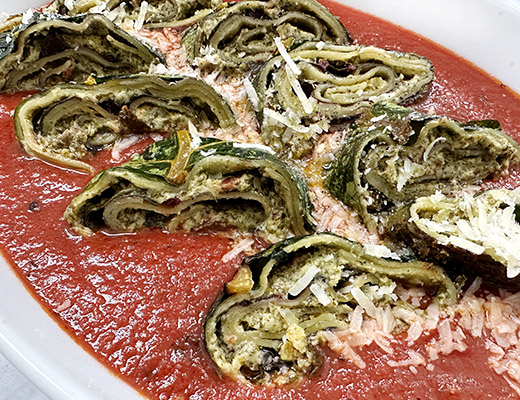
This recipe is a little different from how I’ve made nudi in the past since these are formed into balls about the size of a chestnut. I remember making slightly larger dumplings. Also, here, they’re boiled rather than being baked in a sauce. The smaller size meant it was easier for them to cook through without spending too much time being jostled about in the boiling water. And, they’re daintier looking on the plate. The recipe in the book suggests using a mix of Swiss chard and spinach, but I went with what I could find at the farmers’ market which was chard and arugula. The tomato sauce on top could have been made from fresh tomatoes or canned. I didn’t have quite enough fresh tomatoes on hand, so I went the canned route. You could use canned diced tomatoes or canned whole tomatoes as I did. I think I saw Ina Garten chop canned whole tomatoes by snipping them, in the can, with kitchen shears. That’s what I did, and then the chopped tomatoes went into the saucepan with olive oil and garlic. The sauce simmered away while the nudi were rolled and cooked. The garnish is just a quick shaving of a block of good parmigiano reggiano with a vegetable peeler. 

Making nudi is simpler than filling ravioli, but you still get all the great flavors of the mix of cheeses and greens. The little dumplings plump up as they cook and end up fluffy and delicious with the simple tomato sauce. I’m glad to have been reminded about this dish and to learn about several new ones too. 

Swiss Chard and Arugula Ravioli Nudi in Simple Tomato Sauce 
Recipe reprinted with publisher’s permission from The Glorious Vegetables of Italy.

Tender and delicate, these nudi—essentially, ravioli without the pasta covering—make an elegant first course for an early spring or fall dinner, dressed with a simple tomato sauce. They are also delicious served in soup; just boil the nudi as directed, then ladle hot vegetable or chicken broth over them and sprinkle with freshly grated Parmigiano cheese. For some reason, maybe because of their fluffy texture and gentle flavor, these nudi are a hit with children—no cajoling or bribing necessary. 

Makes 4 to 6 servings 

1 LB/455 G SWISS CHARD, STEMS REMOVED AND RESERVED FOR ANOTHER USE (SEE COOK’S NOTE), LEAVES SHREDDED 
8 OZ/225 G FRESH SPINACH LEAVES 
12 OZ/340 G FRESH SHEEP’S MILK OR WELL-DRAINED COW’S MILK RICOTTA CHEESE 
FINE SEA SALT 
FRESHLY GROUND BLACK PEPPER 
PINCH OF FRESHLY GRATED NUTMEG 
3⁄4 CUP/85 G FRESHLY GRATED PARMIGIANO-REGGIANO CHEESE, PLUS MORE FOR SERVING 
2 LARGE EGG YOLKS, LIGHTLY BEATEN 
1⁄4 CUP/30 G FLOUR, PLUS MORE FOR COATING THE NUDI 
3 CUPS/720 G FRESH TOMATO SAUCE, SIMPLE TOMATO SAUCE, OR SMALL-BATCH TOMATO SAUCE, HEATED TO A SIMMER 

Rinse the shredded chard leaves in cold water. Place the leaves, with the water still clinging to them, into a large saucepan, cover, and set the pan over medium heat. Cook the chard, tossing it from time to time, for 12 to 15 minutes, until tender and most of the water has evaporated. Turn off the heat, and using tongs, transfer the chard to a colander and let it cool. Rinse out the saucepan and return it to the stove. 

Rinse the spinach leaves in cold water. Place the leaves, with the water still clinging to them, into the saucepan, cover, and set the pan over medium heat. Cook the spinach, tossing it from time to time with tongs, for 5 minutes, until tender. Remove from the heat and transfer to the colander with the chard to cool. 

When the greens are cool enough to handle, squeeze as much excess water from them as you can. Transfer them to a cutting board and chop finely. You should end up with about 1 packed cup of freshly chopped greens weighing between 7 and 8 oz/200 and 225 g. 

Place the greens in a large bowl and add the ricotta, 1⁄2 tsp salt, a generous grinding of pepper, the nutmeg, the Parmigiano, and the egg yolks. Mix together gently but thoroughly. Sprinkle in the flour, and gently fold it into the mixture. 

Pour some flour into a small shallow bowl. Have ready a large rimmed baking sheet lined with waxed paper or dusted with flour. With your hands, pinch off a piece of the greens mixture, form it into a ball about the size of a chestnut, roll it in the flour, and set it on the baking sheet. Continue to form the nudi until you have used all of the greens mixture. 

Bring a large pot of water to a boil over high heat and salt generously. Carefully drop in 8 to 10 nudi. Within 1 or 2 minutes, they will begin to float to the surface. Continue to cook the nudi for another 5 to 6 minutes, until they have floated to the surface and are puffed up. With a large skimmer, remove the nudi and transfer them to a warmed serving bowl. Spoon about 1 cup of the tomato sauce over the nudi and mix very gently. Continue to cook the nudi until you have cooked them all. When they have all been added to the serving bowl, spoon additional sauce over the top and sprinkle with Parmigiano. Serve immediately. 

COOK’S NOTE: I love chard stems, so if the chard I purchase has tough stems, rather than discard them I slice them crosswise, sauté the pieces in a little olive oil until they are softened, and then stir them into the tomato sauce. 

Simple Tomato Sauce 

Makes about 5 cups / 1.2 L 

Even though I preserve batches of tomato sauce to use through winter, I still rely on sauce made from good canned tomatoes from time to time. Using excellent-quality canned tomatoes and good olive oil is important to the integrity of this simple, everyday sauce. Look for canned diced tomatoes packed in their natural juice rather than in heavy, pasty puree. 

2 GARLIC CLOVES, LIGHTLY CRUSHED 
1⁄4 CUP/60 ML EXTRA-VIRGIN OLIVE OIL 
TWO 28-OZ/800-G CANS DICED TOMATOES, WITH THEIR JUICE 
FINE SEA SALT 
5 LARGE FRESH BASIL LEAVES, SHREDDED OR TORN 

Warm the garlic in the olive oil in a large saucepan over medium heat. Use a wooden spoon to press down on the garlic to release its flavor. Cook for about 2 minutes, or until the garlic begins to sizzle. Don’t let it brown. Carefully pour in the tomatoes and their juice (the oil will spatter) and stir to coat with the oil. Season with 1 tsp salt and raise the heat to medium-high. Bring the sauce to a simmer, reduce the heat to medium-low, and simmer gently, stirring from time to time, for 30 to 35 minutes, or until the sauce has thickened and the oil is pooling on the surface. 

Remove from the heat and stir in the basil. Taste and add more salt if you like. If not using immediately, transfer the sauce to a container with a tight-fitting lid and refrigerate for up to 3 days or freeze for up to 3 months. 

I am a member of the Amazon Affiliate Program.

Monday, April 22, 2013

Sour Cream Chicken Enchiladas with Swiss Chard

I realize it’s customary for food cravings to strike when you miss a particular dish, when you haven’t had the chance to taste a favorite thing for a long time, and when you can’t wait for the next opportunity to have whatever that is once again. However, even though I live smack in the middle of Austin where you can’t take too many steps in a row without tripping over another Tex-Mex restaurant, I constantly crave Tex-Mex food. I can order tacos for breakfast, burritos for lunch, and enchiladas for dinner by traveling a few blocks from home in any direction whenever I want, but sometimes, home-cooked Tex-Mex is the way to go. Our favorite spots do get crowded causing long waits for a table at peak times, and besides, by making my own enchiladas, I can do things like add some sauteed CSA Swiss chard and top them with sliced, fresh jalapenos for even more heat. These Sour Cream Chicken Enchiladas are found in The Homesick Texan Cookbook as well as on the website, and this tangy sauce is one I’ll now be making often. The sauce is quick to make, and it starts like a veloute with a serrano chile-spiced roux to which chicken broth is added. Sour cream and roasted tomatillos are blended in to finish. It thickens as it bakes with the chicken- and cheese-filled enchiladas and makes you happy you’ll have some leftovers, which is another advantage of cooking at home. 

The recipe includes instructions for cooking chicken breasts for the enchiladas, but any cooked and shredded chicken will work here. With your chicken ready and some Monterey Jack cheese shredded, it’s time to make sauce. To start, I broiled a pound of cleaned tomatillos until well-browned on all sides, and transferred them to the blender. Then, butter was melted in a saucepan, and diced serrano chiles were added followed by minced garlic. Flour was whisked in to make a roux, and then chicken broth was slowly added while whisking. It was cooked until thickened, and I added sour cream, cumin, cayenne, and chopped, fresh cilantro off the heat. The sour cream mixture was poured into the blender with the tomatillos, but it was a little too much for my blender pitcher. I ended up pureeing in two batches. With the sauce completed, you can begin assembly of the enchiladas. I set up a row of warmed corn tortillas and started topping them with the fillings. A little shredded chicken was placed on each, followed by shredded cheese, and in my case sauteed Swiss chard. I skipped the suggested chopped onion because I tend to skip onions most of the time. With all the fillings in place, you just roll each tortilla into a cylinder. A cup of the sour cream sauce is poured into an oiled baking dish, and the filled tortillas are placed seam side down in the sauce. When all the enchiladas are in the pan, the remaining sauce is poured over top, the remaining cheese is sprinkled over it, and the dish is baked for 25 minutes. I gave it a few minutes under the broiler to brown the cheese at the end of the baking time. 

Not all of my food cravings are this crazy. Of course, I crave fresh, ripe tomatoes when there are none to be had in the winter, and I even start to long for dark, leafy greens when they just don’t grow here in the heat of summer. But, I don’t think a day will ever come when I won't crave a Tex-Mex meal either from a restaurant or home-cooked. 

I am a member of the Amazon Affiliate Program.

Thursday, March 7, 2013

Fried Eggs with Chard and Saffron-Red Pepper Hollandaise

I realized the other day that I categorize cooking in a few different ways in my head. There’s the day-to-day cooking that can be done on autopilot. And, there’s cooking from a recipe when I just need to check quantities but otherwise pretty much know what to do when. Then, there’s the exciting stuff that makes me think “now I’m really cooking.” Making sauces falls squarely in that last category. I received a review copy of Modern Sauces by Martha Holmberg, and I can’t seem to put it down. The instructions throughout the book take the fear out of making serious sauces. There are helpful tips, suggestions of what to look for as the sauce cooks, and ways to rescue a sauce that isn’t turning out quite right. The chapters are organized by type of sauce, and those include Vinaigrettes, Herb Sauces, Tomato Sauces, Vegetable Chile and Nut Sauces, Butter Sauces, Cream Sauces, Mayonnaise Sauces, Hollandaise Sauces, Gravy Jus and Pan Sauces, Sabayon Sauces, Custard Sauces, Fruit Sauces, Caramel Sauces, and Chocolate Sauces. There are recipes for several versions of each type of sauce which are followed by recipes for dishes incorporating those sauces. I’ve already made several things from the book, and there’s so much more I can’t wait to try. I want to drizzle the Honey-Ginger-Tangerine Sabayon over fresh strawberries, and I want to add the Fresh Orange-Smoked Paprika Vinaigrette to an arugula salad with grilled shrimp. I already made the Braised Vegetables in Charmoula and the Jalapeno-Lime-Ginger Butter Sauce with stir-fried vegetables. It’s amazing how just a small bit of sauce with big, bright flavors can change a dish. After reading the Chocolate Sauces chapter, I declared that I needed to try each and every version. So far, I’ve only gotten to the Mexican-Style Chocolate Sauce, and I’ll tell you more about that soon. First, I have to mention this lovely spin on a classic which is Saffron-Red Pepper Hollandaise. 

Classic Hollandaise is a beautiful thing, and adding the flavor and color from roasted red peppers, orange juice, and saffron took it to another level. In the book, the sauce is included in an eggs Benedict kind of dish made with sauteed Swiss chard and a fried egg stacked on toasted foccacia. I changed it up just slightly by leaving out the bread and adding a couple of slices of smoked salmon below the egg. Making the sauce requires a couple of easy steps to get everything prepped and ready for the final whisking action. Butter was melted and left to sit so the milk solids could fall to the bottom of the pan. Meanwhile, roasted red peppers were pureed with olive oil. I used a food processor which didn’t result in a perfectly smooth puree, so I strained the mixture and set it aside. Then, you’ll want to have your eggs separated and some orange zest ready. In a heat-proof bowl set over a saucepan with water, you start by warming orange juice with saffron threads. The egg yolks were added next and whisked into the juice. By whisking as the yolks slowly cook, they start to thicken. The recipe includes clear information on what to look for and how long each step should take. Once the yolks were just thick enough, the melted butter was slowly added off the heat while still whisking and the milk solids were left in the bottom of the pan. Last, pepper puree, orange zest, and hot sauce if desired were added, and the sauce was tasted for seasoning. The sauce can be kept warm in the top of a double-boiler while frying the eggs and making the rest of the dish. 

I loved everything about this sauce from making it, to its pretty orange color, to its decadent, orange and saffron flavor. I’m not quite ready to make Hollandaise on autopilot, but I’ll definitely be making it again soon unless I get completely distracted by the Caramel chapter first. I have a feeling this book is going to be spattered and stained from lots of use. 

Saffron–Red Pepper Hollandaise 
Recipes reprinted with publisher’s permission from Modern Sauces

I doubt if any Provencal cook has ever made this version of hollandaise, but I liked the way the flavors in it conjured up a south-of-France feeling as I made it, so I’m projecting a Provencal connection here. Use a nice, fruity extra-virgin olive oil to extend the Mediterranean note.This sauce begs to be served with seafood, especially hot and sizzling from the grill, and it’s crazy good on a gutsier version of eggs Florentine. Jarred Spanish piquillo peppers are excellent in this sauce. You’ll need about three peppers. Or, you can use regular jarred roasted red peppers, in which case one medium pepper should be sufficient. And, of course, you can roast and peel a fresh pepper. 

Makes about 1 cup/240 ml 

1/2 cup/115 g unsalted butter 
2 oz/55 g roasted red peppers 
2 tbsp fruity extra-virgin olive oil 
2 tbsp fresh orange juice, plus more if needed 
1 tbsp water 
Kosher salt 
Large pinch of saffron threads (about 15 threads) 
2 egg yolks 
1/2 tsp lightly packed finely grated orange zest 
1⁄8 tsp hot-pepper sauce such as Sriracha 

In a small saucepan, melt the butter over medium heat. Don’t stir as it melts. You want the milky solids to fall to the bottom and the butterfat to float to the top. Keep warm. 

In a food processor, combine the red peppers and olive oil and process until a smooth puree forms. You want to emulsify the oil with the peppers; the mixture should look creamy and combined. 

Pour water to a depth of 1 to 2 in/2.5 to 5 cm into a medium saucepan and place over medium heat. Rest a medium stainless-steel bowl in the pan over (not touching) the water. Put the orange juice, water, ¼ tsp salt, and saffron into the bowl and let sit over the heat for a few minutes so the saffron infuses the liquid. When you can smell the saffron, add the egg yolks and start whisking. As the bowl heats up, the yolks will begin to thicken. Whisk vigorously, scraping around the bowl with a heat-resistant rubber spatula from time to time so that bits of yolk don’t get stuck and overcook. Beat until thick and frothy but not quite fluffy, 3 to 4 minutes. The whisk will start leaving a clear space on the bottom of the bowl. Remove the bowl from the heat and whisk for another 30 seconds or so to stabilize the sauce and let the bowl cool down. 

Continue whisking as you slowly drizzle in the warm melted butter, taking care not to add too much of the milky-watery layer from the bottom of the pan. As you pour and whisk, make sure the yolks are accepting the butter and the yolks and butter are emulsifying. If the sauce looks at all broken or “curdly,” stop adding butter and just whisk for a few seconds. Only resume adding butter once you’ve whisked the sauce into creaminess again. Once all of the butter has been added, whisk in the pepper puree, the orange zest, and hot-pepper sauce. Taste and adjust the seasoning with salt, hot-pepper sauce, and orange juice if needed. If possible, serve right away. 

Fried Eggs with Garlicky Chard and Saffron-Red Pepper Hollandaise 

Note: For my version, I skipped the toasted bread and added slices of smoked salmon before topping with a fried egg. I also never bother to boil chard before sauteing.

Here is another recipe created by my friend Matthew Card. It’s a riff on eggs Florentine (eggs Benedict but with spinach instead of Canadian bacon or ham) and, like every dish he makes, it is turbocharged with flavor. It would also be delicious with any of the other sauces in this chapter, so feel free to experiment. Avoid using a hard-crusted bread here. If you can’t find focaccia, substitute something tender and flavorful, such as brioche or a soft Italian loaf. Peppadew peppers, which originated in South Africa, are sweet, tangy, and only modestly hot. They are pickled and sold in jars in the deli section of well-stocked grocery stores. 

Serves 4 

Kosher salt 
1 large bunch Rainbow or Bright Lights Swiss chard (12 oz/340 g), leaves and stems separated and stems cut crosswise into slices 1/4 in/6 mm thick 
4 tbsp/60 ml extra-virgin olive oil 
3 cloves garlic, minced 
Pinch of Espelette pepper or red pepper flakes 
1/2 cup/80 g thinly sliced jarred roasted red pepper 
4 tsp minced pickled Peppadew pepper 
4 large eggs 
4 pieces focaccia, toasted 
1 cup/240 ml Saffron–Red Pepper Hollandaise 

Bring a large pot of salted water to a boil. Add the chard leaves (not the stems) and cook, stirring occasionally, until just tender, 3 to 5 minutes. Drain, rinse well with cold water, and squeeze out as much excess water as possible. Chop coarsely and set aside. 

In a large frying pan over medium-high heat, heat 3 tbsp of the olive oil over medium-high heat. Add the chard stems and a large pinch of salt and cook, stirring occasionally, until tender and lightly browned, 6 to 9 minutes. Add the garlic and Espelette pepper and cook, stirring, until very fragrant, about 30 seconds. Stir in the cooked chard leaves, roasted pepper, and Peppadew pepper. Cook, stirring often, until the flavors are blended and the chard is hot, about 2 minutes. Transfer to a medium bowl and cover to keep warm. Do not rinse the pan. 

Break each egg into a small teacup. Return the frying pan to low heat and add the remaining 1 tbsp oil. Carefully slide the eggs from the teacups into the pan so they stay whole. Season them with salt, cover the pan, and cook until the eggs are just set, 2 to 3 minutes. 

Place a piece of focaccia on each plate, divide the chard mixture evenly among the focaccia, top with an egg, and then spoon a generous blanket of the warm hollandaise over the top. Serve right away. 

I am a member of the Amazon Affiliate Program.

Tuesday, January 8, 2013

Tlacoyos with Swiss Chard, Potatoes, Mushrooms, and Salsa Borracha

I had heard lots of good things about Hugo Ortega's Street Food of Mexico and was curious to learn more about the chef and the new book. I made my way to the Texas Book Festival on a chilly Saturday morning in late October of last year for his talk and cooking demo. He spoke about traditional Mexican home cooking as well as the variety of food offered by street vendors in different areas of Mexico. He mentioned how cooking locally and seasonally was a given with the food of his upbringing, and he explained traditional cooking techniques and ingredients and some contemporary updates that can be made these days. For instance, although lard is often used in traditional recipes, he suggests olive oil as a substitute in most of the dishes in the book. I was impressed with the dishes he prepared that morning and couldn’t wait to read the review copy of the book I had received. In the book, you’ll find snacks, tacos, salsas, tortas, ceviches, sweets, and drinks along with stories about how the dishes are prepared by street vendors. Although the food is finished quickly and served to people on the go from vendors, the prep starts in advance so all the parts can be easily combined just before serving. The meats are slowly cooked, the salsas are made fresh, and the masa is portioned and shaped in advance. It’s fast food that isn’t. And, the recipes are very doable at home. The book also offers a visual feast of photos of the dishes, the ingredients, and street scenes in Mexico shot by Penny De Los Santos. After learning about masa and all the different things made with it, I had to decide whether to start with little indented masa bowls called sopes or sweet potato masa cakes for garnachas or thicker gorditas. I’ll get back to the others soon enough, but I decided to try tlacoyos first which are oval masa cakes with a filling of refried beans. They can be topped with any taco filling you like and whichever salsa you prefer, but I went seasonal with Swiss chard, mushrooms, and potato, and a salsa made from dried chiles, orange juice, garlic, and beer.

I made the salsa first since it can sit in the refrigerator for a few days. Dried pasilla chiles were to be used but I only found guajillos the day I was shopping, and I tend to use those two dried chiles interchangeably. The chiles were stemmed and seeded and then left to soak in a mixture of orange juice, beer, and garlic. After about an hour, the chiles and soaking liquid were transferred to a blender to puree. Trust me, use the blender here. My food processor was sitting right there as the chiles were ready to be pureed, so I tried it unsuccessfully. I ended up pouring everything into the blender and washing extra dishes. With this much liquid, the blender is a better choice, and it will produce a smoother puree. Next, I turned to the recipe for refritos. I had some black beans that I had already cooked in my freezer, so I started with those. My thawed beans were pureed in a food processor while finely chopped onion was sauteed in olive oil. Once the onion was translucent, the bean puree was added and simmered for 15 minutes. The refritos were cooled and refrigerated until the next day. For the tlacoyos, I mixed masa flour with a little salt and water and divided the dough into portions. Each ball of dough was flattened, a spoonful of refritos was placed on the dough, and the dough was rolled to enclose the beans. Then, the cakes were formed by pressing the dough into an oval. Mine weren’t very tidy. The dough cracked here and there, and the bean filling squished out in places. I decided not to worry about it. After all the cakes were formed, they were cooked for a few minutes on each side in a cast iron skillet with a little oil. The topping was a quick saute of onion and garlic to which sliced mushrooms, chopped Swish chard, roasted potato chunks, and peeled and chopped roasted poblanos were added. I served the tlacoyos with the “drunken” salsa and some crumbled cotija cheese. 


There are several other things I can’t wait to try from this book like the green tomatillo salsa, the pickled peppers, the cemitas which are sesame seed buns for tortas, the aguachile with shrimp and lime juice, meringue-filled pastries, and rum raisin ice cream. The freshness and flavors and all the great colors in these dishes jump off the pages and make me hungry.

Tlacoyos
Recipes reprinted with publisher's permission from Hugo Ortega's Street Food of Mexico by Hugo Ortega, Bright Sky Press, 2012.

Masa Cakes Stuffed with Refried Beans | Makes 4-8 servings

Tlacoyos are masa cakes stuffed with refried beans — pinto or black. They are usually prepared the night before and the ladies (page 18-19) pack them in baskets to sell the next day. If making ahead, place the raw tlacoyos on a sheet pan lined with a piece of parchment paper; cover with another piece of parchment paper and plastic wrap. Cook on a hot comal right before serving. The papas, champinones y acelgas taco filling (page 96) is another great vegetarian option that can be used as a topping for this recipe.

For the tlacoyos:
1 lb masa (fresh or prepared from mix, page 24)
1/2 cup refritos (page 132)
1 tbsp corn oil

For the tlacoyos (make ahead up to 1 day):
Divide the masa into eight equal masa balls; cover with a moistened kitchen towel while working. Using the palm of your hand, flatten each masa ball into a patty, about 4 inches in diameter and 1/4 inch thick. Place 1 tablespoon refritos in the center and enclose the beans inside each patty by rolling it into a cylinder. Place each cylinder on a clean surface and pat down into an oval shape, about 1/4 inch thick. Store in refrigerator until ready to cook.

Before serving:
Place comal over low heat, preheat 5 minutes. Drizzle with corn oil and wipe off excess with a paper towel. Working two at a time, place each tlacoyo onto the hot comal and cook 3 to 5 minutes on each side. Remove from comal and top each with potatoes, Swiss chard and mushroom mixture, salsa, and garnish with cotija.

Tacos de papas, acelgas y champiñones
Potatoes, Swiss Chard and Mushroom Tacos | Makes 4-8 servings

This vegetarian taco is fulfilling as well as hearty. This recipe shows that tacos are very versatile for any eating lifestyle. This vegetarian Mexican saute can also be used as a substitute for the chicken in the tacos de chile relleno (page 77).

1/3 cup olive oil
1/2 medium white onion, sliced
6 garlic cloves, peeled, minced
1/2 lb white button mushrooms, cleaned, sliced or a mixture of your choice
1/2 large bunch Swiss chard, washed, stemmed
2 chilaca or poblano peppers, roasted, seeded, peeled, deveined, cut into strips
1 large yellow potato, roasted, cut into 1/2-inch cubes
1 tsp kosher salt
8 regular-sized tortillas or masa cakes (page 74), warm
1 recipe Hugo's salsa Mexicana or Salsa Borracha, optional to accompany

Place cast iron skillet over medium heat, add olive oil to skillet and preheat 2 minutes. Add onion and cook until translucent, about 3 minutes. Add garlic and cook 2 minutes more. Add mushrooms and cook until browned, about 5 minutes. Add Swiss chard and allow it to wilt, about 5 minutes. Add peppers and cook for 6 minutes. Add potato and continue to cook 2 minutes. Stir gently as not to mash the potato. Add salt. Divide evenly among the tortillas. Serve with salsa.

Salsa borracha
Drunken Red Chile Salsa | Makes 1 1/2 cups

Traditionally, salsa borracha is made with pulque, a milk-colored alcoholic beverage made from the fermentation of the maguey and agave plant. Due to its scarcity, I used my favorite Mexican beer instead, giving it a delicious, tangy taste. This particular salsa will keep in the refrigerator up to three days. Store in airtight jar or plastic container.

6 long dried pasilla peppers, toasted, stemmed
1 cup fresh orange juice
3/4 cup beer or 1 1/2 cups pulque if available
5 garlic cloves, peeled
1 tsp kosher salt

Place peppers in a deep bowl. Add orange juice, beer or pulque if using, and garlic. To completely submerge peppers in liquid, place a small bowl over peppers to act as weight. Allow peppers to soften in liquid, about 1 hour. Strain, reserving 1 cup liquid, discard the rest. Transfer peppers, garlic and reserved liquid to a blender and add salt. Puree into a smooth, thick consistency. 

I am a member of the Amazon Affiliate Program.

Friday, October 9, 2009

Chickpeas and Swiss Chard in Parmesan and Sun-Dried Tomato Broth


We tend to go through cycles of what we want to eat. It starts with the let’s eat light and healthy segment followed by the let’s have a nice big dinner spurt and then comes the we need a lip-smackingly decadent dessert after our big dinner stretch which leads us back to the beginning. Right now, it seems we’re back at the beginning, for a few days anyway, and this soup fit perfectly into that part of the cycle. This chickpea and swiss chard soup was in the April issue of Food and Wine. Not only was it a healthy meal, there’s a great tip in this recipe for adding rich flavor to a broth in a very simple way. A piece of parmigiano rind was added to simmering broth. That’s a well-known trick, and I save rinds for this purpose even though I usually forget to use them. After just a few minutes, a so-so broth is transformed. This recipe didn’t stop there either. Before serving, sun-dried tomato pesto was stirred into the soup. Not only was this a light and flavorful dish, it was also very quick to prepare.

It would have been one of those record-time dinner preparations, but I decided to make homemade pesto instead of buying a jar of it. I followed the sun-dried tomato pesto recipe from Vegetarian Classics which included flat-leaf parsley along with basil leaves, pine nuts, garlic, olive oil, parmesan, and sun-dried tomatoes which were soaked in boiling water before being drained and added to everything else in the food processor. The soup was started by simmering some broth with the cheese rind and chickpeas. The rind was discarded, and then chopped swiss chard was added and cooked for just a few minutes. The soup was removed from the heat, and some pesto was stirred into it. That was it. Each bowl was garnished with a little bit of pesto and some grated parmesan.

This recipe is a keeper for how quick and full-flavored it was. Chickpeas and swiss chard are always a great match, but the pesto perked them up and gave the soup a tangy freshness. Meals like this make our eating light and healthy kick last a little longer, but soon enough I’ll be deciding what to make for a tempting, rich dessert.


Blogging tips