








 by Andrea Nguyen. It’s such a great book. The instructions guide you so well through each step of making the dough, portioning, flattening, filling, and shaping. The pot stickers were in the back of my mind since I first read the book. It was one of those recipes that I was a little anxious about and imagined all the ways I could end up with a failure. Would they hold their shape while frying and steaming? Would the dumplings stick to the bottom of the pan and not come loose? Would the texture and thickness of the dough turn out right? I wanted to wait until I was in my new kitchen with plenty of space for rolling and filling lots of dumplings. And so, at last, I gave it a go and couldn’t have been happier with the process. I’ve realized that working with dough and seeing the transformation from mixture to final product, whether dumplings, pastry, or bread, is always fun for me. I haven’t met a dough I didn’t like. The Basic Dumpling Dough used for these is a simple one made with all-purpose flour and just boiled water, and it was easy to roll into little circles to be filled. In the book, the filling is a mixture of pork and shrimp with finely chopped cabbage and seasonings, but I chose to use only shrimp with the cabbage and other ingredients. A vegetarian filling would have been a great option too.
I started with the dough because it needs to rest after kneading and can sit at room temperature for a couple of hours. Two cups of all-purpose flour were placed in the food processor while water was brought to a boil. Three-quarters of a cup of boiled water was measured and poured into the food processor through the feed tube with the machine running. In a few seconds, the dough formed a ball on the blade and was done. The water cools enough during that time to be able to handle the dough. Next, the dough was kneaded on a work surface until smooth, and then it was placed in a plastic bag to rest. For the filling, I cleaned and chopped some shrimp, finely chopped some savoy cabbage, chopped some homegrown Chinese chives, and minced garlic and ginger. Black pepper, soy sauce, and sesame oil were also included in the mixture. The cabbage was lightly salted and set aside in a colander to drain for 15 minutes before being rinsed, drained, and squeezed to remove moisture. Then, all of those filling ingredients were combined and mashed together. The rested dough was divided in half. One half was portioned into 16 pieces. Each of those was flattened with a tortilla press and then rolled with a small dowel to flatten the edges more until each circle measured about three and one-quarter inch across. A tablespoon of filling was placed on each dough circle, and then they were closed and crimped. I went with the pleated pattern at the top of each dumpling. The filled dumplings were placed on a parchment-lined baking sheet, and the process was repeated with the second half of the dough. To cook them, two tablespoons of canola oil was added to a large skillet over medium-high heat. The dumplings were set into the hot oil, sealed edges up, and were left to fry for a couple of minutes. The next step is a little scary because water needs to be poured into the skillet with the oil. There’s a great tip in the book for holding the skillet lid close to the top of the pan while pouring the water to prevent it from spattering out too much. One-third cup of water was added, the skillet was covered, and the dumplings steamed until the water mostly bubbled away for about eight minutes. The lid was removed, and the dumplings continued cooking for another minute or two. They were served with a dipping sauce of soy sauce, rice vinegar, and chile oil.


I am a member of the Amazon Affiliate Program.
Speaking of my new kitchen, here's another look at it now that more details have been completed. The wood on the bar, island front, and kitchen desk side was saved from our old house and whitewashed.


Tweet


 grabbed my attention because I too have meat issues. My issues are more of the picky-eater sort, but I was still intrigued by her journey into meat land after living as a vegetarian for her entire life. The book is full of great information about responsible, sustainable farming, ranching, and meat production, in addition to entertaining stories about what she was cooking and eating throughout this adventure. Tara has also been published in

 , which I loved. She profiles a series of women whose work in food has inspired her, but it is Kim’s own story of finding her way back from alcoholism that is perhaps most inspiring.

 . The recipes and photos are so enticing I can hardly stand it.
 (dumpling party, anyone?), Monica Bhide’s
 (I’m fixated on Indian food lately), and Lorna Yee’s just released
 (Lorna’s an amazing cook).

 , by Roy Andreis de Groot. It’s the story and recipes of a small inn high in the French Alps. The book had been highly recommended but I’m finding it slow (Twitter has ruined my attention span, I’m afraid). It’s lovely and lyrical, but old fashioned (published in 1973). I pick it up from time to time and read a bit. It’s like a very rich dessert.

 (dreadful hippie name), by Toby Hemenway. It’s a book on Permaculture, which is a more sustainable way of living and growing food. It’s incredibly inspiring.

 , and Andrea’s site

 . It was released last year abroad and will be available in the U.S. come September. It's a giant book, weighing over eight pounds. Thompson and I were both invited speakers at the Sydney International Food Festival last October and the book had just been released. Few copies were available and he let me walk away with one of them.

 is another book that I find myself leafing through now and again too. It's the opposite of Thompson's book in its small format, light weight, and single color print. It's not graphically sexy. However, Food Rules distills many ideas down for the American eating public. And though I'm one of the long-converted, I read Pollan's work and ponder ways of how I can communicate those eating and lifestyle parameters in what I do to explore and promote Asian foodways.

 So, for my first dumpling adventure, I chose the vegetarian crystal dumplings and chiu chow dumplings. Both are made with wheat starch dough, and this was a fun dough to make. Wheat starch was combined with tapioca starch because the tapioca gives it more elasticity. The two starches were combined in a mixing bowl with a little salt, and just boiled water. After stirring in the water, a little canola oil was added. I doubled the dough recipe, but before kneading it, I divided it in two equal parts. I thought kneading would be easier that way. The dough was kneaded for a couple of minutes on a flour-free surface, and it quickly became smooth and white. It’s noted that it should feel like Play-Doh, and it really does.
 To backtrack just a bit, it’s actually a very good idea to prepare the dumpling filling a day or two before assembling the dumplings. My first choice was the vegetarian filling including dried shitakes, dried wood war mushrooms, shallot, garlic, jicama, carrot, and scallions. The dried mushrooms were soaked and then drained and chopped, and the other ingredients were either minced or finely diced. The shallot and garlic were sauteed, and then the mushrooms, jicama, and carrot were added. A seasoning mixture of sugar, soy sauce, and reserved mushroom soaking liquid was added to the saute pan followed by the scallions and then a small amount of cornstarch dissolved in water. That cooked together just briefly, and then the mixture was left to cool. I decided to go all out and make a second filling as well because since I was doing this whole homemade dumpling thing, I thought why not. And, I thought two kinds of dumplings would be even more fun than one.
 The second filling I made was for chiu chow dumplings. That filling is flavored with dried shrimp and includes some kind of meat, usually pork but I used ground chicken thighs, and it includes some vegetables which make it less dense. It’s made by sauteing garlic and chopped dried shrimp before the ground chicken was added. Once the meat was browned, chopped re-constituted dried shitakes were added, with finely diced jicama, and chopped peanuts. A seasoning mixture of sugar, oyster sauce, soy sauce, shaoxing rice wine, and water was then added to the saute pan. Once again, a cornstarch slurry was added along with scallions. Both fillings were refrigerated overnight before being made into dumplings.
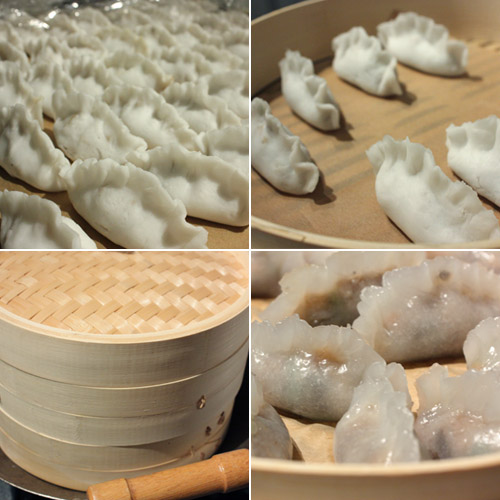 Does the whole process take some time? Yes. Is it worth it? Definitely. I was thrilled with the dumpling dough and how easy it was to shape. I was also really thrilled that every step of the process turned out exactly as described in the book. The quantity of filling for each type of dumpling was exactly right. The texture of the dumpling wrappers was chewy and springy and delightful. The fillings were full of umami, and I really mean that. There are a lot of savory flavors at work in each, and I kept thinking that both were very good examples of umami. The freshly made chile garlic sauce was bright and hot but not painful in small doses. The whole experience from cooking and assembling and steaming to eating was a fun one, and there will be a lot more dumplings in my kitchen in the future.
