I have a little problem. I'm addicted to cookbooks, food writing, recipe collecting, and cooking. I have a lot of recipes waiting for me to try them, and ideas from articles, tv, and restaurants often lead to new dishes. I started losing track of what I've done. So now I'm taking photos and writing about what I've prepared—unless it's terrible in which case I forget it ever happened.
We took a nice drive west of Austin yesterday to attend a vineyard luncheon as part of the Texas Hill Country Wine and Food Festival. The luncheon was held at Stone House Vineyard in Spicewood, Texas. The bluebonnets were putting on a show as they do at this time of year, and there was even some rain throughout the day to keep the flowers happy. The luncheon featured Stone House wines, and each course was prepared by a different local chef. At the Stone House property, Norton grapes are grown and are used in their Claros wine. It’s a dry, medium-bodied red with a little earthiness that I liked. It was served with our second course which included a fantastic truffle polenta, but the dish that was our favorite of the meal was the shrimp from the first course. The hot and crunchy shrimp was prepared by the chef from Hudson’s on the Bend. The crispy, plump shrimp were plated with a tomatillo and jicama salad and were topped with a zingy mango and jalapeño aioli. It was served with a Viognier that had a little sweetness and paired well with the jalapeño heat.
There’s more to the story of the hot and crunchy shrimp. The recent popularity of food trailers continues in Austin, and on South Congress Avenue, you’ll find The Mighty Cone which was created by chefs from Hudson’s on the Bend. Their famous hot and crunchy coating from the restaurant menu has been adapted and used on chicken and avocado in addition to shrimp. The crunchy items of choice are used in wraps with mango slaw which are served in snow-cone cups, and the recipe appeared in the January issue of Food and Wine. The cone version is a lot of fun and delivers the same mix of bold flavors, but the nicely plated hot and crunchy shrimp eaten with a fork and knife and served with chilled wine were delicious in their own refined way and far less messy to eat.
When I first heard the news about this book, I couldn’t wait to get my hands on it. In Asian Dumplings, Andrea Nguyen presents various kinds of dumplings from East Asia, Southeast Asia, and South Asia. This is a very informative guide to dumpling making, and homemade wrappers are encouraged for all of them. I had been curious about making dough for wrappers for a long time, and I was a little afraid of it, but with these instructions the process was a breeze. There are also ‘lazy day tips’ throughout the book that explain how to use packaged wrappers for quicker versions of recipes, but there are advantages to making your own. For one thing, I gained a new appreciation for carefully made-from-scratch dumplings. Of course the fresh dough is delicious and chewy, and it’s also fun to shape. With homemade wrappers, you don’t have to moisten the edges to seal it, and it’s much more forgiving and stretchy when being filled. I learned so much from cooking from this book just once that I’m already looking forward to whatever I might learn next time. I noticed this morning that Heidi at 101 Cookbooks just posted a list of Andrea Nguyen’s favorite cookbooks, and it’s a great list.
So, for my first dumpling adventure, I chose the vegetarian crystal dumplings and chiu chow dumplings. Both are made with wheat starch dough, and this was a fun dough to make. Wheat starch was combined with tapioca starch because the tapioca gives it more elasticity. The two starches were combined in a mixing bowl with a little salt, and just boiled water. After stirring in the water, a little canola oil was added. I doubled the dough recipe, but before kneading it, I divided it in two equal parts. I thought kneading would be easier that way. The dough was kneaded for a couple of minutes on a flour-free surface, and it quickly became smooth and white. It’s noted that it should feel like Play-Doh, and it really does.
For these dumplings, each half (since I doubled the original quantity) was divided into three balls. The balls of dough were placed in a plastic bag and left to rest for five minutes. Then, one ball of dough was removed at a time. It was rolled into a log, and the log was cut into eight pieces. Each of those little pieces was then placed between pieces of plastic cut from a zip bag that had been lightly oiled. The dough was then pressed with the bottom of a glass measuring pitcher (or any heavy, flat, round-bottomed object) to form a three and a half inch round. A tortilla press would have been ideal for this. Each round of dough was then filled, the edges were sealed, and the goal was to crimp the edges for a pretty ruffled look. I did what I could. I’ll have to keep practicing for pretty edges, but the important thing is to be sure the dumpling is sealed.
To backtrack just a bit, it’s actually a very good idea to prepare the dumpling filling a day or two before assembling the dumplings. My first choice was the vegetarian filling including dried shitakes, dried wood war mushrooms, shallot, garlic, jicama, carrot, and scallions. The dried mushrooms were soaked and then drained and chopped, and the other ingredients were either minced or finely diced. The shallot and garlic were sauteed, and then the mushrooms, jicama, and carrot were added. A seasoning mixture of sugar, soy sauce, and reserved mushroom soaking liquid was added to the saute pan followed by the scallions and then a small amount of cornstarch dissolved in water. That cooked together just briefly, and then the mixture was left to cool. I decided to go all out and make a second filling as well because since I was doing this whole homemade dumpling thing, I thought why not. And, I thought two kinds of dumplings would be even more fun than one.
The second filling I made was for chiu chow dumplings. That filling is flavored with dried shrimp and includes some kind of meat, usually pork but I used ground chicken thighs, and it includes some vegetables which make it less dense. It’s made by sauteing garlic and chopped dried shrimp before the ground chicken was added. Once the meat was browned, chopped re-constituted dried shitakes were added, with finely diced jicama, and chopped peanuts. A seasoning mixture of sugar, oyster sauce, soy sauce, shaoxing rice wine, and water was then added to the saute pan. Once again, a cornstarch slurry was added along with scallions. Both fillings were refrigerated overnight before being made into dumplings.
It’s suggested that the dumplings be steamed right away once assembled and not refrigerated until after they’ve been steamed. So, as I assembled them, I placed them on a parchment-lined baking sheet and covered them with plastic wrap. When they were all assembled, I lined steaming trays with parchment so the dumplings wouldn’t stick, and let them steam for seven minutes. Then, I placed enough for dinner in the refrigerator, and the rest went into the freezer. To re-heat them, they went back into the steamer for just three minutes. To serve, soy sauce and/or chile garlic sauce are suggested as accompaniments. I made the homemade chile garlic sauce from the book which included red chiles, garlic, salt, sugar, and distilled white vinegar. If you cook the sauce, which I did, it can be kept refrigerated for about six months.
Does the whole process take some time? Yes. Is it worth it? Definitely. I was thrilled with the dumpling dough and how easy it was to shape. I was also really thrilled that every step of the process turned out exactly as described in the book. The quantity of filling for each type of dumpling was exactly right. The texture of the dumpling wrappers was chewy and springy and delightful. The fillings were full of umami, and I really mean that. There are a lot of savory flavors at work in each, and I kept thinking that both were very good examples of umami. The freshly made chile garlic sauce was bright and hot but not painful in small doses. The whole experience from cooking and assembling and steaming to eating was a fun one, and there will be a lot more dumplings in my kitchen in the future.
Ok, yes, this is another black bean recipe, and another salad, but I have a new book to talk about today, and it’s a really good one. Back in May, I learned of this book on the excellent Dana Treat site. Dana always has beautiful and delicious-looking vegetarian food to share on her site, and she highly recommended this book and the author’s other books as well. I wasn’t familiar with the author, Jeanne Lemlin, but I was instantly intrigued and soon thereafter added Vegetarian Classics to my collection. Lemlin explains that by ‘classics’ she means popular dishes that have become favorites in the vegetarian realm. Rather than referring to ethnically or historically accurate meatless cuisines, these classics may have been adapted from traditional recipes including meat but are now well-loved as vegetarian dishes. Because of a small back-log problem, I only just recently got around to reading the book and cooking from it. I always say this, but every recipe looked like something I’d like as I started reading the book. The first chapter is Basics, and the roasted red pepper and walnut pesto and sun-dried tomato pesto instantly had me planning meals for both. In Soups, the vegetable chowder, the Armenian barley yogurt soup, and the thick corn and vegetable soup with herb dumplings are on my list. Then came Salads, and I headed to the kitchen to try this black bean and mango salad before even finishing the chapter.
I used the last of my freezer stash of cooked black beans. They were rinsed and drained and added to cubed mango, jicama, finely diced onion, and chopped jalapeno. A citrus vinaigrette was made from lemon, lime, and orange juices, red wine vinegar, minced garlic, olive oil, and salt and pepper. The chopped salad ingredients were mixed with some vinaigrette, and it was left to become a little happier for 30 minutes or so. Just before serving, cilantro was added to the salad. I scooped the chunky salad onto a bed of baby spinach leaves and garnished with sliced red, cayenne chiles. It occurred to me while making this that it would also be a great wrap filling with some spinach and some cotija or monterey jack cheese.
As we were eating this for dinner, Kurt inadvertently gave me one of the best compliments he could have. He mentioned something about how canned beans tend to have that particular taste about them, but they seemed different and so much better than usual in this salad. He went on to comment on how he enjoyed all the ingredients and flavors in the salad and that he thought it worked really well. I let him know the beans weren’t from a can and agreed that the salad was a hit.











 , Andrea Nguyen presents various kinds of dumplings from East Asia, Southeast Asia, and South Asia. This is a very informative guide to dumpling making, and homemade wrappers are encouraged for all of them. I had been curious about making dough for wrappers for a long time, and I was a little afraid of it, but with these instructions the process was a breeze. There are also ‘lazy day tips’ throughout the book that explain how to use packaged wrappers for quicker versions of recipes, but there are advantages to making your own. For one thing, I gained a new appreciation for carefully made-from-scratch dumplings. Of course the fresh dough is delicious and chewy, and it’s also fun to shape. With homemade wrappers, you don’t have to moisten the edges to seal it, and it’s much more forgiving and stretchy when being filled. I learned so much from cooking from this book just once that I’m already looking forward to whatever I might learn next time. I noticed this morning that Heidi at 101 Cookbooks just posted a list of
  So, for my first dumpling adventure, I chose the vegetarian crystal dumplings and chiu chow dumplings. Both are made with wheat starch dough, and this was a fun dough to make. Wheat starch was combined with tapioca starch because the tapioca gives it more elasticity. The two starches were combined in a mixing bowl with a little salt, and just boiled water. After stirring in the water, a little canola oil was added. I doubled the dough recipe, but before kneading it, I divided it in two equal parts. I thought kneading would be easier that way. The dough was kneaded for a couple of minutes on a flour-free surface, and it quickly became smooth and white. It’s noted that it should feel like Play-Doh, and it really does.
 To backtrack just a bit, it’s actually a very good idea to prepare the dumpling filling a day or two before assembling the dumplings. My first choice was the vegetarian filling including dried shitakes, dried wood war mushrooms, shallot, garlic, jicama, carrot, and scallions. The dried mushrooms were soaked and then drained and chopped, and the other ingredients were either minced or finely diced. The shallot and garlic were sauteed, and then the mushrooms, jicama, and carrot were added. A seasoning mixture of sugar, soy sauce, and reserved mushroom soaking liquid was added to the saute pan followed by the scallions and then a small amount of cornstarch dissolved in water. That cooked together just briefly, and then the mixture was left to cool. I decided to go all out and make a second filling as well because since I was doing this whole homemade dumpling thing, I thought why not. And, I thought two kinds of dumplings would be even more fun than one.
 The second filling I made was for chiu chow dumplings. That filling is flavored with dried shrimp and includes some kind of meat, usually pork but I used ground chicken thighs, and it includes some vegetables which make it less dense. It’s made by sauteing garlic and chopped dried shrimp before the ground chicken was added. Once the meat was browned, chopped re-constituted dried shitakes were added, with finely diced jicama, and chopped peanuts. A seasoning mixture of sugar, oyster sauce, soy sauce, shaoxing rice wine, and water was then added to the saute pan. Once again, a cornstarch slurry was added along with scallions. Both fillings were refrigerated overnight before being made into dumplings.
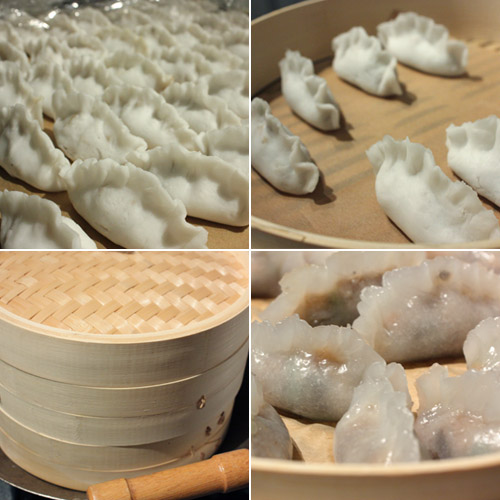 Does the whole process take some time? Yes. Is it worth it? Definitely. I was thrilled with the dumpling dough and how easy it was to shape. I was also really thrilled that every step of the process turned out exactly as described in the book. The quantity of filling for each type of dumpling was exactly right. The texture of the dumpling wrappers was chewy and springy and delightful. The fillings were full of umami, and I really mean that. There are a lot of savory flavors at work in each, and I kept thinking that both were very good examples of umami. The freshly made chile garlic sauce was bright and hot but not painful in small doses. The whole experience from cooking and assembling and steaming to eating was a fun one, and there will be a lot more dumplings in my kitchen in the future.

 As we were eating this for dinner, Kurt inadvertently gave me one of the best compliments he could have. He mentioned something about how canned beans tend to have that particular taste about them, but they seemed different and so much better than usual in this salad. He went on to comment on how he enjoyed all the ingredients and flavors in the salad and that he thought it worked really well. I let him know the beans weren’t from a can and agreed that the salad was a hit.