I have a little problem. I'm addicted to cookbooks, food writing, recipe collecting, and cooking. I have a lot of recipes waiting for me to try them, and ideas from articles, tv, and restaurants often lead to new dishes. I started losing track of what I've done. So now I'm taking photos and writing about what I've prepared—unless it's terrible in which case I forget it ever happened.
The dish I’m showing today would be perfect for celebrating Midsummer. I’ve never been to Sweden or any part of the Nordic region, but I’d love to visit during the Midsummer festival and enjoy daylight all night long. As usual, I’ve been virtually traveling with a cookbook, and this time it’s The Nordic Cookbook by Magnus Nilsson. I received a review copy of this hefty book that covers traditional and contemporary foods from Finland, Sweden, Norway, Denmark, the Faroe Islands, Iceland, and Greenland. Nilsson set out to show the similarities as well as the differences between each part of the Nordic culture. Several dishes are found in multiple locations and go by different names in each place, and some are unique to one area. He accepted that the book could never be a complete record of all the recipes from this large area, but it was intended to inform the reader about this food culture and provide guidance in creating some of that food. It also includes beautiful photos of the areas that were visited during the research phase. There’s a simplicity to the ingredients and most preparations, and flavors are brightened by vinegars, horseradish, and herbs. I loved all the potato recipes including several potato salads, soups, creamed potatoes, gratins, potato cakes, and Potatoes Hasselbacken. Why have I never made those? I learned the dish was invented in the 1950s at a restaurant that became a cooking school called Hasselbacken. There are meat and poultry dishes, sausage and charcuterie, breads and waffles and dumplings, cakes and pastries, and a chapter for little cookies and other sweets that I imagine would be perfect on a holiday cookie tray. I really enjoyed reading about all the various fish dishes with fresh, pickled, smoked, and dried variations. I really like pickled shrimp, so I had to try the Poached and Pickled Salmon since fresh wild salmon season is in full swing.
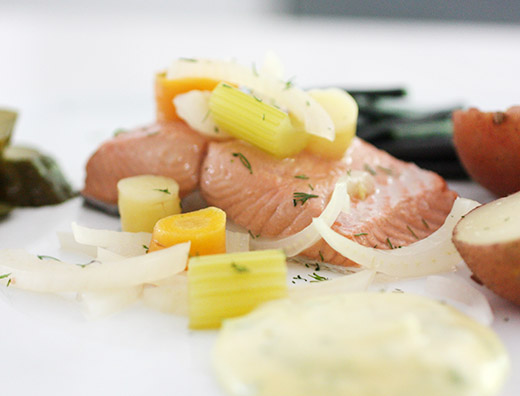
In the end, the dish is a bit of a decomposed salad, and you can mix and match whatever items you’d like to serve with the salmon. Making the salmon itself was as easy as it gets. Fresh salmon fillets were cut into portions and placed in a heat-proof dish. Water was brought to a boil with salt, red wine vinegar, white vinegar, chopped carrots, sliced fennel, sliced onion, chopped celery, thyme springs, bay leaves, parsley stalks, and peppercorns. I'm thrilled to finally get to use my own thyme growing right outside once again. After boiling for a minute, the hot water, with vegetables and herbs, was poured over the salmon, and it was left to cool to room temperature. This steeping step was how the salmon was cooked. Once cool, the salmon was left in the liquid with the vegetables and herbs and refrigerated overnight. The next day, I made a homemade mayonnaise with dill to serve with the salmon. Fresh, new potatoes and purple long beans from Boggy Creek Farm were my cooked accompaniments to the salmon. And, I sliced some lacto-fermented cucumber pickles I had in the refrigerator as well. The chilled salmon was served with the carrot and fennel alongside the boiled potatoes and blanched beans with a dollop of dill mayonnaise and some pickle slices. Each bite of salmon and potato was swiped through the rich mayonnaise.
The flavor of the salmon was mildly pickled, and I might add more vinegar to the steeping liquid next time. But, the mayonnaise was bright and lively with the vinegar in it and the dill. Those fresh, boiled potatoes went so well with the other parts of the dish. And, it could be presented in different ways. The salmon could be flaked rather than left as a fillet, or all the parts could be combined for a less-deconstructed salad. However it’s served, it’s a great way to celebrate summer.
Poached and Pickled Salmon Recipe reprinted from The Nordic Cookbook by Magnus Nilsson with publisher's permission (Phaidon, $49.95 US/$59.95 CAN, October 2015)
This is a real summer dish, often served with Boiled Potatoes, Dill Mayonnaise, and Quick Pickled Cucumber. The pickled vegetables are delicious and should also be served with the fish. The salmon is not pickled in the sense that herrings are pickled and won’t keep for very long but should be eaten within a week if stored in the refrigerator. In a restaurant, where you would fillet a whole salmon to make this dish, it’s a good idea to cook the salmon bones and head together with the pickling liquor. If you do so, it will produce a light and very delicious jelly when it cools down. If you decide to try this at home, then add the bones, head and any salmon scraps you have to the pickling liquor, but leave out the vegetables. Bring it slowly to a simmer, then let it sit for 5 minutes before proceeding as described below. If you like the idea of the jelly, but you have no fish bones, then add 2 leaves of gelatin per 1 litre/34 fl oz (4 1/4 cups) of finished pickling syrup.
800 g/1 3/4 lb salmon fillet, cut into 4 pieces 50 g/2 oz (1/4 cup) sugar 2 tablespoons salt 100 ml/3 1/2 fl oz (1/3 cup plus 1 tablespoon) red wine vinegar 100 ml/3 1/2 fl oz (1/3 cup plus 1 tablespoon)
Attika (12%) vinegar or white distilled vinegar 2 carrots, cut into 5 mm/1/4 inch slices 1 red onion, thinly sliced 1 small fennel bulb, sliced 1 celery stalk, chopped 1 sprig thyme 2 bay leaves 12 white peppercorns 1 handful parsley stalks
Place the salmon pieces in a pot and keep at room temperature to warm up slightly.
Pour 2 litres/3 1/2 UK pints (8 1/4 cups) water into another pot and add the sugar,salt and vinegars. (Remember that it needs to be saltier than you would think because it is supposed to season the salmon. 2 tablespoons fine salt could be a starting point point but you will have to taste your way forward.) Bring to the boil, then add the vegetables and aromatics and continue boiling for 1 minute. Pour the pickling liquor over the pieces of salmon in the other pot and leave to cool to room temperature.
Refrigerate the salmon in the pickling liquor overnight. Serve the salmon cold.
Dill Mayonnaise I hate mayo that is not thick enough; it should be stiff! If not, it goes very liquid from dilution as soon as it comes in contact with any type of moist food you are eating or mixing it with. Add more oil if it isn’t really thick. If you are using it in a sauce that has more liquids in it, or a salad, it could be on the verge of splitting from containing a lot of oil when you mix it with the remaining ingredients. The water content in the thing you are mixing the mayo with will make it perfect as it dilutes it a bit.
Preparation time: 20 minutes Serves: 4
2 egg yolks 1 tablespoon Dijon mustard 2 tablespoons white vinegar 250 ml/8 fl oz (1 cup) neutral oil salt and white pepper, to taste a handful of chopped dill leaves
Put the egg yolks in a bowl. Whisk in the mustard and vinegar then season with a pinch of salt and a little white pepper. Add the oil, a drop at a time, beating slowly but constantly, until no oil remains and the mayo is nice and thick. Stir in chopped dill. Season to taste.
I am a member of the Amazon Affiliate Program. Tweet
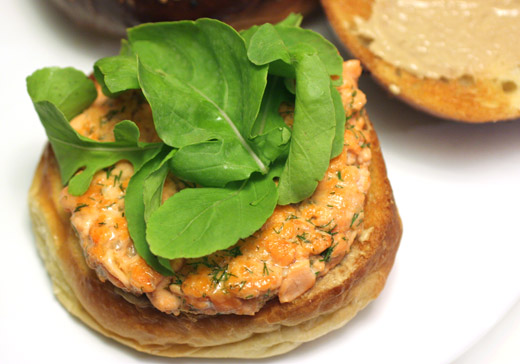
You saw this coming, didn’t you? I couldn’t rave about those brioche hamburger buns and then not tell you about a burger. The fact is that, probably, just about any burger would be delicious with one of those buns. I know this because I’ve used one of those buns for a completely boring, frozen, garden burger and quite enjoyed it. But, that was a later use of a brioche bun. For their debut, I wanted to whip up something special in the way of a burger that would be truly worthy of them. Just when I finally decided to try making those buns, this salmon burger recipe was on the top of my to-try stack. I couldn’t ignore that kind of coincidence. The burger is from the June issue of Living magazine, and it’s made from fresh salmon fillets, cold-smoked or cured salmon, and dill. They’re quick to make and hold together well. If you’d like to grill them though, you might want to use a fish or vegetable tray on top of the grill rack just in case. And, if you choose to brown them in a skillet, they cook in just a couple of minutes per side.
The recipe calls for one pound of fresh salmon and two and a half ounces of thinly sliced smoked salmon. The fresh salmon is cut into large chunks which are chilled before being pulsed in a food processor. The goal is to chop the big chunks but not to a smooth state. The smoked salmon was finely chopped by hand and then stirred into the chopped fresh salmon. Last, chopped fresh dill was added, and the patties were formed. It’s suggested that four patties be formed from the salmon mixture, but since I was dealing with some rather large buns, I divided the mixture into three portions for a better fit. After heating a little oil in a skillet, the burgers cooked for a scant two minutes per side. They just begin to brown, and the salmon barely cooks through. They were topped with mustard and arugula.
The mix of fresh and cured salmon gave these burgers a nice mix of flavors which the dill accented well. And, chopping the fresh salmon just enough but not too much is the key to great texture. For three simple ingredients, they combined perfectly for a very worthy burger.
I hadn’t eaten a fish stick in years. As a kid, I always preferred fish sticks to burgers. In fact, that was about the only school cafeteria lunch item I ever ate, but I never touched the tartar sauce. I don't even know if kids still like fish sticks these days. At some point they disappeared from my diet. I assume that disappearance happened right about the time I was old enough to realize a re-heated, frozen, breaded piece of white fish left something to be desired in flavor, and I have no idea when it was I changed my mind about tartar sauce. So, when I saw this grown-up version of fish sticks with fresh halibut and a pickly, herby, homemade tartar sauce in the June Bon Appetit, I had to try it. I’m pretty sure this version could convince any adult to see fish sticks in a new light. The sticks were pan sauteed rather than deep fried, so there’s no heavy, greasiness about them, and the panko coating made them as crispy as can be.
The tartar sauce came together with mayonnaise, chopped fresh dill, capers, chopped fresh chives, and finely chopped cornichons. Maybe I would have liked tartar sauce all along if it had always been made like this. For the fish sticks, fresh halibut was cut into short, narrow pieces and seasoned. Then, it was coated in egg and dredged in panko breadcrumbs. It cooked quickly in a nonstick skillet with just a tablespoon and a half of oil. It was a quick meal and a nostalgic one as well.
Unlike the ones that came out of a box, these fish sticks were light, crunchy, and fresh-tasting. The tartar sauce was rich and tangy and addictive. I can’t remember what side dish the school cafeteria used to serve with their fish sticks, but it might have been tater tots. We enjoyed these with salad instead, and they surpassed any memory I had of fish sticks. I think they've found their way back into my diet for the foreseeable future.
Of course there were eggs for Easter. I usually make deviled eggs, but this year I decided to mix it up just a bit. The flavors here were the same as what you’d find in my deviled eggs, but the delivery took a different form. These tartines are from Ina, and I’ve always thought her egg salad topped with thinly sliced smoked salmon looked delicious. I thought about making them for the longest time. In fact, I thought about them for so long, I forgot which one of her books included the recipe. In the past, I used to search my cookbooks by pulling each one off the shelf and flipping to the index. I did that to find recipes I remembered or to get ideas for cooking with specific ingredients. That was the old way of searching. These days, I use Eat Your Books, which accomplishes the same thing with just the click of a mouse. You build a list of all of your books which you can then search for recipes or ingredients. The search result will show the book title that includes your search term and the list of ingredients in the recipe. It’s so much easier than the old way. I quickly found that the egg salad tartines are in Barefoot Contessa at Home. This recipe is also on the FoodNetwork site.
I wanted to find Ina’s recipe to see exactly how she made her version and to check the ratio of mayonnaise to egg, but I had to make a few additions of my own. Ina’s egg salad is very straightforward with just hard-boiled eggs chopped in a food processor, mayonnaise, whole-grain mustard, fresh dill, salt, and pepper. I wanted to add a couple of things that are always in my deviled eggs, so I included finely chopped cornichons and spring onions. I had some pretty, red, spring onions from the farmers’ market and wanted to make use of their flavor and color. For bread, I had just baked some sourdough baguettes which are even more fun to bake now that I have a proper baguette pan. I sliced a baguette and toasted the pieces before spreading them with the egg salad and topping it with smoked salmon. I wish I had cured my own salmon, but that’s something that remains on my to-try list.
I knew I was going to like this a lot, and I think I enjoyed it even more than my usual deviled eggs. The smoked salmon added savory, slightly salty bite to the egg salad. Another option would have been to slice some olives to use as a topping. I have a thing for the pickled element of cornichons with hard-boiled eggs, but I’m not sure how popular that is. Do you have a favorite ingredient for egg salad or deviled eggs?









 by Magnus Nilsson. I received a review copy of this hefty book that covers traditional and contemporary foods from Finland, Sweden, Norway, Denmark, the Faroe Islands, Iceland, and Greenland. Nilsson set out to show the similarities as well as the differences between each part of the Nordic culture. Several dishes are found in multiple locations and go by different names in each place, and some are unique to one area. He accepted that the book could never be a complete record of all the recipes from this large area, but it was intended to inform the reader about this food culture and provide guidance in creating some of that food. It also includes beautiful photos of the areas that were visited during the research phase. There’s a simplicity to the ingredients and most preparations, and flavors are brightened by vinegars, horseradish, and herbs. I loved all the potato recipes including several potato salads, soups, creamed potatoes, gratins, potato cakes, and Potatoes Hasselbacken. Why have I never made those? I learned the dish was invented in the 1950s at a restaurant that became a cooking school called Hasselbacken. There are meat and poultry dishes, sausage and charcuterie, breads and waffles and dumplings, cakes and pastries, and a chapter for little cookies and other sweets that I imagine would be perfect on a holiday cookie tray. I really enjoyed reading about all the various fish dishes with fresh, pickled, smoked, and dried variations. I really like pickled shrimp, so I had to try the Poached and Pickled Salmon since fresh wild salmon season is in full swing.




 . This recipe is also on the

