

 back in late May. One of my first thoughts about the book was that it reminded me a little of Anthony Bourdain’s style of explaining the uniqueness of a place through the food. For this book Edward Lee visited different cities around the US, but what the reader learns from him of those places is not the typical or expected or most common thing about each place. He set out to find stories of food made by immigrants and how those dishes have become American food. There may be interpretations of dishes from home countries or an evolution of dishes over time, but the priority here is to tell the story behind the food and appreciate it for what it has become. Each chapter ends with a recipe or two or three that are Lee’s take on a dish or dishes particular to a place. His story about Lowell, Massachusetts starts with the town’s tradition of boxing but leads to the Cambodian immigrants that now make up 40% of the local population. The recipes include Amok Trey which is a coconut curry with fish that’s cooked in a banana leaf and a Pork Lab with Fried Egg on Popcorn Bread to mimic hash on toast. It was interesting to learn of the Lebanese food traditions in Clarksdale, Mississippi where kibbeh is common and the Chinese buffet restaurant serves sushi and lo mein alongside fried chicken, lima beans, and cornbread. Patterson, New Jersey offered another intriguing story where you’ll find “the largest concentration of Peruvian restaurants in the country” due to immigrants from Peru who came to this city for factory jobs. Lee points out that “the food of immigrants is not authentic but frozen in time, reflecting the culinary moment when the immigrants left their home.” It’s also dependent on what ingredients can be found in the current location. Tastes and customs change dishes in home countries and abroad, and what results is no less traditional just different. The recipes for this chapter include Pollo a la Brasa which is a slow-smoked, marinated chicken and Green Fried Rice with Chicken, Cilantro, and Aji Sauce. The question of why German cuisine isn’t more championed was brought up in a chapter about Wisconsin in which Lee and his wife visited several German restaurants and food shops. It’s a good question. This is the one type of cuisine for which I can’t think of a well-known cookbook devoted to it. But, I was delighted to see a unique spin on schnitzel with the recipe for Roast Butternut Squash Schnitzel with Squash Kraut. And, now I need to explain a little about our local, Austin food scene. Our seasons don’t always align with those of other parts of the country. While some area farms continue to have butternut and other hard squashes through the fall, our urban farms tend to have them early in June. I learned that’s due to insects that attack the plants when they’re planted later in the summer. The plants do fine when planted early but won’t survive the summer bugs. So, I was able to get lovely, local butternut squash to make this dish well before fall.
 First, the butternut squash kraut was started since it needed a few days to naturally ferment. The squash was grated and combined with minced onion, garlic, salt, and caraway seeds. I was sure I had caraway seeds to use for this, but when I searched through my spices there were none to be found. Instead, I used nigella seeds which are also sometimes called black caraway so they’re not too weird of a choice. The squash and other ingredients were mixed by hand in a bowl and squeezed to get some juices extracting. The mixture with all the juices was then placed in a jar, water was added, and I weighted down the mixture with a smaller jar. It was left at room temperature for 48 hours and was then refrigerated for a few days. It can be kept for a month or so. For the schnitzel, butternut squash was peeled, seeded and roasted until somewhat tender. When cool, rounds were cut and pressed to flatten a little. Then, I made a little change to the recipe. Rather than breading the squash with flour, egg, and breadcrumbs, I took a simpler route. I spread the tops with Dijon mustard and pressed on breadcrumbs. I do this often with fish for a simpler breading technique. Also, the recipe in the book includes a mustard-cream sauce which I skipped to make it a little lighter and because the mustard flavor was already present. The breaded squash slices were fried in olive oil until crispy and served topped with the squash kraut.


Tweet


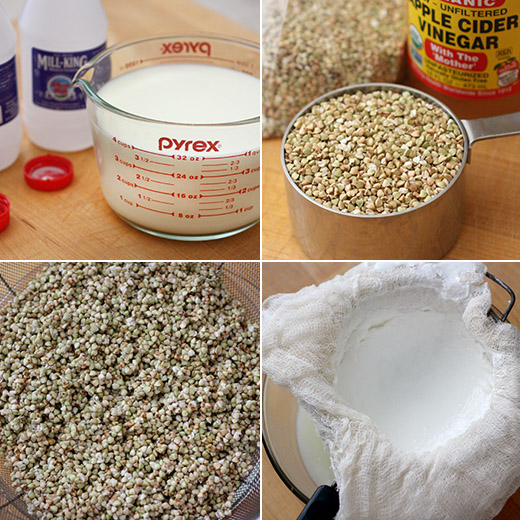
 , and it gave me even more ideas for fermenting. But, let’s back up for a moment. You may be wondering, why ferment food at all? Traditionally, fermentation allowed foods to be preserved, but magically, it also offers a way of getting even more nutrition from food than you would without doing so. During fermentation, good bacteria are formed with all sorts of beneficial effects ranging from better absorption of nutrients to boosting the immune system. The only thing to keep in mind regarding fermentation is that those beneficial bacteria get killed off when exposed to high heat. I keep fermented pickles in the refrigerator for a couple of months if they even last that long. If they were heat-processed for canning and long-term storage, they’d still taste great but the beneficial bacteria would be killed off. Fermented foods, however, can be frozen and the good bacteria will survive. I mention this because the fermented cereal shown here was heated to a point that destroyed the good bacteria. In this case though, all was not lost.