Showing posts with label scallops. Show all posts

Thursday, June 20, 2019

Thai Scallop Tostadas

Back in 2010, the food truck trend was in full swing here in Austin, and it hasn’t stopped. That’s the year The Peached Tortilla truck appeared on the scene. I believe the first time I visited it was at a craft beer festival, and I remember the Asian flavors meet American and Tex-Mex street food vibe. Since then, some food trucks have transitioned into restaurants, others continue as trucks, and several have come and gone. The Peached Tortilla has evolved to include a restaurant right in my neighborhood as well as a location at the airport, a catering business, and an event space. And now, there’s a cookbook of which I received a review copy. The book includes classic and current dishes from the business as well as some of author and founder Eric Silverstein’s childhood favorites and some dishes inspired by his mother’s cooking. Silverstein had the unique experience of being born in Tokyo to his Chinese-American mother and Jewish-American father before the family moved to Atlanta, Georgia when he was 11. There’s a lot of varied inspiration for the recipes here. I’m always drawn to Laksa recipes, and the one here looks delicious with the homemade paste of chiles, herbs, and spices and the mix of shrimp stock, coconut milk, and fish sauce. Another favorite of mine is shrimp toast, and I’ll be turning back to the page with Mom’s Shrimp Toast served with Thai Chili Dipping Sauce. There are burgers with sauces and toppings, a hot dog, and even a tempura fish burger. But, the Asian Street Tacos chapter really grabbed my attention. The Banh Mi Taco and Pad Thai Taco make appearances as well as the Kimchi Queso and Roasted Cauliflower Taco. But, it was the Thai Shrimp Tostadas that called out to me first. 

Although in the book it is shrimp tostadas, the day I planned to make them scallops happened to be on sale and I couldn’t resist. I’ve made kimchi tacos before, but I hadn’t extended Asian flavors into tostada making. And, I love making tostadas. This one is built on a base of Thai slaw made with purple and green cabbage, julienned carrots, green onions, cilantro, and Thai Peanut Dressing. The scallops were tossed with more of the Thai Peanut Dressing before being sauteed, and I cut them into pieces after they were cooked. My preferred method for crisping tortillas for tostadas is to toast them under the broiler with just a brushing of oil and flipping them once browned on top. It’s quicker, easier, and uses a lot less oil than frying. The tostadas were built with a layer of slaw topped with chunks of scallops and garnished with cilantro leaves, chopped peanuts, and Sriracha. 

This immediately became my summer tostada of choice. Sometimes I make vegan tostadas with refried beans, avocado, chiles, and lettuce, and other times I top them with shrimp or fish. This was a delightfully different approach. It was light and lively with the slaw and all those delicious flavors in the peanut sauce. And, any shellfish, fish, chicken, or tofu would be great here. This just guarantees I’ll be bringing home even more tortillas than usual. 

Thai Shrimp (or Scallop) Tostadas 
Reprinted with permission from The Peached Tortilla: Modern Asian Comfort Food from Tokyo to Texas © 2019 Eric Silverstein. Published by Sterling Epicure. Photography © Carli Rene/InkedFingers.  

Serves 4 

FOR THE THAI SLAW 
2 cups purple cabbage, shredded thinly on a mandoline 
1⁄2 cup green cabbage, shredded thinly on a mandoline 
3⁄4 cup carrots, peeled and julienned 
1⁄4 cup green onions, sliced on a 1⁄4-inch-wide bias 
1⁄4 cup fresh cilantro leaves 
3 tablespoons Thai Peanut Dressing (recipe to follow) 
Kosher salt 
Freshly ground black pepper 

TO MAKE THE THAI SLAW In a medium-size mixing bowl, toss together the purple and green cabbage, carrots, green onions, cilantro, and Thai Peanut Dressing. Add salt and pepper to taste. Set the mixture aside. 

ASSEMBLY 
2 quarts + 1 tablespoon vegetable oil 
8 (5-inch) corn tortillas 
1⁄4 teaspoon kosher salt 
1 cup (approximately 1 1⁄4 pounds) shrimp, shelled, deveined, and chopped into 1⁄2-inch pieces 
1⁄4 cup Thai Peanut Dressing 
Asian Slaw 
1⁄4 cup cilantro, chopped 
2 tablespoons roasted peanuts 
1⁄4 cup Sriracha Sauce 
1⁄2 lime, cut into wedges 

1. Place the 2 quarts of oil in a Dutch oven or deep cast iron pan. Bring the oil to 350°F. 
2. When the oil is at temperature, fry the tortillas for 2–3 minutes or until they are a light golden brown. Remove the tortillas from the hot oil with a pair of tongs and set them to dry on a plate covered with a paper towel. Immediately season the tortillas with the kosher salt. 
3. In a medium-size bowl, mix the chopped shrimp with the Thai Peanut Dressing. 
4. Place the 1 tablespoon of oil in a medium-size skillet over medium heat. Once the oil starts to shimmer, add the shrimp to the skillet and cook for 3–4 minutes. Since the shrimp is already chopped, it should cook relatively quickly. 
5. Layer two fried tortillas on a plate, so that one covers a third of the other. Spread a portion of the Thai Slaw on top of the tortilla, then layer 1⁄4 cup of the cooked shrimp on top of the Thai Slaw, making sure to cover it evenly. 
6. Garnish the Thai Shrimp Tostada with the Thai Peanut Dressing, cilantro, roasted peanuts, and a little bit of Sriracha. Serve the tostadas with a lime wedge. 

Thai Peanut Dressing 
Makes about 2 cups 
1 cup plus 1 1⁄2 tablespoons vegetable oil 
2 cloves garlic, peeled 
2 Thai Chilies 
1⁄2 cup peanuts, roasted 
2 tablespoons Shrimp Paste 
1⁄4 cup lime juice 
2 1⁄2 tablespoons Fish Sauce 
3 tablespoons sugar 

TO MAKE THE THAI PEANUT DRESSING 
1. Place a small skillet over low heat and add 1 1⁄2 tablespoons of the oil. Sauté the garlic for 2–3 minutes until it starts to brown and become aromatic. Add the Thai chilies and sauté them for another 45 seconds to 1 minute. 
2. Place the garlic and Thai chilies into a blender and add the peanuts, shrimp paste, lime juice, fish sauce, and sugar. Blend all the ingredients together. Add the remaining oil slowly and continue to puree the mixture. Be patient when adding the oil; otherwise the dressing will separate.


I am a member of the Amazon Affiliate Program. 

Monday, November 25, 2013

Sea Scallops with Saffron Potatoes and Orange-Meyer Lemon Salsa

I have go-to cookbooks for different purposes, different types of dishes, or different times of year. For instance every year when my birthday is approaching, the book I turn to for special dishes for celebrating with flavors that I love is Sunday Suppers at Lucques by Suzanne Goin published in 2008. It would be an understatement to say that I was a little excited when I learned she was releasing a new book. The A.O.C. Cookbook appeared at the end of last month, and I received a review copy. In a lot of ways, this new book feels like a continuation of Sunday Suppers. The seasonality, style of cooking, and flavors are consistent, but this time rather than menus for meals, the dishes are organized by starters, mains, vegetables, and desserts. The recipes are based on the menu from Goin’s restaurant A.O.C. which focuses on small plates, but in the book, the savory recipes are written to serve six as full courses or appetizers. Each section of the book is divided by season so you can turn to the appropriate time of year for what’s fresh and available at the markets. Also, in this book, Goin’s business partner, Caroline Styne offers wine pairing suggestions for every dish. And, there’s a cheese guide with descriptions of every type ever served at A.O.C. It was interesting to read that Goin has learned from her fans over the years. She knows that some cooks prefer simpler, streamlined recipes and others enjoy a bit of a challenge. In the headnotes, she mentions when a recipe fits that latter category so you know what to expect. I’ve flagged several pages including the ones for Dandelion and Roasted Carrot Salad with Black Olives and Ricotta Salata; Black Bass with Fennel Puree, Winter Citrus, and Green Olives in Green Harissa; Grilled Quail with Couscous, Walnuts, and Pomegranate Salsa; Turmeric-Spiced Root Vegetables with Kaffir Lime Yogurt and Mint Chutney; Torchio with Kabocha Squash, Radicchio, Walnuts, and Taleggio; and Ricotta Cheesecake with Dried Fruit Compote and Walnut Biscotti. And, those are just a few of the fall and winter dishes. 

I’ve tried two items from the book so far. The Butterscotch Pot de Creme with Salted Cashew Cookies was a comfort-food kind of dessert at its best. Sadly, butterscotch is never particularly photogenic, but it is delicious especially paired with a crunchy, nutty cookie. The second dish I made was the Sea Scallops with Saffron Potatoes and Orange-Meyer Lemon Salsa. This was a classic Suzanne Goin dish to my mind due to the lemon zest and herb seasoning applied to the scallops before cooking and the bright-tasting, citrus salsa. I took a couple of liberties with the recipe, and you can see the original version from the book below. Rather than skewering the scallops on trimmed rosemary sprigs and grilling, I seared the scallops in a hot pan. Also, even though blood oranges had appeared at the grocery store the week before I went looking for them, on the day I needed them there were none. I used Cara Cara navels instead which aren’t as deep red in color and are less bitter. It was the best option available, but I wish I could have used blood oranges. For the potatoes, I used fingerlings that I cut into thick chunks. They braised on top of the stove in a bath of saffron, water, and olive oil with onion, and chile de arbol. They absorbed all those lovely flavors while cooking until tender. The plate was assembled with potatoes topped with arugula, then the scallops, and finished with the citrus salsa on top. 

This dish was delightful in every way. The potatoes were both literally and figuratively the foundation. Earthy and mild with hints of saffron and onion in each bite, they countered the bitter, peppery greens while the scallops were sweet bites of the sea. And, the salsa punctuated everything just as it should. It’s going to be a lot of fun to cook from this book from season to season. 

Atlantic Sea Scallops with Saffron Potatoes and Blood Orange–Meyer Lemon Salsa 
Excerpted from The A.O.C. Cookbook by Suzanne Goin. Copyright © 2013 by Suzanne Goin. Excerpted by permission of Knopf, a division of Random House LLC. All rights reserved. No part of this excerpt may be reproduced or reprinted without permission in writing from the publisher. 

I love the colors of this Sicilian- inspired dish—the deep red, orange, and yellow tones of the salsa spooned over those white scallops and over the mounds of sienna- hued potatoes remind me of an Italian vacation. I was never a big fan of scallops until I tasted the super- sweet, succulent, meaty East Coast diver- caught ones we are lucky enough to get from Steve Connolly in Gloucester, Massachusetts. Seek them out—they are so worth it! This preparation would also work beautifully with halibut, sole, or other white flaky fish. 

NOTE Mexican diver-caught scallops are a good alternative to the Atlantic sea scallops. 

6 branches rosemary, about 7 to 8 inches long 
18 Atlantic sea scallops, each about 2 ounces 
1 tablespoon Meyer lemon zest 
2 tablespoons finely diced shallots 
1 tablespoon champagne vinegar 
2 Meyer lemons 
3 large blood oranges 
1 cup extra-virgin olive oil 
1 tablespoon sliced mint 
1 teaspoon saffron threads 
2 pounds Yukon Gold potatoes, peeled and cut into 1 1/2-inch chunks 
1 cup diced red onion 
1 tablespoon thyme leaves 
1 chile de arbol, crumbled 
2 ounces young dandelion greens or arugula 
Kosher salt and freshly ground black pepper 

Remove the rosemary leaves from the branches except for 2 inches at the bottom of each. Cut the leafless end of each branch at an angle with a sharpknife to make a point and coarsely chop the picked rosemary leaves. Season the scallops with the lemon zest and 1 1/2 tablespoons chopped rosemary. Skewer three scallops onto each rosemary branch. Cover and refrigerate. Place the shallots, champagne vinegar, and a healthy pinch of salt in a small bowl, and let sit for 5 minutes. 

Cut away the stem and blossom ends from the Meyer lemons. Stand the lemons on one end, and cut them vertically into 1/8-inch slices (keeping the rinds on). Stack the slices in small piles on a cutting board, and cut them lengthwise into 1/8-inch thick matchsticks. Line up the matchsticks, and cut them into 1/8-inch cubes. Cut away the stem and blossom ends from two blood oranges. Place the oranges cut- side down on a cutting board. Following the contour of the fruit with your knife, remove the peel and cottony white pith, working from top to bottom, and rotating the fruit as you go. Then hold the oranges in your hand, one at a time, and carefully slice between the membranes and the fruit to release the segments in between. Add the diced lemon, blood- orange segments, their juices, and the juice of the remaining orange to the shallot mixture. Stir in 1/2 cup olive oil, the mint, 1/2 teaspoon salt, and a few grinds of pepper. 

Light the grill 30 to 40 minutes before cooking, and take the scallops out of the refrigerator. Place the saffron in a small bowl, and pour 1 cup warm water over it. 

Heat a large Dutch oven over high heat for 1 minute. Swirl in 1/4 cup olive oil, and wait 1 minute. Add the onion, thyme, chile, 1/2 teaspoon salt, and a few grindings of black pepper. Reduce the heat to medium, and sauté for about 3 minutes, stirring often, until the onion is translucent. Turn up the heat to medium- high. Add the potatoes and 2 tablespoons of olive oil, and season with 1 teaspoon salt and a few grindings of pepper. Don’t stir the pan for a couple of minutes while the potato edges sear in the hot oil and form a nice crust. Lift and tilt the pan to distribute the oil evenly. After 3 to 4 minutes, firmly shake the pan to loosen the potatoes. Turn with a wooden spoon and cook for another 3 minutes, stirring to coat with the onions. Add the saffron water. Stir to combine, cover the pot, reduce the heat to low, and let simmer for about 25 minutes, until the potatoes are nicely glazed and tender when poked with a paring knife. If at any point the liquid starts to dry up, add a little more water. The saffron potatoes should be glazed, neither dry nor soupy. Turn off heat, and put the lid halfway on. When the coals are broken down, red, and glowing, brush the scallops with remaining 2 tablespoons olive oil, and season with salt and pepper on both sides. 

Place the skewered scallops on the grill, and cook for 4 minutes, rotating once to create crosshatch marks and a browned crust. Flip the scallops, move them to a cooler side of the grill, and cook for another 1 to 2 minutes, until they’re medium-rare. Spoon the hot saffron potatoes into the center of six dinner plates, scatter the dandelion, and place the scallop skewers on top. Spoon the blood orange-Meyer lemon salsa over the scallops. 

I am a member of the Amazon Affiliate Program.

Thursday, January 17, 2013

Seared Scallops and Potato Celery Root Puree

This is a Goldilocks story. I was looking for something to make for a weekend dinner that would be kind of a special meal. I had just finished reading, and cooking a few other things from, the brand new Barefoot Contessa Foolproof book. In it, there’s a Seared Scallops and Potato Celery Root Puree dish that sounded delicious. Even though the dish seemed perfectly lovely, I wanted something just slightly more dressed up, more special, more this-isn’t-your-usual-weekend-dinner-at-home. A few days later I was flipping through Stir: Mixing It Up in the Italian Tradition which is full of great ideas and has never disappointed. There, I found a very similar dish called Scallop and Pureed Celery Root Gratinee. This was a dolled up version of the same thing with just a few differences. It was topped with crispy breadcrumbs, finely diced Granny Smith apple, and a celery emulsion. It was beautiful in the photo. But, I realized I didn’t really want to fuss with a celery foam. I can be hard to please. I picked my favorite parts of each dish from both books, and voila. I went with Ina’s version of the puree which included leeks and potato and was cooked in cream. Then, after pureeing it, I pushed it through a fine-mesh strainer just like Barbara Lynch suggested for a velvety smooth finish. I topped the seared scallops with buttery breadcrumbs and diced apple as shown in Stir, but instead of a celery foam, I used finely diced celery. The last detail was Ina’s drizzle of olive oil. And, dinner was just right. 

This is what the cooking entailed: Chopped leeks were sauteed in butter, and diced peeled potato and celery root were added along with cream and salt and pepper. I used two and half tablespoons of butter, two chopped leeks, two Yukon gold potatoes, one celery root, and one and a half cups of cream. This was brought to a boil and left to simmer for about 25 minutes until the potatoes and celery root were very tender. The cooked vegetables and cream were transferred to a food processor and pureed until smooth. Then, I scooped the puree into a fine-mesh strainer and pushed it through using a metal spoon. The strained puree was kept warm in a saucepan over low heat. The scallops were patted dry, seasoned with salt and black pepper, and seared in grape seed oil over medium-high heat for about three minutes per side. To top the scallops, panko breadcrumbs were toasted in melted butter, Granny Smith apple and celery were finely diced, and chives were chopped. Once plated, Ina recommends drizzling the scallops with basil oil, but I used a plain, extra virgin olive oil. 

I never would have thought to pair Granny Smith apple with scallops, but it was a fantastic idea. The tartness of the apple functioned just as a squeeze of lemon would but added a little crunchiness as well. During dinner, we argued as to whether the apple, celery, and breadcrumb toppings were better with the scallops or the potato and celery root puree. They were great with both, and I wouldn’t change a thing when I make this again. 

I am a member of the Amazon Affiliate Program.

Wednesday, September 28, 2011

Entertaining, Chilean Style

I was recently transported, metaphorically speaking, to Chile for an evening of learning about the country’s food and wine. I’d love to really go there someday, and travel along the entire long coastline. That night, I learned about wine making in Chile and how easily a diversity of plants grow in different regions of the country at the class Entertaining, Chilean Style at Central Market Cooking School. The class was taught by Ruth Van Waerebeek, house chef of Concha y Toro and owner of Hostal Gastonomico and Mapuyampay Cooking School in Chile, and I attended with a media pass. As the name of the class implied, all the dishes presented were good choices for parties, and they each hinted at both traditional Chilean cooking styles and influences from afar. For instance, cuisine from both Chile and Argentina has been affected by adopted Chinese and Japanese flavors. Traditional ceviches are combined with Asian ingredients like soy sauce and sesame oil. Influence has also come from France for both cooking and wine making. Rich buttery sauces and custards combined with local, Chilean ingredients are common, and a lot of Chilean vine stock originally came from France. And, of course, the South American enthusiasm for meat is evident in Chilean food where lamb is prevalent.

Our first dish of the class was cucumber rolls with shrimp and salmon ceviche with a spicy Asian-style dipping sauce, and this was paired with Casillero del Diablo Sauvignon Blanc. Van Waerebeek suggested briefly poaching the shrimp if it’s not absolutely, perfectly fresh. For ceviche, she prefers to only marinate the raw fish for 30 minutes, so sushi-quality freshness is key. The sauce here was a spicy mix of soy sauce, sesame oil, rice vinegar, chopped red chile, and black and white sesame seeds.

Next, we saw some of that French influence in a baked scallop dish with parmesan butter and sauteed vegetables. In season, local vegetables would be used here, and for this version, carrot and bell pepper were thinly julienned and sauteed until crisp. The vegetables were placed in the bottom of ramekins and were topped with a scallop. Smaller, bay scallops are more common in Chile, and if using those, a few would be placed on top of the vegetables. The scallops were topped with a generous bit of parmesan butter and were then broiled to just cook the scallops almost through. This dish was served with a young, light Casillero del Diablo Chardonnay.

Quinoa is one of those many plants that grows so well in Chile, and the seeds are prized for nutritional content. They were used here for a vegetarian custard. The egg and milk base was blended with pureed fresh corn, cooked quinoa was added, and sauteed, finely diced zucchini, bell pepper, and leeks were added as well. The custard was cooked in individual portions in ramekins, and the airiness of the custard was given heft by the tender pearls of quinoa. This course was served with Casillero del Diablo Carmenere, and we learned that Carmenere is the flagship varietal of Chile. It’s a light enough red wine to pair well with a range of flavors.

The quinoa custard was followed by a lamb chop served with an almond, green olive, and mint salsa. The lamb was marinated in olive oil with rosemary and garlic before being grilled, and the salsa was an easy puree of toasted almonds, green olive, fresh mint, and a little white wine to thin as needed. The wine was a robust Marques de Casa Concha Cabernet Sauvignon, and it was my favorite wine of the evening.

Dessert wasn’t a Chilean dish at all, but rather, it was a Catalonian idea for ending a meal imported from Spain. An aged Manchego cheese was served with pieces of rosemary bread and black cherry preserves, and this was paired with Casillero del Diablo Reserva Privada. Although this idea came from Spain, sheep’s milk cheeses similar to Manchego are common in Chile but are difficult to find outside the country.

Until I get a chance to trek the length of Chile, I can at least daydream about it and enjoy these dishes and wines at home. The seafood, the quinoa, and the wine will be waiting when I finally get there.


Tuesday, May 3, 2011

Thai-Style Scallops and Asparagus

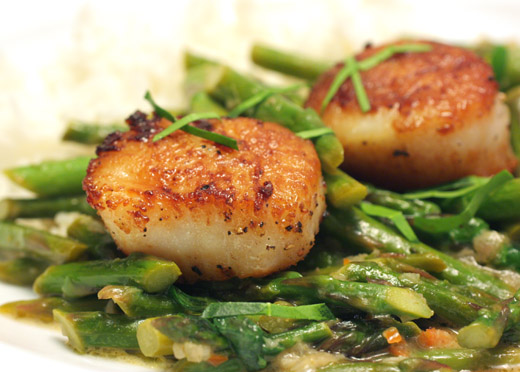
Scallops plus asparagus and Thai flavors was all I needed to know. I saw this dish in the food section on The New York Times site last week, and it immediately became a part of our weekend dining plans. With the current fling I’m having with asparagus and scallops’ unwavering appeal, this meal was sure to be a hit. That being said, I made some minor changes to the suggested preparations. First, Kurt and I both prefer for large scallops to be seared. While we agree on that point, Kurt also feels that sauce should never cover scallops once they’re seared because tampering with that seared bit of crust on the surface should be illegal. So, rather than cooking the scallops in the sauce as was recommended, I seared them separately and set them on top of the asparagus and sauce for serving. Another change I made was simply due to laziness. I didn’t feel the need to make fish stock for a mere one-third cup, so I used water and added a little fish sauce instead. Last, since I have a cute, little kaffir lime tree growing in a container on my front porch, I grabbed a few leaves from it to slice thinly for garnishing.

I made the curry paste mostly as directed by the recipe. Shallots, cores of lemon grass bulbs, ginger, garlic, anchovy paste, coriander, lime juice, and lime zest were mixed in a food processor. Oil was heated in a saute pan, and the curry paste was added. Asparagus, and I used more than suggested because I couldn’t help myself, was cut into small pieces and added to the curry paste. Then, I added water and fish sauce instead of fish stock, more coconut milk than suggested because I used more asparagus than suggested, and sriracha, and allowed the asparagus and sauce to simmer. Meanwhile, I seared the scallops in a separate pan, and all the while jasmine rice was steaming. The rice was served on the side, and the scallops were set on top of the asparagus and sauce making sure that nothing sauce-like came in contact with the top of the scallops.

The spiciness level can be determined by the amount of sriracha added, and I boosted it just a bit, but I didn’t want to overshadow the flavor of the scallops. The simple curry paste was a breeze to make, and I’m now certain I need a mortar and pestle. It was such a small amount to pulverize, it took longer to make the paste in a small food processor, with several stops to stir, than it would have by hand. Still, it made a flavorful sauce for this fresh, spring-like dish.


Sunday, April 18, 2010

Scallops with Blood Orange and Campari Granita


I love it when I have an opportunity to plan a dinner party. Choosing each course and beverages, deciding on a dessert, and figuring out how much can be prepared in advance is a fun challenge. Last week, friends who now live in Dublin were in Austin for a visit, and we were excited to invite them for dinner one evening. When your dinner guests happen to do a lot of traveling and happen to know food, it makes menu planning a little more stressful, but I knew we’d have a fun time regardless of the meal. Since I’ve been so interested in The New Spanish Table lately, I chose several things from that book for our menu. First was a sangria made with tempranillo, brandy, and my favorite liqueur Paula’s Texas Orange. Along with tapas of olives, nuts, and Spanish cheeses, I wanted to serve something a little different which was an idea that actually came from the dessert chapter in the book. There is a suggestion to use a blood orange and campari granita with shrimp or scallops, and I was intrigued. There’s a small amount of sugar in the granita, but the blood orange juice and campari made it more tart and fruity than sweet. The idea of a frozen, brightly colored topping on a scallop was something I had to try.


Making the granita was straightforward. I juiced some blood oranges after zesting one of them. The juice and zest were added to one quarter cup of sugar in a saucepan, and the mixture was warmed until the sugar dissolved. It was left to reduce for a few minutes, and then allowed to cool. Once cool, about one-third cup of campari was added. Freezing a granita is easiest in a wide, shallow pie dish. The juice mixture was poured into the dish and placed in the freezer for about an hour before being stirred and scraped. Then, every 30 minutes for the next couple of hours it was scraped and flaked. It takes a little longer to freeze a mixture with alcohol in it, but soon enough it became grainy and icy as it should. Then, I seared large sea scallops and allowed them to cool to room temperature so that the granita topping wouldn’t melt instantly. I topped each scallop with a little scoop of granita and some chopped cilantro.


The bitterness of blood orange and campari balanced the sweetness well and mingled nicely with the mild flavor of scallops. Next time, I might sear the scallops earlier and even chill them a bit before topping them with granita since it did melt more quickly than I would have liked. The bright orange color of the frozen granules was as pretty as can be, and it was a fun play on sweet and savory expectations. There was more to come after the tapas, and I’ll show the rest of the meal in upcoming posts.


Monday, January 4, 2010

Scallops with Chestnut Sauce and Crispy Sage

This may look like a scallop dish, but it’s all about the bacon. Did I just say that? Yes, I know, I don’t eat red meat, and I use turkey bacon. Good, natural, nitrite-free turkey bacon can be found, and that’s what I use. Although, I’m hoping to get my hands on some local duck bacon one of these days, but I digress. What I wanted to explain was that the flavors in this dish were very subtle and lovely, and the smokiness from bacon was essential to the chestnut sauce. The recipe clearly states that one thick slice of bacon should be used, and my turkey bacon, natural or not, wasn’t sliced very thickly. So, I should have used two slices, but I couldn’t have known that before finishing the sauce. Regardless of fussy details like that, it was a delicious sauce for scallops with fried sage leaves. This was in the November issue of Food and Wine and was created by Rajat Parr. As I read the issue over Thanksgiving weekend, I decided then and there that this would be our Christmas Eve meal.

To begin the sauce, the bacon of your choice is to be cooked in butter. Not a bad start for building flavor. After the bacon has cooked, a chopped leek was added. Next, cognac was to be added and flamed, but since I really didn’t want to burn the house down on Christmas Eve, I opted to just let the cognac simmer without flames. Last, chicken stock and vacuum-packed chestnuts were added, and the sauce was brought to a boil. It simmered for three minutes before being transferred to a blender to be pureed. The puree was poured back into a saucepan and was kept warm on the stove while the sage leaves were fried and the scallops were seared.

The primary ingredients here, scallops and chestnuts, are both very mild. Scallops have a slight sweetness, and chestnuts are almost earthy, but the bacon smoke and sage were there to tie it all together and punch it up a bit. The sauce was velvety and thick without being too rich. I knew as I tasted it I should have used a little more bacon, and how often does that thought ever occur to me, but it was still a great match for simply seared scallops.


Wednesday, July 15, 2009

Coquilles St. Jacques a la Provencale

My copies of Mastering the Art of French Cooking, Vol. One and Vol II have been sitting on the shelf, waiting patiently for years for me to cook from them. I’ve referred to The French Laundry Cookbook as kitchen scripture belonging on a pedestal, but I think I had mentally placed Mastering the Art on an even higher perch. A month or so ago, I read My Life in France which tells the story of the making of Vol I. The hard work and dedication involved in creating that book, not to mention the patience with getting it published, was staggering. This book contains the first published recipes for hollandaise, mayonnaise, and beurre blanc. No one had written them down for the home cook before. Reading about Julia’s life was just a treat, and after finishing that book I had to finally crack open Mastering the Art. You may have heard about a little movie that’s coming soon to every theater near you, Julie and Julia. With news of that popping up everywhere, and with Bastille Day this week, I was inspired to prepare some French cuisine. I chose a couple recipes that seemed pretty straightforward for my first time with this book, and scallops gratineed with wine, garlic, and herbs was one of them.

Now that I’ve actually cooked from this book, I realize how well-written the recipes are. I appreciated how the ingredients are grouped for each step of the preparation. Rather than looking back to the top of the page for the quantity of an ingredient, it’s right there next to the instruction for using it. I should point out that although I have the utmost respect for the book, I of course made a change to the dish. The scallops were supposed to have been cut into one-quarter inch thick slices. I couldn’t do it. I love a nice, tall, plump scallop like nothing else, and I left them full-sized. Other than that, I followed the instructions nearly exactly and resisted the urge to garnish with some parsley or something at the end. I cooked minced onion in butter and added shallot and garlic and then set it aside. I seared the (whole, unsliced) scallops but removed them from the pan to prevent over-cooking. They were to have remained in the pan while the sauce was prepared. I made the sauce with white wine, half of a bay leaf, and some thyme and added the reserved, cooked onion mixture. I returned the scallops to the pan, topped them with grated Swiss (Gruyere) cheese and pieces of butter, and gratineed them under the broiler.

To sum up the flavors, there was butter, onion, shallot, garlic, butter, scallops, wine, herbs, butter, and a little cheese. Delicious. It was somewhat rich, but I kept the portions small and served a simple salad on the side. The sauce was nicely put together, and the intention of pre-cooking the onion mixture was, I believe, to prevent the scallops from cooking too long in the sauce. I have a thing about scallops and wanted to completely avoid an over-cooked situation; hence, I didn’t cook them in the sauce and waited to put them back in the pan before broiling. The cheese and butter topping was extravagant both in taste and calorie-count, but I’m so glad to have followed the instructions for that. This dish was just a pleasure to experience. I think that Julia Child might have known a thing or two about cooking, and I’ll be learning more from her and both volumes of the book.


Wednesday, March 18, 2009

Tamari Shrimp and Scallops

I returned to Michel Nischan’s book, Taste Pure and Simple, for a light and delicious shellfish meal. This time, I didn’t have to beg any favors to procure all the ingredients. In fact, there are only five ingredients in the recipe if you exclude the garnish. It is a very straightforward dish in which the flavors of the shrimp and scallops are simply accented by tamari and black pepper.

The presentation is as important here as the ingredients. A sea scallop was to be snuggled into the curve of each shrimp and secured with a pick. I bought U16 gulf shrimp, but the gigantic sea scallops available that day would never have fit in them. I used bay scallops instead, and they fit nicely. Once assembled, I placed them back in the refrigerator while the sauce was prepared. Rather than using tamari sauce straight from the bottle, it was reduced in a double-boiler for about 40 minutes. It was to reduce by half and thicken. During this time, a thin crust or slight film formed on top of the sauce. Nischan explains that this is a salt crust and should be left behind when the reduced sauce is poured from the bowl. He suggests that removing this crust reduces the saltiness of the tamari, but I found it didn’t change the flavor much.

The prepared shrimp and scallops were seasoned only with black pepper and then brushed with the reduced tamari sauce. They were quickly seared on each side in a skillet heated with a small bit of canola oil. To serve, some of the sauce was spooned onto each plate, and the shellfish was placed on top. This couldn’t have been simpler. In the book, it’s suggested as a first course, but I served it as a main course with stir fried vegetables on the side. The vegetables found their way into the meandering sauce on the plate, and all the flavors of the meal worked together very well. Each piece is very pretty with the shrimp curling around the scallop, and they would also make nice hors d’oeuvres for a party.


Monday, July 28, 2008

Seared Scallops with Corn Cream and Macque Choux

Last Thursday evening, we attended Crescent City Cooking with a Focus on Seafood at Central Market cooking school. The class was taught by Susan Spicer who is Chef of Bayonna and Herbsaint in New Orleans. Her self-described style of French-inspired, eclectic cooking was demonstrated in four courses. Spinach salad with pan-sauteed Gulf oysters, a soup and sandwich course of shrimp and tomato bisque with a seared tuna muffaletta, a duo of fish course of cornmeal crusted catfish over a red bean puree and a pecan crusted red snapper with a citrus butter sauce, and last, mint julep ice cream. I left the class very happy and inspired. Bean puree as a sauce for fish! Keep the shrimp flavor subtle in bisque and add just a hint of anise from Herbsaint or Pernod! Cook over lower heat when using a nut crust on fish fillets so it doesn’t burn!

Armed with a signed copy of Crescent City Cooking: Unforgettable Recipes from Susan Spicer's New Orleans and the desire to keep eating food like what we sampled in the class, I set out to create one of her dishes at home over the weekend. That dish was Seared Scallops with Corn Cream and Macque Choux. Spicer explains that macque choux is a Cajun version of Yankee succotash made with corn kernels, diced tomatoes, and green onion.

Now, Kurt likes to point out that, due to my Illinois upbringing, I’m a sucker for fresh corn. He’s from Illinois too, but I really love fresh corn (and popcorn and cornmeal and polenta and grits). I can tell good fresh corn from so-so fresh corn and several levels of ok-ness in the middle. Small-kerneled, crunchy white corn can be the very best there is, but big, juicy yellow kernels are undeniably addictive. But, even if you only moderately like corn, like normal people, you will really like this dish. It was in the category of I can’t believe I made this it’s so good.

Corn freshly cut from the cob is briefly cooked in butter and a small amount of water. Then, it’s pureed in a blender and should be poured through a sieve into simmering cream. I didn’t sieve it because I wanted all the corn goodness I could get. The texture was still very smooth and silky despite having skipped the sieving. The corn cream is pooled on a plate, the macque choux is piled in the center, the scallops are nestled about the center pile, and pan drippings from the searing are dribbled about the composition. It was unbelievable how simple this preparation was in relation to its deliciousness. 1:5,000. I think this new book and I are going to be spending a lot of time together in the kitchen.


Blogging tips