I have a little problem. I'm addicted to cookbooks, food writing, recipe collecting, and cooking. I have a lot of recipes waiting for me to try them, and ideas from articles, tv, and restaurants often lead to new dishes. I started losing track of what I've done. So now I'm taking photos and writing about what I've prepared—unless it's terrible in which case I forget it ever happened.
Have you seen the book My Favorite Ingredients? I saw it mentioned a few times here and there, and then when I finally had a look at a copy of it, I had to bring it home. The book is by Skye Gyngell, and she is the head chef at London’s Petersham Nurseries Cafe. She describes her cooking as produce driven in that she takes inspiration from what is at its freshest and what flavors would complement that ingredient best. Her intention is to not interfere with the ingredients too much, to let them taste of themselves. That results in recipes that are very doable and very delicious when made with produce at the peak of its season. Each chapter in the book focuses on one ingredient, and it is shown in several different types of dishes. In the asparagus chapter, there’s a beautiful dish involving a tomato dressing and creme fraiche, one simply prepared with ginger and garlic, and a gratin of white asparagus. I’m really looking forward to cherry season, because the chapter about cherries has a cherry cordial and brandied cherries I want to try. There are chapters for tomatoes, nuts, fish and shellfish, vinegar, apples, cheese, and more. I currently have six pages marked, and those are just the recipes with ingredients that are in season right now. The dish you see here today is from the garlic chapter, and I had locally-grown garlic to use from my CSA. It was minced and then mixed with yogurt to make a tangy, flavorful sauce for a spicy, fried egg.
First, the yogurt was mixed with the minced garlic and salt and pepper, and that was left to sit so the flavors could mingle a bit. Next, butter was browned with a few sage leaves in it, and I used leaves from my new sage plants in my garden. When I read this recipe with browned butter with sage and garlic yogurt, I knew this was going to be good. The browned butter was used to fry the eggs, I used some beauties from a local farm, and sliced red chiles were added as well. To serve, a dollop of garlic yogurt was placed on the plate, the egg and some chile slices were added, and that was topped with the sage leaves and a little drizzle of brown butter.
This couldn’t have been simpler, and the flavors couldn’t have been more right. Rich, nutty, brown butter with earthy, herby sage and cool, savory, garlicky yogurt all to accompany a nicely fried egg with a hint of chile heat was, well, a pretty good breakfast to say the least. I’ll probably be mentioning this book a lot, and since I’m eyeing the crab cakes with corn puree and chili oil as I type this, that just might appear next.
Tara Austen Weaver’s recently published book The Butcher and the Vegetarian grabbed my attention because I too have meat issues. My issues are more of the picky-eater sort, but I was still intrigued by her journey into meat land after living as a vegetarian for her entire life. The book is full of great information about responsible, sustainable farming, ranching, and meat production, in addition to entertaining stories about what she was cooking and eating throughout this adventure. Tara has also been published in several anthologies, written for Edible San Francisco and other print publications, and her blog, Tea and Cookies, was selected as one of the top 50 food blogs in the world by the Times of London. I asked Tara, what are you reading?
Tara:
I just finished reading Kim Severson’s new memoir,Spoon Fed: How Eight Cooks Saved My Life, which I loved. She profiles a series of women whose work in food has inspired her, but it is Kim’s own story of finding her way back from alcoholism that is perhaps most inspiring.
On the cookbook front, I am mesmerized by David Lebovitz’s gorgeous new bookReady for Dessert. The recipes and photos are so enticing I can hardly stand it.
Other current inspirations are Andrea Nguyen’sAsian Dumplings (dumpling party, anyone?), Monica Bhide’sModern Spice (I’m fixated on Indian food lately), and Lorna Yee’s just releasedThe Newlywed Kitchen (Lorna’s an amazing cook).
The book on my bedside table isAuberge of the Flowering Hearth, by Roy Andreis de Groot. It’s the story and recipes of a small inn high in the French Alps. The book had been highly recommended but I’m finding it slow (Twitter has ruined my attention span, I’m afraid). It’s lovely and lyrical, but old fashioned (published in 1973). I pick it up from time to time and read a bit. It’s like a very rich dessert.
Gaia's Garden(dreadful hippie name), by Toby Hemenway. It’s a book on Permaculture, which is a more sustainable way of living and growing food. It’s incredibly inspiring.
Thank you for participating, Tara! Check back to see who answers the question next time and what other books are recommended.
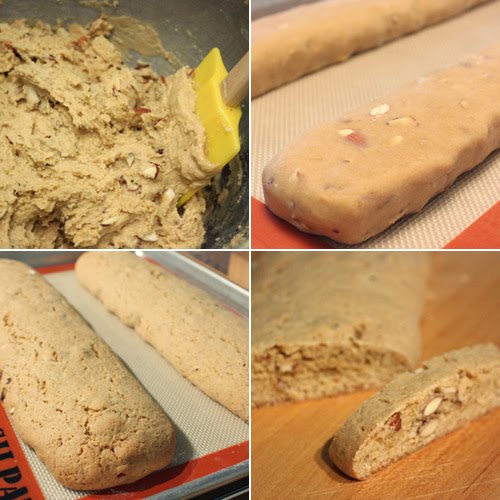
I can’t believe there are zero posts about biscotti on my site. Well, now there is finally one, but more than two years went by without any biscotti posts. I should explain that biscotti are kind of like scones to me. I’ve admitted that I try almost every scone recipe I ever see, four of which I’ve posted on this site, and I have the same issue with biscotti recipes although I’ve neglected to mention them. The difference is that I seem to encounter more failures with biscotti. I’ve tried recipes that resulted in cookies that were too large and unwieldy, or the add-ins were too difficult to slice through and the cookies were ugly, or the cookies didn’t bake evenly and were too dark on one side. I’ve learned that the initially baked dough logs shouldn’t be too large. Two to three inches wide seems to work best. Then, once the individual cookies are cut, they should be flipped at the half-way point in their baking time. That way, the cookies don’t brown too much on one side and not enough on the other. I’ve also read that some people have success with baking the cookies on their edges rather than flat on a cut side, but I haven’t tried that. Regarding the slicing issue, I now let the dough cool a little longer after the first baking and before slicing, and I always use a serrated knife. With these lessons in mind, I tried a biscotti recipe I’d seen in the December 2009 issue of Living, and these turned out great.
Whole wheat flour, all-purpose flour, and baking powder were sifted together and set aside. Butter was mixed with sugar, honey, lemon zest, and salt, and three eggs were added one at a time. Nice, big measures, one whole tablespoon each, of vanilla and almond extract were added, and that’s why these biscotti smelled so amazing as they baked. Then, the flour mixture was added followed by almonds. I used a mix of whole almonds and sliced almonds because I was in pantry-clearing mode. The dough was wrapped in plastic and chilled for an hour. It was then divided in half, formed into two logs, of appropriate size of course, the logs were placed on a silpat-lined baking sheet, and they were chilled for 30 minutes. The first baking was at 325 degrees F for 35 minutes. Then, the dough logs were allowed to cool enough to handle before they were cut on the bias into cookies. I placed the cut cookies on two baking sheets, and they were baked this time at 300 degrees F for 35 minutes. After about 18 minutes, I flipped each cookie for even browning.
The extracts, lemon zest, almonds, and honey worked together to make these biscotti incredibly fragrant and delicious. They were packed into an airtight container, and each time I opened it, I was struck by how great these cookies smelled. Of course, they were enjoyed dipped in coffee or cappuccino, and I liked them with tea as well. They were crunchy as can be and a definite success in my hit-or-miss history of biscotti making.
Parsnips aren’t usually one of the vegetables I associate with spring, but what do I know? My last CSA delivery included the prettiest, little carrots and parsnips, and I also saw parsnips at the farmers’ market last weekend. I always try to find good ways to use the locally grown produce that’s delivered to my door, and I was sure I had seen a really great-looking parsnip recipe somewhere at some point in time. Luckily for me, I had saved the link in my Evernote food notebook. I love how handy that is, and I can even access it on my iphone, and no, they didn't pay me to say that unfortunately. The idea for perfect parsnips came from the Good Mood Food blog, and I had saved this link thinking they did indeed look rather perfect. Roasted parsnips become crunchy and delightful with a coating of whole wheat flour and parmesan. It occurred to me that these would make great bar snacks since we enjoyed them with glasses of Mighty Arrow beer, and I think they'd go well with red wine too.
Although the recipe is for parsnips, I decided to use both the parsnips and carrots I had on hand, and since they were all very slender, I left them whole. I didn’t peel them either since they were young, tender things. I gave them a good scrubbing and pulled off the little hanging roots. The trimmed and cleaned parsnips and carrots were boiled for four minutes and then drained. Whole wheat flour, salt, and pepper were combined, and the cooked carrots and parsnips were tossed in that mixture. They were placed on a sheet pan, sprinkled with freshly grated parmigiano reggiano, and they were drizzled with olive oil. They roasted for about 25 minutes until crispy and irresistible.
They’re sweet, savory, salty, crispy, tender, and easy to handle as finger food. All things that make bar snacks good. I made these as an appetizer course to enjoy while I finished getting dinner ready one evening. Dinner paled in comparison. After these crunchy, parmesany vegetables, we both looked at dinner like it didn’t even matter. So, try this with spring parsnips or fall parsnips or with carrots whenever you can.
You can imagine Kurt’s excitement when a book with the title Steak with Friends arrived in the mail. Steak! Naturally, my first thought was: what’s in the salad chapter? I received this review copy of Rick Tramonto’s newest book, and it’s devoted to home cooking for casual entertaining. It’s full of ideas for gathering friends around the grill and sharing fun, hearty meals, and it’s also about cooking the things that partner well with steak. So, in addition to steak recipes, you’ll find soups, salads, cedar-plank salmon with mustard and maple, rubs and sauces, grilled chicken with roasted squash salad, bread pudding with gruyere and shitake mushrooms, waffle-battered onion rings with maple-chili sauce, and even desserts. And, while this book is all about entertaining at home, it is clearly from a chef’s perspective with recipes like pan-seared foie gras with peaches and mint, hamachi sashimi with pineapple bubbles (foam), and filet oscar topped with an asparagus and crab salad layered with bread cut in rounds the size of the filet. I like that about this book. I appreciate learning chefs’ techniques as they’re adapted for home cooking. So, of course, Kurt was not deprived of a steak meal, but the first dish that caught my eye was the peanut noodle salad.
I made the peanut salad dressing in advance. Peanuts were finely ground in a food processor, and then peanut oil was pulsed into the ground nuts to moisten them. Rice vinegar, soy sauce, chopped ginger, garlic, a chopped red chile, dried chile flakes, ground Szechuan pepper, a little sugar, and some salt were added, and the mixture was processed until smooth. The sauce was transferred to a bowl, and sesame oil and chili oil were added. Interestingly, before adding the dressing to the cooked noodles, it was thinned with hot, Chinese black tea. Thinning the dressing with tea was something I hadn’t seen in other peanut sauce recipes before, but I have to say I’m not sure I noticed the tea flavor among the other ingredients. Chinese egg noodles should have been used for the salad, but I was lazy about making a special trip to buy them and used spaghetti instead. After the cooked pasta was tossed with the dressing, it was topped with sliced cucumber, bell pepper, jalapeno, scallions, and peanuts, sesame seeds, and lime wedges.
The flavors in the dressing made the salad addictive, and all the fresh, crunchy toppings just made it more so. No kidding, I ended up having this salad for lunch every day until it was gone, and then I missed it. This could be topped with chicken, or even steak I suppose, and the vegetables could be added to or changed. I think the cucumber and scallions are necessary though, as those flavors marry with the dressing so perfectly.
Kurt grilled his own New York strip, and I whipped up Tramonto’s gorgonzola crust to top it. In the steak chapter, there are three different ‘crusts’ to place on just-grilled steaks, and they are gorgonzola, horseradish, and parmesan. They’re called crusts because the choice ingredient is mixed with panko bread crumbs, and as the mixture melts onto the steak, the bread crumbs give it a layer of crunch. Gorgonzola was mixed with panko, butter, cream cheese, lemon juice, and salt and pepper. I sliced the chilled mixture and placed two pieces on the steak, and Kurt grabbed it and ran to the table with knife in hand before I could get a shot of them melting into the meat. He said it was delicious.
Chicago has been the home to some of the very best Mexican, regional cooking since Rick Bayless’ Frontera Grill opened in 1987. Two years later, Topolobampo, a fine-dining Mexican restaurant, opened in the same building. And, the newest member of this restaurant family is Xoco which is right next door. Xoco’s menu is described as street food, and Rick wrote a compelling explanation of what street food is and what contributes to the experience of eating it on his blog. Chef Bayless’ list of accomplishments and awards is lengthy and well-deserved, and it was a delight to cheer him on to victory on the first season of Top Chef Masters. I’ve been enjoying cooking from his book Mexico One Plate at a Time, and his brand new book, Fiesta at Rick's: Fabulous Food for Great Times with Friends, will be available this July. I knew he would have an interesting answer when I asked, what are you reading?
Rick:
Izakaya: The Japanese Pub Cookbookby: Masashi Kuma People think that as a chef who specializes in Mexican cuisine, the only thing I cook in my spare time is Mexican food. Quite the contrary actually. One of my favorite things to play around with on the weekends is Asian flavors, especially Japanese flavors. This book shows people a great counterpoint to what many of us think of as Japanese cuisine. The “other side” of sushi rolls if you will. The tradition of Izakaya is rooted in deliciously fast, fresh bar fare, something everyone can appreciate.
Momofukuby: David Chang David Chang is one of the most progressive Asian chefs in the culinary world today. But buyer beware, this book is not for the faint of heart. His use of vulgar language and ingredients like pigs head are definitely not for your casual food fan.
Thank you for participating, Rick! Check back to see who answers the question next time and what other books are recommended.
Is it just me, or is strawberry season far too short? It’s an especially short season for locally-grown strawberries in Austin. We’ve been getting pints of them in our CSA from Farmhouse Delivery, and I’ve been buying them at farmers’ markets. Just yesterday, when I bought some at Boggy Creek Farm, I worried they might be the last of the local season. Yes, I worry over strawberries. I worry over homegrown lemons too and how to best use them, and that could be why I decided to combine the two in a dessert. This fruit salad is from Barefoot Contessa Back to Basics, and the recipe is also available online. Fresh berries were mixed with limoncello and topped with a yogurt sauce made with lemon curd.
The recipe actually suggests using purchased lemon curd, but I had a last bit of frozen meyer lemon juice, so I made my own lemon curd. I also still had some of the limoncello I made earlier in the year. The lemon curd was whisked into some Greek yogurt along with honey and vanilla. For the salad, I used only strawberries and raspberries rather than the recommended mix of berries and bananas. The berries were tossed with a pinch of sugar and a few tablespoons of limoncello and allowed to sit at room temperature for five minutes or so. The macerated fruit was topped with the yogurt sauce and chopped mint.
I don’t think I’d ever tried limoncello with strawberries before, but it’s a combination that’s very worth remembering. In fact, I see a cocktail created with strawberry juice and limoncello in my future. And, the lemony, tangy yogurt sauce made the dessert more special than you would expect a fruit salad to be. I may not have much time left to repeat this dessert with local strawberries this year, but I might try it again when blackberries make an appearance.






 ? I saw it mentioned a few times here and there, and then when I finally had a look at a copy of it, I had to bring it home. The book is by Skye Gyngell, and she is the head chef at London’s Petersham Nurseries Cafe. She describes her cooking as produce driven in that she takes inspiration from what is at its freshest and what flavors would complement that ingredient best. Her intention is to not interfere with the ingredients too much, to let them taste of themselves. That results in recipes that are very doable and very delicious when made with produce at the peak of its season. Each chapter in the book focuses on one ingredient, and it is shown in several different types of dishes. In the asparagus chapter, there’s a beautiful dish involving a tomato dressing and creme fraiche, one simply prepared with ginger and garlic, and a gratin of white asparagus. I’m really looking forward to cherry season, because the chapter about cherries has a cherry cordial and brandied cherries I want to try. There are chapters for tomatoes, nuts, fish and shellfish, vinegar, apples, cheese, and more. I currently have six pages marked, and those are just the recipes with ingredients that are in season right now. The dish you see here today is from the garlic chapter, and I had locally-grown garlic to use from my CSA. It was minced and then mixed with yogurt to make a tangy, flavorful sauce for a spicy, fried egg.


 grabbed my attention because I too have meat issues. My issues are more of the picky-eater sort, but I was still intrigued by her journey into meat land after living as a vegetarian for her entire life. The book is full of great information about responsible, sustainable farming, ranching, and meat production, in addition to entertaining stories about what she was cooking and eating throughout this adventure. Tara has also been published in
 , which I loved. She profiles a series of women whose work in food has inspired her, but it is Kim’s own story of finding her way back from alcoholism that is perhaps most inspiring.
 . The recipes and photos are so enticing I can hardly stand it.
  (dumpling party, anyone?), Monica Bhide’s
  (I’m fixated on Indian food lately), and Lorna Yee’s just released
  (Lorna’s an amazing cook).
 , by Roy Andreis de Groot. It’s the story and recipes of a small inn high in the French Alps. The book had been highly recommended but I’m finding it slow (Twitter has ruined my attention span, I’m afraid). It’s lovely and lyrical, but old fashioned (published in 1973). I pick it up from time to time and read a bit. It’s like a very rich dessert.
 (dreadful hippie name), by Toby Hemenway. It’s a book on Permaculture, which is a more sustainable way of living and growing food. It’s incredibly inspiring.


 arrived in the mail. Steak! Naturally, my first thought was: what’s in the salad chapter? I received this review copy of Rick Tramonto’s newest book, and it’s devoted to home cooking for casual entertaining. It’s full of ideas for gathering friends around the grill and sharing fun, hearty meals, and it’s also about cooking the things that partner well with steak. So, in addition to steak recipes, you’ll find soups, salads, cedar-plank salmon with mustard and maple, rubs and sauces, grilled chicken with roasted squash salad, bread pudding with gruyere and shitake mushrooms, waffle-battered onion rings with maple-chili sauce, and even desserts. And, while this book is all about entertaining at home, it is clearly from a chef’s perspective with recipes like pan-seared foie gras with peaches and mint, hamachi sashimi with pineapple bubbles (foam), and filet oscar topped with an asparagus and crab salad layered with bread cut in rounds the size of the filet. I like that about this book. I appreciate learning chefs’ techniques as they’re adapted for home cooking. So, of course, Kurt was not deprived of a steak meal, but the first dish that caught my eye was the peanut noodle salad.


 , and his brand new book,
 by: Masashi Kuma
 by: David Chang
 , and the recipe is also
