Showing posts with label eggs. Show all posts

Tuesday, September 3, 2019

Brioche

As a long-time fan of Martha Stewart, when she raves about a cookbook I pay attention. I noticed on Instagram that she had mentioned Baking at République: Masterful Techniques and Recipes by Margarita Manzke a couple of times. Specifically, she mentioned baking the brioche from this book and how delicious it is. Naturally, upon receiving a review copy of the book, I had to try the brioche. There are chapters devoted to some of the basic recipes that are used for several types of baked goods. Brioche is the first, and after the master recipe for brioche dough, there are several examples of how to use it including Brioche Fruit Tarts, Brioche Bread Pudding, Cardamom Sticky Buns, and more. Other chapters offer master recipes for Pain au Lait, Croissants, Kouign Amanns, Pate Sucree, Pate Brisee, and Pate a Choux. And, there are delightfully decadent recipes for using all of those types of dough. Following those chapters are ones for Muffins and Scones, Cookies and Bars, Cakes, Custards Puddings and Cream, and Basic Components. The Chocolate-Hazelnut Paris-Brest, Creme Brulee Cheesecake Tarts, and Mini-Chocolate Bundt Cakes all nearly distracted me from my intent to make the brioche first. But, I stayed on track. Now, in the days prior to tackling the brioche recipe, my trusty stand mixer of about 18 years had started acting a little funny. It didn’t seem to like operating at the lowest speed, but it was working at all the higher speeds. I was sure I could get through the dough making for this recipe by avoiding the lowest speed and working with the weirdness. Onward I went with letting a pound of butter warm a bit out of the refrigerator, cracking nine eggs, and getting the milk and locally-milled flour ready to go. And, the mixing got off to an ok start, but as soon as the dough became a bit heavy with the flour my mixer just stopped working at any speed. I was completely offended. How could it do this to me after all these years? How did it know I had all these ingredients ready to be used for a big batch of sticky, messy dough that really, really would be best made with a mixer? I didn’t seriously consider throwing out all the butter and eggs for even a moment. Instead, I started devising a plan for mixing all that butter in by hand without getting the butter too warm from my hands. Did I mention this was a big batch of sticky, messy dough? My kneading method involved using a bench scraper in one hand while turning and kneading with the other hand. After a few turns, I scooped it all into a bowl and refrigerated it for a bit before repeating. I wasn’t at all sure that this would turn into any kind of edible bread, but I was going to bake whatever became of it. 

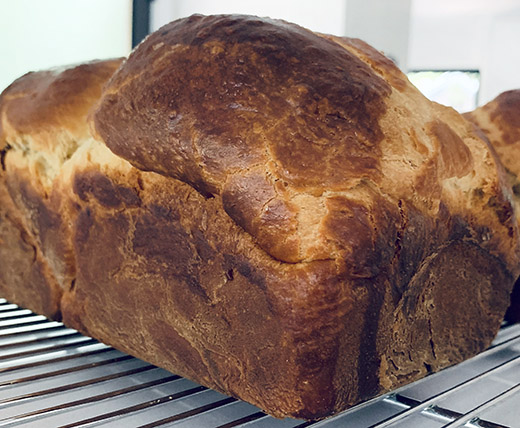
It wasn’t particularly helpful to be reminded by others that we didn’t always have mixers. There must have been a time when this dough was made by hand. After everything was mixed, more or less, the dough was left to rise for 30 minutes before being turned and left for another 30 minutes. After the second rise, it was refrigerated overnight. I really believe the slow, cold rise overnight saved the dough. It was a smoother, lovelier dough the next day. To make the loaves, the dough was divided into four pieces, two dough balls were placed in each of two loaf pans, and they were left to rise again for about an hour and a half. After being brushed with an egg wash, the loaves were baked until deeply browned. 

Amazingly, the result was outstanding. Tender, buttery loaves were delicious sliced and served with blueberry jam. I also made very thick-cut French toast inspired by the book. I still have the second loaf in the freezer awaiting an occasion for a savory French toast with slow-roasted tomatoes. My old mixer and I have since parted ways after learning that a repair was unlikely, and a newer model has taken its place in the kitchen. I have lots of recipes to try with it!

I am a member of the Amazon Affiliate Program. 

Sunday, August 27, 2017

Tomato Leaf-Egg Pasta

For a thorough look at food history in the South from the mid-twentieth century on, I highly recommend The Potlikker Papers: A Food History of the Modern South by John T. Edge of which I received a review copy. All angles are covered from the atrocities of segregation and the civil rights movement as they related to restaurant dining to home cooking including how the food being prepared and access to it have changed over time. There’s a moving passage about Edna Lewis and how her family had “embraced agriculture.” “They found joy among the furrows and reveled in the pleasures of the table… In a rapidly urbanizing America, her knowledge of native plants and heritage breed animals, learned on the family farm, set her apart.” Alice Waters regarded Lewis as “an advocate of organic foods and seasonal diets.” Lewis, in fact, spoke of the same principles on which the Slow Food movement would later be founded. The book offers insights into the careers of several famous Southern chefs, food writers, restaurant founders, and producers and also delves into issues of industrial farming and the need for progress for laborers. And, it clearly depicts how a changing population “proved essential in the making of the newest New South, in which expertise in tortilla making mattered as much as biscuit baking, and Indian chefs set the standard for fried okra.” Sadly, that doesn’t mean all problems have been solved, but it is exciting to see the food landscape shift and new dishes become iconic. Edge writes: “Food serves the region as a unifying symbol of the creolized culture we have forged, making explicit connections between the breads made from corn that Native Americans call pone and the breads made from corn that Mexican Americans call tortillas, bonding Louisiana Cajuns of French descent who boil crawfish in water spiked with Tabasco mash and Vietnamese Texans on the Gulf Coast who boil crawfish in pots that bob with lemongrass.” It’s fascinating to experience the varied ways food products of the South can be interpreted. Here in Austin, I look to our local farms for inspiration based on what’s growing from month to month. A few weeks ago as the height of tomato season was coming to an end, I wanted to make use of the less popular part of the plants. The Tomato Leaf-Egg Pasta from The Book of Greens was on my mind, and I had to give it a try.

Springdale Farm was kind enough to harvest a bag full of tomato leaves for me to purchase, and a local restaurant had been purchasing them as well. It’s great to know the plants were being put to such good use. To make the pasta dough, the tomato leaves were blanched, drained, and squeezed in a towel to remove moisture. Next, the leaves were placed in the blender with eggs and pureed. I prefer to make pasta by hand, so I transferred the tomato leaf and egg mixture to a big bowl with some flour. I used a mix of whole wheat and all-purpose flour. The flour and tomato leaf mixture were stirred together and kneaded on a floured surface until smooth. The dough was covered with plastic wrap and allowed to rest for about an hour before being divided and rolled through a pasta machine. I cut the strands into linguine and cooked them briefly in salted boiling water. For a quick sauce, I followed the suggestion in the book and melted butter in which fresh tomatoes were briefly warmed. Pasta was topped with the sauce, strands of basil, and some parmigiano reggiano. I loved the herby flavor in the rich egg pasta, and the speckled green color was pretty with the fresh tomatoes. I'll definitely make this again when I can get some leaves from tomato plants.

A lot of progress has been made in the South, and I hope it continues. Undeniably, there are still issues to be addressed and problems to be solved, and only time will tell what changes will come next. But, seeing the mix of cultures and its positive affect on what we eat is a positive sign. I’ll keep eating all the new and different dishes that appear and cooking with all the great ingredients grown in this little pocket of the South that I call home. 

I am a member of the Amazon Affiliate Program. 

Friday, June 30, 2017

Everything Biscuit Sandwich with Smoked Whitefish Schmear

Is breakfast the most likeable meal of the day? I think it might be. Or, maybe I’m just a really big fan of eggs and the myriad ways they can be prepared. So, the new book Egg Shop: The Cookbook, of which I received a review copywas sure to be a winner to me. It’s from the New York City restaurant that came about because of a love of egg sandwiches. And, there’s even more to like about this book and restaurant beyond the breakfast menu. There’s a real commitment to best-quality ingredients and a made-from-scratch approach. Of course, you can choose how many items you prefer to make yourself rather than buy, but all the recipes are here for the breads and rolls, cold-press coffee and chai concentrate, nut milk, homemade bacon, pickles, aioli, flavored oils, and more. The recipes range from indulgent to lean and nutritious. After a chapter that covers basic egg cooking and some classic ways to use those cooked eggs, there are sandwiches, bowls, California-inspired dishes, snacks and sweets, and drinks. Did I mention that everything in this book looks like something you’ll love eating? It does. I’ll be trying the Egg Salad Sandwich made with yogurt in the egg salad rather than mayonnaise. This sandwich is layered on multigrain bread with sliced tomato, baby greens, and an optional piece of boneless fried chicken. The Duck Confit Banh Mi topped with a sunny side up duck egg and the Cognac-Cured Gravlax sandwich on seeded rye are two others on my to-try list. On the lighter side, the Warrior One bowl is composed of sweet potato and broccoli salad, Masala lentils, sliced almonds, onion chutney, and a poached egg. And, from the California-inspired dishes, I’m always drawn to Huevos Rancheros. Here, it’s made with Black Bean Smash, a homemade Salsa Ranchera, crispy blue corn tortillas, and salsa-basted fried eggs. Every recipe has considered components lending great flavors and special touches that seem to guarantee deliciousness. I knew the smoked whitefish sandwich would be a savory thrill with all the parts that come together for it. 

First, the sandwich is built on an “everything” biscuit. The toppings from “everything” bagels are here applied to a buttermilk, drop biscuit. The biscuits are baked until a few minutes from being done, and then they’re pulled from the oven, given an egg wash, sprinkled with the toppings, and put back in the oven to finish. That delayed topping procedure prevents any burning of the onion flakes, sesame seeds, etc. The smoked whitefish spread was full of big flavors and several things that could be homemade or not. The whitefish was skinned, boned, and flaked. Rather than making a caramelized onion aioli from scratch, I caramelized some local leeks and added them to store-bought mayonnaise. Also, rather than making my own hot pickles, I used a locally-made, spicy, fermented pickle. For the caperberry mustard, I chopped some rinsed and drained capers and added them to Dijon mustard. The other ingredients in this spread were minced green onion, chopped celery and leaves, zest and juice of a lemon, and a pinch of cayenne pepper. To build the sandwich, biscuits were cut in half and spread with the whitefish mixture, sliced tomatoes were added, a fried egg went on top, and a sprinkling of dill completed it. 

I can assure you this sandwich did not disappoint. The everything biscuit will be the kind of biscuit I bake most often from now on. It made an excellent delivery system for the smoked whitefish schmear and all its tangy, bright flavors. Perfect, local, summer tomatoes and a fresh farm egg rounded the experience. Having breakfast for dinner will come in handy with so many more egg dishes I can’t wait to try. 

I am a member of the Amazon Affiliate Program. 

Thursday, November 10, 2016

Sunday Tomato Eggs

I’ve been fortunate enough to meet Marcus Samuelsson in person on two different occasions. I first met him at a cooking class at Central Market back in 2012, and the following year, he participated in a Brooklyn Brewery event benefiting Slow Food Austin that was held at Springdale Farm. Obviously, I’m a fan, and I couldn’t wait to have a look at his newest book, The Red Rooster Cookbook: The Story of Food and Hustle in Harlem, of which I received a review copy. Of course, the book is full of recipes for the great food that’s served at the restaurant, but it’s also full of stories about Harlem where the restaurant is located. The stories cover past and present and make evident Samuelsson’s respect and affection for this community. The recipes begin with cocktails and bar snacks. Right away, I started mixing up a Rum Rum Punch. It’s made with coconut water, pineapple juice, lime juice, white rum, and Goslings Black Seal rum, and it did not disappoint. I only wish I’d had some of the Cauliflower Frites with Green Mayonnaise or Fish Croquettes to go with it. The dishes in this book include American classics, a few from Ethiopian cuisine, some inspired by the cultures present in Harlem, and some more modern chef creations. So, you’ll find Fried Yardbird, Corn Bread, Beef Kitfo with Awase, Pescado Wrapped in Banana Leaves with Green Sauce, Curried Goat Stew, and Lacquered Halibut with Charred Eggplant and Spinach. Some are more complicated than others, but they all offer great flavor combinations and, in some cases, interesting hits of spice. I was ready to make the Peas and Rice that involves cooking the rice in coconut milk with tomatoes and then make the Red Rooster Hot Sauce to drizzle on top until I turned a few more pages and saw the Sunday Tomato Eggs dish. And, I did make it for Sunday brunch. 

Let me start by saying that this dish was to be made with Mexican pork chorizo, but I used soy chorizo instead. The first step was to cook the chorizo with onion, celery, and garlic. Next, canned tomatoes were added along with capers, chopped Kalamata olives, a minced chipotle in adobo, and some water. The mixture was left to simmer for a few minutes before freshly grated horseradish was added. Eggs were then cracked directly into the mixture and cooked until set. Meanwhile, some sourdough bread was toasted to serve on the side. Just before serving, basil was added on top.

This dish was a lot like shakshuka, but here there were spicy, bloody mary flavors along for the ride. For a brief moment, I wondered if it was all too much with the chorizo, celery, chipotle, and horseradish, but it definitely was not. The flavors meld nicely and make an exciting surround for the eggs. Here’s how I know the dish was fantastic: there was supposed to have been a piece of burrata with each serving. I love burrata. I bought the burrata just for this dish. Then, I completely forgot about it. I plated the dish, took photos, ate it happily, and only later realized I had forgotten the burrata. If it was good enough that I didn’t even realize it was missing the burrata, then it was very, very good. Read this book to learn about Harlem, the Red Rooster, and to cook some good food. 

I am a member of the Amazon Affiliate Program. 

Friday, April 8, 2016

Black Sesame Noodle Bowl

A book about noodle, rice, and dumpling dishes reconsidered from an entirely vegetarian perspective was something I knew I was going to like. After reading my review copy of Bowl: Vegetarian Recipes for Ramen, Pho, Bibimbap, Dumplings, and Other One-Dish Meals by Lukas Volger, I couldn’t wait to try several things. Dishes like ramen and pho have always presented a stumbling block for me both at restaurants and in cookbooks because although they often include lots of vegetables, the broth is usually red meat-based. Here, at last, is an entire book devoted to making meat-free versions. For the brothy dishes, there are recipes for vegetarian dashi, vegetarian pho broth, and vegetable stock. There’s also a recipe for vegetarian kimchi since it traditionally contains fish sauce or dried shrimp. In fact, there are recipes for every component of the dishes like pickles, flavored oils, chili-garlic sambal, and even homemade ramen noodles. The chapters are organized by type of starch. So, there are wheat noodle bowls, rice noodle and rice bowls, other grains bowls, and dumpling bowls. The Vegetarian Curry Laksa looks delightful with the spicy broth with coconut milk, the fresh green beans and cherry tomatoes, the shredded cabbage, and hard-boiled egg. There are bibimbap versions for every season, and they all include instructions for making a crispy base that mimics the results of the bottom layer of crusted rice when served in a traditional dolsot. The Grilled Vegetable Couscous Bowl with tofu, eggplant, corn, and tomato looks perfect for summer, and I’m looking forward to trying the Black Rice Burrito Bowl with black beans, chiles, lime juice, mango, and avocado. I didn’t mark pages in the dumplings chapter because I want to make them all. Chickpea Potstickers, Kabocha Dumplings, Rich Lentil Dumplings, and all the rest sound delicious. Right away, I set about making the Black Sesame Noodle Bowl because it incorporates radishes, and this is the height of their season. 

Black sesame seeds were toasted in a dry pan and then coarsely ground with a mortar and pestle. After transferring them to a mixing bowl, canola oil, soy sauce, rice vinegar, wasabi powder, and salt were whisked into the mixture. Eggs were hard-boiled, and tender greens like spinach leaves, radish leaves, and some pretty mache I found at Boggy Creek Farm were prepped. Soba noodles were cooked, rinsed, and drained. The drained noodles along with some minced shallots were added to the mixing bowl with the sesame mixture. To serve, greens were placed in bowls and topped with the noodles followed by sliced avocado, radishes cut into matchsticks, sliced green onion, shredded hard-boiled egg, and the top was drizzled with a little soy sauce rather than the kecap manis suggested. 

I loved the flavors of the dressed noodles which got even better as the noodles sat. The egg and avocado added richness, and the green onion and radishes made it fresh and spunky. This was quick and easy to prepare, and the leftovers were a treat for lunch the next day. There are so many great ideas in this book, I might need to buy more bowls since I’ll be using them even more often. 

Black Sesame Noodle Bowl
Recipe excerpted with permission from BOWL © 2016 by Lukas Volger. Reproduced by permission of Rux Martin Books/Houghton Mifflin Harcourt. All rights reserved.  

For this noodle bowl, I took inspiration from Heidi Swanson’s Black Sesame Otsu in Super Natural Every Day, in which a blanket of black sesame seeds is toasted until it smells heady, then pounded with a mortar and pestle and combined with some Asian pantry staples to make a thick, savory, and tangy dressing, here given a bit more punch with wasabi. Like other cold noodle dishes, this is a good dish for packing up, and in my experience has been wonderful on the beach. The shredded egg and wisps of radish incorporate into the noodles, the shallot brings crunch and zing, and the final drizzle of kecap manis—the Indonesian soy sauce— brings the whole bowl together in the most satisfying way. 

SERVES 4 

1/4 cup black sesame seeds 
2 tablespoons neutral-tasting oil 
5 teaspoons soy sauce 
1 tablespoon rice vinegar 
1 tablespoon brown sugar 
1/2 teaspoon wasabi powder 
1/4 teaspoon fine sea salt 
3 bundles (about 11.5 ounces) dried soba, udon, or somen noodles 
2 medium shallots, minced 1 avocado 
2 large boiled eggs, firm yolks 
 8 small-to-medium radishes 
4 cups tender greens, such as watercress, upland cress, baby arugula, or tatsoi 
2 scallions, white and green parts, thinly sliced 
Kecap manis (Indonesian soy sauce), for drizzling 

Place the sesame seeds in a dry skillet and set over medium-low heat. Toast, swirling the pan frequently, until fragrant—90 seconds to 2 minutes. Watch and smell carefully so that they don’t burn. Transfer to a mortar and coarsely grind, then transfer to a mixing bowl. Add the oil, soy sauce, vinegar, brown sugar, wasabi, and salt, and whisk until thoroughly combined. 

Bring a saucepan of salted water to a gentle boil. Add the noodles and cook until tender, usually 4 to 7 minutes or according to the package instructions. Drain, rinse thoroughly under cold running water, then drain again thoroughly. 

Add the noodles and shallots to the bowl with the sauce and toss well, until the noodles are thoroughly coated. At this stage, the noodles can be transferred to an airtight container and kept in the fridge for up to 2 days. Bring to room temperature before serving. 

Quarter the avocado around the pit. Remove and peel the segments, then slice into thin strips. Peel the eggs and grate them using the large holes of a box grater. Slice the radishes into thin rounds. Stack the rounds on top of each other and slice into thin matchsticks. 

Divide the greens among four bowls, then top with the dressed noodles. Fan the avocado over the noodles in each bowl, then add a pile of the shredded egg, radishes, and scallions to each serving. Drizzle a bit of kecap manis over the avocado and serve. 

 I am a member of the Amazon Affiliate Program. 

Thursday, November 6, 2014

Roasted Cauliflower Polonaise

It’s actually feeling like fall here this week. Cooler weather, drizzly rain, and earlier sunsets are making it clear that summer is gone. Just in time to help warm up the house with the oven, Ruhlman's How to Roast has appeared, and I received a review copy. This new book covers the basics of oven roasting everything from the Thanksgiving turkey to roasted fruit for dessert. He starts by explaining what roasting has come to mean. Originally, roasting involved a spit and fire, but these days, the process of roasting is really the same as that of baking. The different names are used depending on what is being cooked. With either name, it’s a “dry-heat cooking method.” And, it’s a pretty easy way to make things delicious when they take on a golden crispness in the oven. Starting with a classic roasted chicken, Ruhlman walks you through the simple steps of seasoning, bringing up to temperature, prepping, roasting, and carving. Beef, pork, lamb, fish, and shellfish are all covered including an actual spit-roasted leg of lamb, and then there are lovely, golden, roasted vegetables. I’ve roasted all sorts of vegetables over the years. Usually, I just toss the vegetables with some olive oil, maybe add some sliced garlic or smashed whole cloves of garlic, and pop them in the hot oven on a sheet pan. But, now that I’ve tasted the wonder of roasting cauliflower in a cast iron skillet with butter, I may never go back. The Roasted Cauliflower Polonaise recipe caught my eye because it was completely unfamiliar to me. I learned that Polonaise refers to any dish topped with buttered breadcrumbs and hard cooked eggs. Here, there’s also a splash of lemon and chopped fresh parsley. It’s one of two recipes that uses Basic Roasted Cauliflower in the book, and I highly recommend it. 

Now, I have to explain that I took option B in making this dish. Option A would have been to roast the whole head of cauliflower intact. Then, it would have been served in the cast iron skillet and portions would have been cut as wedges. It’s a lovely, old-school kind of preparation and presentation, but since I was just cooking for two, I went the simpler route. I cut the head of cauliflower into florets, and roasted them in the skillet with butter. Every ten minutes or so, I turned the cauliflower pieces and spooned melted, browned butter over the tops. The cauliflower pieces roasted for about 40 minutes total, and came out of the oven nicely golden. Meanwhile, I hard-cooked two eggs, chopped parsley, and toasted breadcrumbs in melted butter on top of the stove. To serve, I transferred cauliflower pieces to a platter, squeezed lemon juice over the top, added the toasted buttery breadcrumbs and chopped eggs, and garnished with parsley. 

For me, this was a vegetarian main course. The buttery goodness was undeniable, but the crispy breadcrumbs, bright lemon, and rich chopped egg combined delightfully. My next stop in the book will either be the Duck Fat-Roasted Potatoes or the Roasted Pineapple with Vanilla Ice Cream and Caramel Sauce. The oven is going to get plenty of use this fall. 

Roasted Cauliflower Polonaise 
Recipes reprinted with publisher’s permission from Ruhlman's How to Roast. Copyright ©2014 by Ruhlman Enterprises, Inc. Courtesy Little, Brown and Company. The book is available at Barnes and Noble and IndieBound.

Boiled cauliflower with hard-cooked eggs, bread crumbs, and parsley? When I first learned this old preparation, in a culinary basics class at the CIA, I thought it was too goofy for words. But when I asked my cooking partner, Adam Shepard, what he thought of it, he said, “I’d serve it at my restaurant. Though I’d figure out a way to make the egg and bread crumbs stick to the cauliflower.” That he took it seriously made me take it seriously. As my appreciation of classic dishes grew, so too did my affection for this dish. Prepare it with roasted cauliflower rather than boiled, and it becomes a great dish for any occasion. 

1 head cauliflower (whole or cut into florets), roasted 
1/4 cup/20 grams panko bread crumbs 
1 or 2 hard-cooked eggs, chopped 
3 tablespoons chopped fresh parsley 

• PLACE the hot roasted cauliflower on a serving platter. If there is no remaining butter in the skillet, add another tablespoon. Add the bread crumbs to the skillet and cook over medium-high heat till they’re toasted. 

• SQUEEZE the lemon over the cauliflower and then spoon the toasted bread crumbs over the cauliflower. Spoon the chopped egg over the cauliflower (don’t worry if it doesn’t stick). Sprinkle it with parsley and serve in wedges or slices, scooping up extra garnish as you do so. 

• If you’re using roasted florets, melt 1 tablespoon butter in a separate small skillet over medium-high heat and toast the bread crumbs. To serve, simply sprinkle the lemon juice, toasted bread crumbs, chopped egg, and parsley uniformly over the top of the florets and serve right from the skillet. 

Basic Roasted Cauliflower 
6 tablespoons/90 grams butter, at room temperature 
1 head cauliflower 
Kosher salt 

• PREHEAT the oven to 425˚F/220˚C (use convection if you have it). 

• Cut the stem and leaves off the cauliflower so that it will sit flat in a skillet; the more of the cauliflower that’s in contact with the skillet the better, as it gets very brown and tasty. 

• Set the cauliflower in an ovenproof skillet and smear the butter all over the surface. Give it a liberal sprinkling of salt. 

• Roast till tender (a long knife should slide easily down into the cauliflower all the way through to its stem), 1 hour to 1 hour 15 minutes. Several times while it’s roasting, baste it with the butter, which will have melted and started to brown. (If you’re roasting a cut-up cauliflower, simply put the florets and butter in the skillet and put it in the oven. After 5 or 10 minutes, stir and toss the cauliflower to coat the florets with the melted butter, and then continue roasting and basting till tender, 30 to 40 

• Serve immediately, in wedges or slices, or keep warm and reheat for a few minutes in a hot oven before serving. 

I am a member of the Amazon Affiliate Program.

Tuesday, June 10, 2014

Buckwheat Crepes with Gruyere, Sage, and Sunny-Side-Up Egg

I’ve never been to Buvette, but I’ve decided I want to live there or at least right upstairs. It’s a dreamy thought to imagine waking up to breakfast there every morning. And, I'm not picky. I would live at either the New York City or Paris location. After reading a review copy I received of the new book, Buvette: The Pleasure of Good Food, by Jody Williams, it’s clear that there’s more to this restaurant than just the lovely food. There’s a sense of hospitality that runs through the uncomplicated but perfectly prepared things chosen for the menu, the way they’re served on antique silver trays and pedestals, and the care in all those details. Just reading about the coffees and teas convinced me I would be quite comfortable here. From classic cappuccinos, lattes, and the Bicerin which is espresso with shaved bittersweet chocolate melted into it with barely whipped cream on top to the Russian samovar used to keep hot water at the ready for teas and tisanes, every aspect of the service has been considered to set the right mood. That mood seems to be unfussy but with a sense that things have been made special. For breakfast, I’d want the custardy Oeufs Brouilles served with smoked salmon and creme fraiche or the Asparagus Milanese with eggs and Parmigiano-Reggiano. The menu is equally influenced by French and Italian cuisine. For lunch, the Pan Bagnat with diced bell pepper, cucumber, and fennel would be my choice or maybe the Carciofi alla Romana. The list of Aperitifs and Cocktails is classic and edited including Lillet, a perfect Martini, Pimm’s Cup, and a Manhattan. And, there are snacks to go with the drinks like freshly made Rosemary Potato Chips, Marinated Olives with Orange Zest and Red Chili, and Tartinettes and Crostini with various toppings. For dinner, there’s Scallops with Brown Butter and Capers, simply perfect Poulet Roti, and a few options for Risotto. Dessert might be Tarte Tatin or Espresso Granita topped with whipped cream. Yes, I would be quite happy living here. 

Every page in the book has something I want to try, but first, I had to face my ongoing fear of crepes. There’s something about thin crepe batter and its refusal to spread itself into a nice circle in my pan that puts the fear in me every time. I’ve realized while making crepes that my stove isn’t perfectly level. The batter always runs more to the back of the pan. So, that’s one problem. And, I don’t seem to have the skill to swirl the pan in a way that makes pretty crepes. I still need more practice. Some actually from circles, and others look more like state shapes like Michigan or New York. I made the Buckwheat Crepe variation and left the batter to rest in the refrigerator overnight. Using the crepes I managed to make into proper circles, I filled them with grated Gruyere, sage leaves from my garden, and sunny-side-up eggs. Each crepe was folded around the fillings and placed on a baking sheet. The filled crepes were baked for about ten minutes until the edges were crisp and the cheese had melted. It was a rich and delicious dish for brunch. 

Some other suggestions for serving crepes were: to spread them with butter, sprinkle with sugar, squeeze on some lemon juice, and roll them and top with powdered sugar; or to julienne an apple and saute in butter with walnuts, cinnamon, and sugar and then add crepes cut into ribbons and cook until crisp. Until I get a chance to see about moving into Buvette, I’ll keep trying to create the experience at home. 

Crepes 
Excerpted from the book Buvette: The Pleasure of Good Food by Jody Williams. © 2014 by Jody Williams. Reprinted by permission of Grand Central Publishing. All rights reserved. 

[Makes a generous pint of batter; about a dozen 8-inch crêpes] 

Ingredients: 
3⁄4 cup unbleached all-purpose flour 
Pinch coarse salt 
2 large eggs 
4 tablespoons (1⁄2 stick) unsalted butter, melted and cooled, plus more for cooking the crepes 
1 1⁄4 cups whole milk 

Directions: In a large mixing bowl, whisk together the flour, salt, and eggs to make a paste. Whisk in the butter. Slowly whisk in the milk, being sure to take your time so that you avoid lumps. Cover the bowl with plastic wrap, or transfer the batter to an airtight container and refrigerate for at least 4 hours or up to 3 days before cooking. 

Once the batter has rested, heat up a slick of butter in a small skillet, preferably nonstick (if not, just use more butter!) over medium heat. Pour in just a little less than 1⁄4 cup of batter. Tilt the pan in a circular motion so that the batter finds itself in an even layer on the bottom of the pan. Cook the crepe until the bottom is just golden brown, about 1 1⁄2 minutes, loosen the edges with a spatula, and turn the crepe. Cook until it’s nicely browned on the opposite side, about 1 minute more. Transfer the crepe to a warm plate and fill it or garnish it however you’d like. Repeat the process until you’ve used up all of the batter. 

Buckwheat Crepes: 
Prepare the Crepes as directed, but substitute 1/4 cup buckwheat flour for 1/4 cup of the unbleached all-purpose flour. Fill each crepe with a slice of good ham (prosciutto cotto if you can find it), a small handful of grated Gruyere, or a slice of Brie or other soft cheese (Epoisses is really lovely here), and a sage leaf and fold the crepe into quarters. Transfer the filled crepes to a buttered baking dish and bake in a 400 degree F oven until crisp and golden brown, about 10 minutes. These can also happily get a sunny-side-up egg tucked inside as well. 

I am a member of the Amazon Affiliate Program.

Sunday, November 3, 2013

Brussels Sprout Hash

An egg is probably the world’s most versatile ingredient. And, thinking of all the things you can do with whole eggs, yolks, whites, quail eggs, and duck eggs, I think an egg might also be the world’s most delightful ingredient. Lara Ferroni’s latest book, Put an Egg on It, supports those claims and offers delicious uses of eggs of all sizes. I recently received a review copy. She writes that her fascination with topping all sorts of dishes with an egg started when she encountered New Mexico-style stacked enchiladas topped with a fried egg. But, you’ll find more than just fried eggs as the crowning touch in this book. First, there are cooking instructions for the basics including soft-, medium-, and hard-boiled; sunny-side up and over easy or hard; scrambling; poaching; pickling; and meringue. Of course, there are great suggestions for adding a sunny-side up to things like Salsa Roja Chilaquiles, Kimchi Fried Rice, and the Egg-Topped Deep-Dish Pizza. And, then there are things like Blasted Cauliflower with chopped hard-boiled eggs, Roasted Eggplant Puree with Harissa and grated hard-boiled egg, and Creamy Green Goddess Wedge salad with shredded hard-boiled eggs. All of the recipes are fun and very approachable whether for breakfast, brunch, lunch, dinner, dessert, or cocktails. Speaking of fun, the meringue “eggs” are faux fried eggs made with a dollop of orange curd, and the Maple Meringue filled Doughnut Holes have been calling my name since I first flipped through the book. Also right away, I was drawn to the breakfast bowls each topped with an egg because they look a lot like what I usually prepare for weekend brunches. A few pages later, I came upon the Brussels Sprout Hash. I don’t know why I’d never thought to make a hash of Brussels sprouts before. I’ve made hash with just about every other vegetable which left me feeling silly for overlooking Brussels sprouts. They’re so pretty when they’re thinly sliced, I couldn’t wait to get chopping.

This makes for a low-maintenance brunch dish since everything is cooked in one skillet. First, a sprig of rosemary was fried in olive oil. Our rosemary plants have been taking over our yard thanks to the recent rain, so I love getting to snip off sprigs every chance I get. The rosemary fries for just a minute and is then set aside to cool. Minced onion and garlic were added to the pan next and cooked until softened. The fried rosemary leaves were pulled from the stem, chopped, and added to the skillet. Next, shredded Brussels sprouts were added to the cooked onion and garlic and sauteed until tender and starting to take on some color on the edges. Then, it was time for the eggs. Little wells were scooped into the Brussels sprouts, and an egg was cracked into each. The skillet was covered, and the eggs were left to cook for a few minutes. 

Brussels Sprout Hash will now take a spot in my rotation of brunch options, but it would also make for a quick and easy dinner meal. With so many different ideas for incorporating eggs into dishes, I’ll be grabbing this book for inspiration for meals at any time of day. Or instead of planning a meal, a cocktail like the Lime Meringue Margarita might be the next recipe I have to try. 

Brussels Sprout Hash 
Recipe reprinted with publisher's permission from Put an Egg on It.

If brussels sprouts had been served this way when I was a kid, instead of being little balls of gray, bitter mush, I might not have missed out on twenty-something years of one of my favorite fall vegetables. How sad! 

Makes 4 servings 

2 tablespoons grapeseed or olive oil 
1 (5-inch) sprig fresh rosemary 
1⁄4 cup chopped onion 
2 cloves garlic, minced 
4 cups shredded brussels sprouts 
4 eggs 
Salt and freshly ground pepper 

Heat the oil in a medium, lidded cast-iron skillet over medium heat. When it’s shimmering, add the rosemary. Cook for about 1 minute, then remove the sprig, setting it aside on a plate to cool. Add the onion and garlic and reduce the heat to medium-low. Cook until the onion softens, about 5 minutes. Add the sprouts and increase the heat to medium-high. Chop up a bit of the fried rosemary leaves (discarding the woody stem) and add them to the pan. Stirring frequently, cook until the sprouts are golden on the edges, about 5 minutes. 

Use a large spoon to create 4 wells in the sprouts and carefully pour an egg into each. Reduce the heat to medium-low, cover, and cook for 2 to 3 minutes, until the eggs are set. 

To serve, using a large spoon, carefully scoop from under each egg, gathering a bit of the sprout hash as you go. Season with salt and pepper to taste. 

I am a member of the Amazon Affiliate Program.

Thursday, April 18, 2013

Roman-style Artichokes

I imagine when the day comes that I’m living on that quaint, scenic, stretch of land in rural Italy, this is the kind of thing I’ll have for lunch every day during artichoke season. And, there will be wine from nearby and olive oil from my neighbor of course. I do live a rich fantasy life. Until then, I can now get locally grown artichokes right here at home, and I’m very excited about that. The other day, I went on a bit about our local Austin food scene and incredibly fresh asparagus, and then we received artichokes for the first time ever from our CSA. I was beyond thrilled to find them in the box, and I just happened to have a good idea for how to use them sitting in my stack of recipes to try. In the March issue of Living, Roman-style braised artichokes were shown served with hard-boiled eggs with pine-nut sauce. I followed the recipe almost exactly for the artichokes and delighted in the aroma of garlic and wine from the oven as they cooked. For the eggs, I took a turn from the exact suggestion in the magazine since I had some arugula in my herb garden that I was planning to turn into pesto. I topped my eggs with the arugula pesto and a few extra toasted pine nuts for garnish. 

I used to live in fear of cleaning artichokes. It seemed like the most daunting task in the kitchen. I think I’m finally getting used to it somewhat. I’ve learned to work quickly, have lots of lemons at the ready, and focus on how delicious the finished dish will be. Having a bowl of acidulated water ready for the trimmed artichokes is key, and having a cut lemon to rub on each artichoke while you’re trimming it is helpful too. I pulled off the loose outer leaves, cut off the top, trimmed the stem and peeled it, cut them in half, and spooned out the choke before dunking them in the lemon water. A plate is useful to keep the cleaned artichokes submerged in the water. From that point on, this dish couldn’t be easier. The halved artichokes were placed cut side up in a Dutch oven and topped with white wine, olive oil, red pepper flakes, minced garlic, salt, and herbs. I used parsley, oregano, and basil from my garden and skipped the mint since I didn’t have any. The liquid was brought to a boil on top of the stove and then the dish was transferred, covered, to a 350 degree F oven to continue cooking for about 45 minutes. The eggs were simply hard-boiled, peeled, halved and arugula pesto was spooned on each with a few toasted pine nuts. 

The artichokes were completely tender and flavorful from the wine, olive oil, and garlic. With the eggs with pesto, some crunchy, toasted bread, and a glass of wine, it made an almost perfect, light meal. The only thing missing was a view of the rolling, Italian countryside. Some day. 


Sunday, December 23, 2012

Scuttlebutt Sandwich with Pickled Beets and Hard-Boiled Egg

The list of restaurants I’d like to visit in Brooklyn keeps growing, and I just added one more to it. Saltie is a sandwich shop that specializes in putting classic combinations of things that might not have been thought of as sandwiches before between pieces of bread. They rely on local and seasonal ingredients and make their breads, mayonnaise, vinaigrettes, pickles, yogurt, sweets, and soups from scratch. The new book from the shop is Saltie: A Cookbook, and I received a review copy. The recipes include the focaccia and naan they use for sandwiches as well as all the condiments, pickles, and other items they prepare. A few of the sandwiches that jumped out at me were the Curried Rabbit which is a play on Welsh rarebit with cheddar, curried mayonnaise, apple salad, and currant pickle; the Spanish Armada with potato tortilla and pimenton aioli; and the Henry Hudson with fried green tomatoes, bacon, mayonnaise, and fresh basil. Then, from the Soups section, there’s a Cauliflower, Leek, and Gruyere Soup and a Curried Squash and Red Lentil Soup I want to try. There are also salads with greens, grains, and bread in some cases. Every dish offers a fresh, savory mix of things you know will taste great together. For instance, I already had a thing for the combination of beets and hard-boiled eggs. So, the Scuttlebutt sandwich had to be my first stop in the book. It’s built on freshly-baked focaccia and layered with pimenton aioli, feta, and black olives. I couldn’t wait to taste it.

First, I followed the recipe from the book for focaccia with an easy, no-knead process. The dough was mixed, then transferred to an oiled bowl, and then refrigerated for anywhere from eight hours to two days. The dough was spread on a baking sheet and left to come to room temperature before being dimpled, sprinkled with salt, and baked. Up next, I made the pimenton aioli. As usual, I’m not capable of making a mayonnaise or aioli in a food processor or blender. I only seem to have luck with a hand mixer. I eventually got a good emulsion. A day in advance, I roasted and pickled some beets, and the pickled beets will last in the refrigerator for up to two months. For the hard-boiled eggs, the authors offer an interesting technique. They suggest poking a hole in the big end of each egg with a thumbtack. The tack should be twisted into the shell and pushed all the way in until the flat part of the tack touches the shell and then removed. Then, the eggs were placed in boiling water and left for ten minutes before being transferred to ice water. I was using very fresh, local eggs, and the shells did come off more easily than they usually do. So, I’ve been repeating this for all the eggs I’ve boiled since. To make the sandwich, the focaccia was cut into squares and sliced in half horizontally. On the cut sides, the pimenton aioli was spread on each piece. Then, sliced hard-boiled egg was added followed by a mix of black olives, capers, herbs, sliced green onion, and sliced radishes. I added the sliced pickled beets last with sliced feta.

This was one of those deliciously messy sandwiches in which everything wants to squish out the sides and you try to keep things intact since you don’t want to lose a single bit of it. You could give up and attack it with a fork and knife, but where’s the fun in that? Until I can plan a food tour of Brooklyn, I’ll keep sampling more things from this book.

Scuttlebutt
Hard-boiled egg, pimentón aioli, feta, black olive, capers, fresh herbs, pickled beets
Recipe re-printed with publisher's permission from Saltie: A Cookbook.

“I’m English, and the Scuttlebutt is really a sandwich my sister used to make for me of salad on white bread with salad cream. . . . It’s obviously tweaked a bit, but when we said, ‘Oh, we’re going to make sandwiches; what was your favorite sandwich?’ I’d say I had this really awesome sandwich of hard- boiled eggs and whatever was in the fridge—a Dagwood Bumstead. It was really delicious.” —RC

Makes 1 Sandwich

There is so much to say about the Scuttlebutt. It really has earned its gossipy title. It’s the sandwich that is most likely to change, as the ingredients rotate with the seasons and with what’s in the refrigerator. In summer, it has tomatoes and arugula; in winter, squash and a chiffonade of Tuscan kale. There is a rotating cast of pickles, the most popular being the beet. Some people order the Scuttlebutt as “the sandwich with the beets,” which never fails to disappoint when those particular pickles are off the menu. The staple ingredients remain pimentón aioli, hard-boiled egg, feta, capers, and olives. The rest is a free-for-all that for some can end in tears. The Scuttlebutt makes people emotional. It is an exercise in impermanence.

1 sandwich-size piece of Focaccia (see separate recipe)
2 tablespoons Pimentón Aioli
1 hard-boiled egg, peeled and sliced
1 tablespoon pitted oil-cured olives, chopped
1/2 tablespoon capers
1/4 cup Fresh Herb Mix
2 tablespoons chopped pickles, ideally Pickled Beets (see separate recipe)
1 radish, thinly sliced (optional but nice)
Extra-virgin olive oil
1 ounce sheep’s milk feta

Cut the focaccia in half horizontally and put on a plate, cutsides up. Spread both cut sides with aioli. Arrange the egg slices evenly on the bottom half of the bread. Set aside.

In a bowl, toss the olives, capers, herbs, pickles, and radish (if using) with just enough olive oil to coat lightly. Mound the salad on top of the egg. If you can, slice the feta and arrange on top of the salad. If you can’t get a nice even slice of feta, you can either crumble it on top of the salad (although it will tend to roll off the top of pile), or you can toss the feta with the salad. Quickly replace the top of the bread before the sandwich falls apart, pressing gently to help it hold together, and serve right away.

Focaccia

Focaccia is the bread that we use for most of the sandwiches at Saltie. The reasons for choosing this soft-but-chewy Italian yeast bread were equally pragmatic and delicious. We considered what we could reasonably produce and decided a bread that we could make on a baking sheet would be much more economical in terms of time and space than one that required more individual attention. As has been the case with many of our choices at Saltie, landing on focaccia at first may have seemed the solution to how to do something in the best and most efficient way, but it quickly became the fact-of-the-matter only possible choice that it is today. Now I can’t imagine life without focaccia. Its fluffy, oily welcome greets me daily.

Enough for 8-10 sandwiches

6 1/4 cups all-purpose flour
2 tablespoons kosher salt
1 teaspoon active dry yeast
3 1/2 cups warm water
1/4 cup extra-virgin olive oil, plus more for greasing and drizzling
Coarse sea salt

Preheat the oven to 450°F. In a large bowl, whisk together the flour, salt, and yeast. Add the warm water to the flour mixture and stir with a wooden spoon until all the flour is incorporated and a sticky dough forms (no kneading required). Pour the 1/4 cup olive oil into a 6-quart plastic food container with a tight-fitting lid (see Note). Transfer the focaccia dough to the plastic container, turn to coat, and cover tightly. Place in the refrigerator to rise for at least 8 hours or for up to 2 days.

When you’re ready to bake, oil an 18-by-13-inch baking sheet. Remove the focaccia dough from the refrigerator and transfer to the prepared pan. Using your hands spread the dough out on the prepared pan much as possible, adding oil to the dough as needed to keep it from sticking. Place the dough in a warm place and let rise until about doubled in bulk. The rising time will vary considerably depending on the season. (In the summer, it may take only 20 minutes for the dough to warm up and rise; in the winter it can take an hour or more.)

When the dough is ready, it should be room temperature, spread out on the sheet, and fluffy feeling. Pat down the focaccia to an even thickness of about 1 inch on the baking sheet tray and begin to make indentations in the dough with your fingertips. Dimple the entire dough and then drizzle the whole thing again with olive oil. Sprinkle the entire surface of the focaccia evenly with sea salt.

Bake, rotating once front to back, until the top is uniformly golden brown, about 15 minutes. Transfer to a wire rack to cool, then slide out of the pan. Use the same day.

Note : This easy recipe calls for a large plastic food-storage container, about a 6-quart capacity, with a tight-fitting lid. Otherwise, you can use a large mixing bowl and cover the dough with plastic wrap. Unfortunately, focaccia suffers a rapid and significant deterioration in quality after the first day. It is also impossible to make bread crumbs with focaccia. Ideally, bake and eat focaccia on the same day. If there is some left over, wrap it tightly in plastic and store at room temperature for one day more. Day-old focaccia is delicious in soup.

Pickled Beets

These are the pickles that have caused our customers to ask for the Scuttlebutt not by name but as “the sandwich with the beets on it.” People love beets! Go figure. Here’s what they are talking about.

Makes 2 Quarts

2 bunches beets (about 10 beets, or 5 pounds total weight), scrubbed and trimmed
1/4 cup olive oil
1 tablespoon kosher salt
2 cups red wine vinegar
2 cups water
1 cup sugar
1/2 tablespoon kosher salt
1 tablespoon whole black peppercorns
1 tablespoon coriander seeds
1 tablespoon mustard seeds
2 whole star anise, broken up
8 whole allspice berries

Preheat the oven to 400°F. Put the beets in a roasting pan. Add just enough water to the pan to evenly cover the bottom. Salt the beets and drizzle with olive oil. Cover with aluminum foil and roast until tender when pierced with a knife, about an hour, depending on the size. Let cool until you can handle them, then peel the beets, slipping the skins off with your fingers or a kitchen towel and using a paring knife where they stick. Cut into slices 1/4 inch thick and put in a large, heatproof bowl. In a saucepan, combine the vinegar, water, sugar, salt, and spices and bring to a boil over medium-high heat, stirring to dissolve the sugar and salt. When the sugar and salt have dissolved, pour the pickle over the beets. Let the pickles cool at room temperature and then put them into a plastic or glass container, cover, and refrigerate. The pickled beets will be ready to eat the next day and will keep for up to 2 months.

Variation: Pickled Red Onions
Follow the main recipe, substituting 4 large red onions, thinly sliced, for the beets.

I am a member of the Amazon Affiliate Program.

Tuesday, November 27, 2012

Profiteroles with Cranberry Caramel Sauce and Maple Spiced Pecans

After holding tryouts for Thanksgiving dessert, I of course ended up going in a completely different direction than any of the contestants. Let me explain how this happened. Kurt claims to not have much of a sweet tooth, but there are three similar sweets that he really likes. Those are Boston cream pie, eclairs, and profiteroles. I’d made the first two at different times in the past, but I’d never made profiteroles even though we always order it when we see it on a restaurant dessert menu. I had various ideas about how to change up the classic components of a profiterole to make it a more seasonal, Thanksgiving kind of dessert, and Kurt voted down almost all of them. He insisted plain, vanilla ice cream and standard chocolate sauce was the only way to go. There would be no pumpkin or cinnamon ice cream or spiced pate a choux or nutmeg dusting on top or any such thing. But, there was a Cranberry Caramel Sauce that I absolutely had to try. It’s from the October/November issue of Garden and Gun, and it belongs with a Pumpkin Bread Pudding recipe from Austin’s own Jodi Elliott of Foreign and Domestic. So long as the ice cream remained nothing but vanilla and the pastry puffs weren’t messed up with any spices, Kurt was willing to try a sauce other than chocolate. Then, I went ahead and made the Maple Spiced Nuts from the bread pudding recipe as well. One last, little change from the classic preparation wouldn't hurt.

This dessert was made up of four parts, so I started by making the vanilla ice cream in advance to have one part completed and ready. I used the vanilla ice cream recipe from Eggs by Michel Roux which is nicely rich with six egg yolks and perfumed with seeds from a vanilla pod. Next, I made the puffs according to Ina Garten’s recipe in Barefoot in Paris. I like that she suggests pulsing the eggs into the pastry dough in a food processor rather than stirring and stirring by hand. That recipe is also available online. The great thing about choux pastry puffs is that you can refrigerate them or even freeze them, and then just re-warm them for a few minutes in the oven before serving. The tops will re-crisp and the airy insides will be as puffy as when they first came out of the oven. The third part of the dessert was the cranberry caramel sauce which was a simple matter of cooking sugar, water, and corn syrup until amber and then adding cranberries and pure cranberry juice. The berries and juice were stirred into the caramel and the mixture was brought back to a boil until the cranberries had all popped. Off the heat, salt and vanilla were added. After letting the sauce cool a bit, it was pureed in a blender, and then I strained it before letting it completely cool. Last but not least, the pecans were tossed with maple syrup, corn syrup, sugar, salt, and a mix of cumin, cinnamon, ginger, nutmeg, and cayenne. The nuts were baked until toasted through and allowed to cool before I chopped them.

The hint of spiciness and bit of salt in the nuts was perfect with the tart and sweet sauce. And, I think plain vanilla ice cream was the way to go here since it allowed the flavors in the toppings to shine. In the end, we were both completely happy with these changes to the traditional profiterole for Thanksgiving dessert, but I don’t think I’d get away with messing with the classic eclair.

I am a member of the Amazon Affiliate Program.

Tuesday, April 19, 2011

Vegetarian Scotch Eggs

I've been fascinated by the idea of Scotch eggs for a while now. Traditionally for Scotch eggs, hard-boiled or soft-boiled or even pickled eggs are encased in a sausage mixture, coated in breadcrumbs, and fried. Since I don't eat red meat, I'd never attempted to make them or even tasted one. Then, along came this lovely vegetarian version with an outer layer made with beets. They couldn't be more perfect. The beets give the outside a good contrasting color to the white and yellow of the egg inside. Just in time for Easter, I found these on Mess in the Kitchen the other day and headed straight to the kitchen. The beet mixture was actually first imagined as a veggie burger and then was used for coating Scotch eggs. I made just a couple of changes to the recipe so as to use what I had on hand, and I was beyond thrilled with the results. The mixture held together very well, and the outside fried to a crisp around the soft-boiled eggs. Not only do you get a tender soft-boiled egg surround by a crispy, tasty, fried coating, there's another bonus to making Scotch eggs. You know how fresh eggs can be difficult to peel after boiling? If there are any uneven surfaces on the eggs after they're peeled, you'll never see them once they're coated with the beet mixture. Everything about these eggs made me very happy.

I decided to go with soft-boiled rather than hard-boiled eggs thinking that the eggs would cook a little more in the hot oil causing the yolks to set, and that's exactly what happened. I used the smallest ones from the carton I had, but you can really use any size of eggs you'd like. I placed five eggs in a saucepan, covered them with water, added a pinch of salt, and brought the water to a boil. As soon as the water bubbled, I turned the heat to low, covered the pan, and let the eggs cook for eight minutes. I drained the eggs and peeled them while still warm, and they were fresh enough to still be difficult to peel but, delightfully, that didn't matter here. For the beet mixture, I peeled two medium beets and chopped them. The beets were placed in a food processor with a chopped leek, about three ounces of firm tofu that I squeezed a bit to remove some water, two chopped green onions, about three tablespoons of flaxseed meal, a quarter cup of toasted breadcrumbs, two peeled and chopped cloves of garlic, an egg, and salt and pepper. The mixture was processed until a paste developed. If the mixture is too dry, try adding a tablespoon or two of water, and if it's too wet add a little more breadcrumbs. The beet mixture was pressed around each egg, and I had extra which I formed into two veggie burgers for another day. Once the eggs were encased in the beet mixture, I rolled each one in some remaining breadcrumbs before frying. I fried them, two or three at a time, in about an inch of grape seed oil in a saucepan, turning from time to time, for about five minutes total.

Did I mention how much I enjoyed these eggs? I already want to make them again for a party and use quail eggs for a daintier portion. They'd look great cut in half and lined up on a serving tray. Or, I could imagine going the other direction and using duck eggs. One Scotch duck egg cut in half with some smoked salmon on top of each piece would make a lovely brunch meal. Obviously, I'll be making this recipe repeatedly.


Blogging tips