Showing posts with label cranberry. Show all posts

Tuesday, December 2, 2014

Cranberry Pie with Pecan Crumble

I always have a hard time choosing what to make for Thanksgiving dessert. It was especially difficult this year since I’d just read a couple of new baking books and had even more delicious ideas than usual. There were two different sweet potato pies that were very strong contenders, and I’m already planning to choose one of them for the top of next year’s list of dessert considerations. After some serious reflection and dessert-focused meditation, I decided to go in a fruity direction with the Cranberry Pie from Nick Malgieri's Pastry. This was one of the recipes in the book that got my attention when I first flipped through the pages. The cranberries make a pretty filling, and the added pecans give it great texture. There’s an option for adding a nut crumb topping, and I couldn’t resist. Regarding crumb toppings, I’m one of those people who tend to double the quantities to make a very generous topping. I can report that technique is not necessary here. The amount of crumb topping suggested covered the pie completely and was almost too much. (almost) And, interestingly, Malgieri suggests baking the crumb topping separately on a baking sheet for a bit before adding it to the pie. It gets delightfully crispy and crunchy, and I’ll remember to do that with other crumb topping from now on. 

The pie was baked in a nine-inch pie pan, and a sweet crust dough was made in advance and fit into the pan. I left the prepared but unbaked pie crust in the freezer until the filling was ready. For the filling, one and a half pounds of cranberries were combined with a third of a cup of sugar, two thirds of a cup of brown sugar, a tablespoon of freshly grated ginger, the zest of an orange, a half of a cup of orange juice, four tablespoons of butter, a half teaspoon of cinnamon, and a quarter teaspoon of ground ginger. This mixture was brought to a simmer in a large saucepan and stirred often. There’s a warning in the recipe that if the filling is overcooked, it will be hard once baked in the pie. The mixture only cooked for five minutes, maybe even less than five minutes, just until thickened. It was left to cool, and then a half a cup of chopped pecans was added. For the crumb topping, one cup of flour was added to three tablespoons of sugar, a quarter teaspoon of freshly grated nutmeg, one half cup of chopped pecans, and six tablespoons of melted butter. The mixture was stirred together evenly and left to sit for five minutes for the flour to completely absorb the butter. It was broken into crumbles and scattered on a parchment-lined baking sheet. It was baked at 350 degrees F for about 15 minutes. Next, the prepared pie crust was filled with the cranberry mixture, the pre-baked crumb topping was strewn about on top of the pie filling, and the pie baked at 350 for about 40 minutes. 

Even with the nutty crumb topping, this pie isn’t overly sweet. The tart cranberries give it great, fruity flavor and temper the sweetness. I served the pie with maple-sweetened whipped cream to fit the Thanksgiving theme. I don’t think any of the desserts I considered would have been bad choices, but I’m thrilled to have gotten to taste this cranberry pie. And, now that the Christmas season is upon us, I need to start making another holiday dessert decision. 

I am a member of the Amazon Affiliate Program.

Tuesday, November 27, 2012

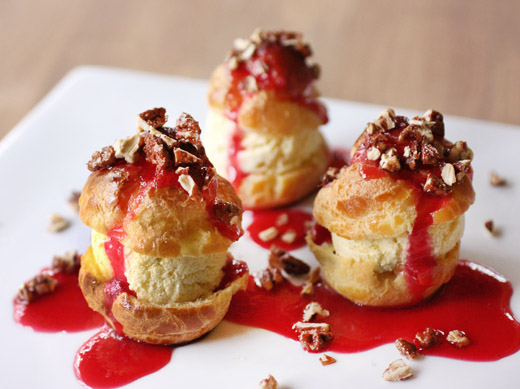
Profiteroles with Cranberry Caramel Sauce and Maple Spiced Pecans

After holding tryouts for Thanksgiving dessert, I of course ended up going in a completely different direction than any of the contestants. Let me explain how this happened. Kurt claims to not have much of a sweet tooth, but there are three similar sweets that he really likes. Those are Boston cream pie, eclairs, and profiteroles. I’d made the first two at different times in the past, but I’d never made profiteroles even though we always order it when we see it on a restaurant dessert menu. I had various ideas about how to change up the classic components of a profiterole to make it a more seasonal, Thanksgiving kind of dessert, and Kurt voted down almost all of them. He insisted plain, vanilla ice cream and standard chocolate sauce was the only way to go. There would be no pumpkin or cinnamon ice cream or spiced pate a choux or nutmeg dusting on top or any such thing. But, there was a Cranberry Caramel Sauce that I absolutely had to try. It’s from the October/November issue of Garden and Gun, and it belongs with a Pumpkin Bread Pudding recipe from Austin’s own Jodi Elliott of Foreign and Domestic. So long as the ice cream remained nothing but vanilla and the pastry puffs weren’t messed up with any spices, Kurt was willing to try a sauce other than chocolate. Then, I went ahead and made the Maple Spiced Nuts from the bread pudding recipe as well. One last, little change from the classic preparation wouldn't hurt.

This dessert was made up of four parts, so I started by making the vanilla ice cream in advance to have one part completed and ready. I used the vanilla ice cream recipe from Eggs by Michel Roux which is nicely rich with six egg yolks and perfumed with seeds from a vanilla pod. Next, I made the puffs according to Ina Garten’s recipe in Barefoot in Paris. I like that she suggests pulsing the eggs into the pastry dough in a food processor rather than stirring and stirring by hand. That recipe is also available online. The great thing about choux pastry puffs is that you can refrigerate them or even freeze them, and then just re-warm them for a few minutes in the oven before serving. The tops will re-crisp and the airy insides will be as puffy as when they first came out of the oven. The third part of the dessert was the cranberry caramel sauce which was a simple matter of cooking sugar, water, and corn syrup until amber and then adding cranberries and pure cranberry juice. The berries and juice were stirred into the caramel and the mixture was brought back to a boil until the cranberries had all popped. Off the heat, salt and vanilla were added. After letting the sauce cool a bit, it was pureed in a blender, and then I strained it before letting it completely cool. Last but not least, the pecans were tossed with maple syrup, corn syrup, sugar, salt, and a mix of cumin, cinnamon, ginger, nutmeg, and cayenne. The nuts were baked until toasted through and allowed to cool before I chopped them.

The hint of spiciness and bit of salt in the nuts was perfect with the tart and sweet sauce. And, I think plain vanilla ice cream was the way to go here since it allowed the flavors in the toppings to shine. In the end, we were both completely happy with these changes to the traditional profiterole for Thanksgiving dessert, but I don’t think I’d get away with messing with the classic eclair.

I am a member of the Amazon Affiliate Program.

Thursday, November 15, 2012

Cranberry Orange Cornmeal Cake

I’m enjoying this concept of tryouts for Thanksgiving dessert. Why didn’t I think of this years ago? It’s a perfect excuse to sample several desserts, test the recipes, and eventually make a decision for our menu. Today’s contestant hails from the LA Times. I believe I stumbled upon it two years ago when it was part of a slideshow of Thanksgiving dishes, but it was originally published in the paper in 2008. I hope you’re not thinking this is a light and healthy dessert with the fruit and cornmeal in its title. I wouldn’t want you imagining this isn’t rich and decadent enough for the biggest food holiday of the year. No, this is a buttery cake with plenty of eggs and ricotta to make the crumb very tender. There are also maple syrup and vanilla along with the orange zest and fresh cranberries. It has all the flavors we love at this time of year, and it’s easy to make.

The recipe recommends using a nine-inch cake pan that is three inches tall. My cake pans are two inches tall. So, I used a nine-inch springform pan which is taller. You’ll want to butter and flour it well, and place a round of parchment in the bottom of the pan. My cake stuck on one side of the springform pan just a little. Next time, I’ll add a ring of parchment around the inside of the pan as well. The dry ingredients were whisked together, and those included flour, cornmeal, baking powder, baking soda, and salt. In a separate bowl, eggs, maple syrup, vegetable oil, and vanilla were combined. In the bowl of a stand mixer, butter, sugar, and orange zest were creamed. The egg mixture was added to the butter and combined. Then, the dry ingredients were mixed into the batter in two parts. Ricotta was added with the second addition along with some fresh cranberries. The batter was poured into the prepared springform pan, more fresh cranberries were scattered on top, and they were topped with a little sugar. The cake baked for an hour and fifteen minutes. To serve, you can choose whether you’d like the cranberry surface to be the top or bottom. I flipped it so the top was completely flat.

The cake was shown served with a scoop of vanilla ice cream. Since this was just a tryout, I served it plain with only a dusting of confectioners’ sugar. A dollop of maple whipped cream on each slice would be another nice way to embellish it for dessert. Or, I think this would make an excellent coffee cake for breakfast or brunch. Pies usually get more attention at Thanksgiving time, but we should make some room for cakes on the dessert table too.


Friday, December 9, 2011

Apple Cranberry Crumb Tart

I have to tell you about one more Thanksgiving dish, and then I promise to move on. As usual, I was indecisive about what dessert should be, and I considered everything from a chocolate and caramel tart to various pumpkin creations. In the end, fall fruits won. Actually, that’s not entirely true. I saw a crumb tart that was originally made with summer fruits, and the crumb topping and crisp-edged crust are what won me over. Crammed away in my files, the page with this tart had been cut from the June 1999 issue of Living magazine, and the recipe is online. I decided to switch out the raspberries and plums from the original version and use granny smith apples and cranberries instead. The important thing here, though, is really the crust. It was made with ground hazelnuts and cinnamon, and it was pressed into a spring-form pan and up the sides. I was sure that as soon as the tart finished baking, cooled, and the ring was loosened, the tall sides of the crust would crumble and fall into pieces. I was thrilled to be wrong. The lacy, crisp edges of crust held their shape perfectly even after the tart was cut for serving. There is one other interesting detail about this tart, and that’s the custard in the filling. After adding cranberries and apple pieces to the blind-baked crust, some custard was poured over the top to settle its way in and around all the fruit. With crust edges that didn’t crumble, a custard and fruit filling, and the golden crumb topping, this dessert scored well in all categories.

First up was toasting the hazelnuts and rubbing them in a towel to remove the skins. Then, they went into a food processor and were pulsed until medium fine. The ground nuts were transferred to a stand mixer bowl, and flour, sugar, light brown sugar, cinnamon, and salt were added. Cold pieces of butter were added next, and it was mixed until crumbs started sticking together. Three cups of the crumb mixture was pressed into a spring-form pan, and the rest was set aside. The crust was then baked for about 20 minutes. Meanwhile, the apples were sliced, and the cranberries were washed. The custard was made with flour, sugar, an egg and an egg yolk, heavy cream, cinnamon, salt, and nutmeg. The fruit was placed in the baked and cooled crust, and the custard was poured over it. The remaining crumb mixture was sprinkled on top, and the tart baked for 50 minutes. I wasn’t completely happy with the color of the crumb topping after that amount of time, so I turned on the broiler for a few minutes to brown the crumbs a bit more. For serving, I topped each piece with whipped creme fraiche.

The custard in the filling is just enough to hold the fruit together well. The flavor and texture are really all about the fruit. But, it was the nutty, golden crust and crumb topping that stole the show in my opinion. The crust edges held their shape so nicely, and the buttery, golden crumbs on top were just right with the sweet-tart filling.


Monday, November 21, 2011

Boston Bog Cocktail

I tend to be a fiddler when it comes to cocktails, but it’s not that I pick up a stringed instrument after I’ve had a drink or two. What I mean is that I mix and taste and add a little more of this and then a little more of that and mix again and so on. That wasn’t the case this time though. I followed the instructions and actually really liked this just as it was with no fiddling necessary. This Boston Bog cocktail recipe came from the new book The American Cocktail from the editors of Imbibe magazine, and I received a review copy. It’s a great, little book that presents drinks from each region of the US. The West chapter includes Texas, and I was proud to see Austin’s own David Alan, the Tipsy Texan, mentioned along with his Loquacious cocktail made with loquats, Tito’s vodka, and Paula’s Texas Lemon. Many of the recipes include some specific, regionally-made products, but substitutions can always be made. For instance, one of the pages I bookmarked included the Big Bay Storm from the South chapter. It’s made with Gosling’s rum, Campari, and Cheerwine soda which is made in North Carolina. Here, another cherry cola could be used instead. I also want to try the O’Yahderhay which is a cocktail from Wisconsin made with brandy, vermouth, and a homemade syrup with the flavors from a kringle pastry popular in Racine. There’s also a Verde Maria, like a Bloody Mary, made with tequila and tomatillos, and a Stumptown Vanilla Flip with vanilla liqueur, espresso, and orange liqueur. There are a lot of fresh flavors in the cocktails in this book, and I’ve marked so many pages, I’ll be mixing my way through most of it.

With Thanksgiving on its way, I wanted to test a seasonally appropriate cocktail to be sure it would be a hit on Thursday. The Boston Bog is made with fresh cranberries and rum, and it sounded like the perfect option. For two cocktails, about 12 cranberries were muddled in a cocktail shaker. Then, three ounces of Appleton Estate Jamaican rum and an ounce of Rothman and Winter apricot liqueur were added. I made the ginger syrup in advance, and that involved dissolving Demerara sugar in simmering water and then adding chopped ginger. The mixture was pureed in a blender and then strained and chilled. One ounce of the ginger syrup was added to the shaker along with an ounce of lemon juice and some ice. It was shaken until well chilled and then double-strained into glasses. Each glass was garnished with a twist of orange peel.

The cranberries, apricot liqueur, ginger syrup, and lemon made a lovely combination, and I’m always a fan of rum. This was a serious kind of cocktail that should be offered in small portions, but the tart fruit flavors and sweet apricot and ginger syrup were well-balanced with the alcohol. So on Thursday, at some point after the parade and before carving the turkey, we’ll definitely being mixing more of these without changing a thing. Happy Thanksgiving!


Friday, January 28, 2011

Heart-Healthy Dried Fruit Scones

It’s the start of a new year and time to eat a little lighter, but we do like our scones. I’m a little surprised that this is only the fifth time I’ve posted about scones because Kurt and I both enjoy them in all flavors, shapes, and sizes. They can be decadent though. So, I was happy to try this slimmed down recipe from Flour since I’m becoming convinced this book can do no wrong. Joanne Chang set out to make less indulgent scones that didn’t rely on extra sugar for flavor. Instead, these are packed with dried fruit and frozen cranberries, and the not-too-sweet dough is made with a little canola oil instead of a lot of butter. They’re also topped with a vanilla glaze which gives them instant visual appeal. I even went one step further and used some whole wheat flour in place of some of the all-purpose. The result was a scone that’s good enough to look forward to each morning without a trace of guilt.

These scones were also very easy to make. There was no butter to cut into the flour, and the dough wasn’t even rolled out or cut to form the scones. To start, I mixed whole wheat flour with all-purpose flour, sugar, baking powder, baking soda, salt, and cinnamon in a big bowl. Then the fruit was added, and that included dark raisins, golden raisins, chopped dried apricots, I used chopped dried pineapple instead of dried apples, dried cranberries, chopped candied ginger, and I used frozen cranberries since fresh ones are no longer available. In a small bowl, eggs, yogurt, and buttermilk were whisked together, and then that was stirred into the flour mixture. The dough was scooped one-half cup at a time onto a baking sheet, and the scones were ready to bake. There was a note in the recipe stating that once the scones are scooped onto a baking sheet, they can be frozen and then baked directly from the freezer. So, I made them in advance and baked them from the freezer so we could have freshly baked scones for breakfast. They just require about five extra minutes in the oven if frozen. After baking and cooling, a confectioners’ sugar and vanilla glaze was spooned over each one.

The mix of fruit was delightful with the cranberries’ tartness and the ginger’s zing. The crumb of the scone was lighter, less dense, and a little like a cross between a scone and a muffin. Obviously, they’re not as rich as an ordinary scone, but when we’re feeling like being less decadent, I now have a trusted alternative to enjoy.


Saturday, December 11, 2010

Cranberry-Maple Pecan Breakfast Cake

I had high hopes for this breakfast cake. With tart cranberries, sweet maple syrup, and lots of pecans, I imagined this was going to be a keeper. This is from the new book Flour by Joanne Chang, the pastry chef and owner of the two Flour Bakery and Cafes in Boston, and I received a copy to review. This was one of those books that had me turning pages and walking toward the kitchen at the same time. It's full of irresistible looking treats and informative tips in each recipe. Chang's background includes an education in applied mathematics and economics, but her love of pastries inspired an eventual career change. She worked in other restaurant kitchens, including a stint in New York with Francois Payard, and then opened her own bakery in Boston. Her philosophy is one of "simple things are best" because even complex pastries start with the basics. Hence, the name Flour for her bakery. Those simple things throughout the book range from breakfast treats to cookies, cakes, pies, and tarts, and then there are other sweets and breads. I have a feeling I'll be mentioning this book frequently around here. I've already baked two items from it, and both were very well-received.

For this breakfast cake or pound cake or whatever you'd like to call it, maple pecans were made by warming pure maple syrup and toasted and chopped pecans in a saucepan. The goal was to stir the mixture and allow the pecans to absorb the syrup. Then, the pecans were cooled while the batter was mixed. Flour, sugar, baking powder, baking soda, salt, and butter were mixed, and the instructions include the amount of time for mixing with a stand mixer and a hand-held mixer depending on what equipment you are using. I like a thorough recipe like that. Then, in a small bowl, buttermilk, eggs, vanilla, and more maple syrup were whisked together before being added to the flour mixture. The liquid ingredients were added in two parts, and again mixing times were given. Last, fresh cranberries and the maple pecans were folded into the batter, and the batter was scraped into a parchment-lined loaf pan. It baked for just over an hour and filled the house with maple goodness all the while. Once it cooled, the cake was removed from the pan and topped with a thick maple syrup and confectioners' sugar glaze.

In the notes for this recipe, Chang writes that "the cake tastes remarkably like pancakes," and it really does. The maple flavor permeates the cake, and the pecans and cranberries accompany it well. I was so thrilled with the cake when I first tasted it, I declared it Christmas breakfast-worthy. And, if you have any left for the day after Christmas, it just gets better.


Thursday, November 18, 2010

Mini Cranberry Meringue Pies

I thought this recipe was from last year. The image of these cute, little, mini pies had been on my mind since last winter when I vowed to attempt them when fresh, fall cranberries came around again next time. Actually, this first appeared in Living magazine in November 2006, but it did appear again in a special holidays publication last year. I had the 06 article tucked away in my files, and I pulled it out last week to finally try this. The pasty is a citrus version of a pate sucree I've made before with the addition of lemon and blood orange zest. It occurred to me that I should make a big batch of these mini pastry shells and keep them in the freezer to use as needed. They would come in especially handy when I have some leftover pumpkin puree like I probably will later this afternoon. In this case, those handy pastry cups were filled with thickened cranberry sauce that was made in two stages. First, cranberries were cooked, and the juice was strained from the berries. Second, that juice was combined with whole cranberries to make a sweet, tart, filling with pops of flavor. Fluffy, toasted meringue topped it off.

The pate sucree was cut into four-inch circles which were crimped and fitted into twelve standard muffin cups. Each cup was lined with a small square of parchment paper, filled with weights and baked for fifteen minutes. The weights and parchment were removed, and the cups were baked for another five minutes or so. Once cool, they were ready to be filled. For the filling, first, fresh cranberries were brought to a boil with sugar and water. They were simmered until the cranberries burst and then passed through a sieve to extract the juice. The recipe states the solids should be discarded, but I'm getting more and more militant about not wasting food, so I kept the cranberry solids and enjoyed them on plain yogurt for breakfast. Next, the cranberry juice was returned to a saucepan, and sugar, lemon and blood orange zest, salt, cinnamon, cloves, and more whole cranberries were added. This time, the cranberries were cooked over a lower heat to prevent them from bursting. They should just become soft. Cornstarch was whisked into a mixture of blood orange juice and water, and that was added to the cranberries and juice to thicken it. Once cooked and cooled a bit, the filling was divided among the pastry cups, and they were chilled until set for at least an hour. Last but not least, a meringue was whipped to glossy peaks, spooned onto each mini pie, and the tops were browned under the broiler in about a minute.

While trying to get these pies done in less time than I should have planned to spend on them, the extra step of straining cranberries and then adding more whole cranberries seemed a little fussy. In the end though, I see why it mattered. The thickened juice nicely suspended the softened, whole cranberries in a way that a standard cranberry sauce would not have done. That being said, for a quicker version, a thick, sweet cranberry sauce would work fine here. Also, I'm always up for a meringue topping, but Kurt suggested that whipped cream would have been just as good. Either way, these festive, seasonal treats have earned a trip from my temporary, to-try file to my permanent, keeper file.


Tuesday, February 2, 2010

Cranberry-Cornmeal Quick Bread

I guess I’ve finally gotten around to cooking from November magazines. This quick bread was in the November issue of Living, and the title alone made me want to bake it. Cranberry and cornmeal sounded like a great combination. Then, I read on into the recipe. I admit to having several food issues with ingredients that I usually avoid. One of those many issues is with crystallized ginger. I don’t even know why. I like ginger in both sweet and savory applications, and nibbling on crystallized ginger is perfectly fine. For some reason though, when baked goods include chopped crystallized ginger, I often omit it. Well, I decided to get over it and just go with the original intent of this recipe. At last, my mind might have been changed forever about this ingredient. The little bits of chewy, gingery goodness throughout the loaf were lovely in the cornmeal crumb.

A sauce was made from cranberries, melted butter, and sugar. That mixture was cooked until the cranberries started to pop, and at that point, the sauce had thickened. Fresh cranberries were suggested, but I used frozen, and they worked perfectly fine. I also added a few extra cranberries just because I love their tart flavor. The cranberries and sauce were transferred to a loaf pan and left to cool. The batter was made from butter, sugar, eggs, and a whisked together mixture of flour, cornmeal, baking powder, baking soda, and salt. Then, the chopped crystallized ginger was folded into the batter. Something that worked well for me was to toss the chopped crystallized ginger with a small amount of flour. That way, the pieces didn’t stick all together in one clump in the middle of the batter. The thick batter with well-distributed chopped crystallized ginger was spooned over the cranberries and carefully smoothed. The loaf baked for about 35 minutes.

My only complaint is that my quick bread didn’t rise to the nice, tall height seen in the magazine photo. I’m not sure why it didn’t since I used the same size pan and same quantities of ingredients in the batter. My baking powder is brand new too. Other than that minor quibble, I was very pleased with this. The cooled loaf was turned out to allow the cranberries to sit on top like jewels. It was sweet and tart and the cornmeal and crystallized ginger flavors worked together very well. And, just like that, I might be over my crystallized ginger thing.


Wednesday, November 11, 2009

Apple Cranberry Crumble

The fall meal from the ‘What’s for Dinner’ recipe cards concluded with apple cranberry crumble for dessert. While making the crumble, I realized this might be the most forgiving dessert there is. You place fruit in a baking dish and top it with a crumbly, buttery mixture. You can use a combination of fruits as was done here or you can use all of one kind. You can use a little more or a little less, and you can peel or not peel, slice or chop, mix and match as you wish. Then, the topping quantity is really just a suggestion. If you like a lot of crumble topping, you can increase the total amount and mound it over the fruit. If you prefer the dessert to be more fruit-focused, cut back on the crumble quantity for little bits of buttery crunch. It’s really all up to you, and I like that about a crumble.

For this one, I used three gala apples, I left the peels on, and I sliced them. One half cup of fresh cranberries was suggested, but I used a little more than that. The fruit was tossed with sugar, cinnamon, and a pinch of salt and was placed in a buttered baking dish. The crumble topping was made with butter, flour, oats, chopped pecans, and light-brown sugar. I went with the suggest quantities but added just a few extra pecans. The topping was sprinkled over the fruit, and the dish baked until golden for about 30 minutes. Not only is this dessert forgiving, baking this is one of the easiest ways to make your house smell amazing.

I like that the apple slices have a little more texture when the peel is left intact. And, I really like the tartness of the cranberries studded throughout the dessert. Of course, the crumble topping is what makes it what it is, and the mix of oats and chopped pecans with the cinnamon-spiced fruit is always a natural fit. Next time I might use a colorful combination of red apples and granny smiths, and I might increase the amount of cranberries even more. It’s so easy and foolproof, it makes a perfect, quick dessert for a fall meal.


Sunday, December 28, 2008

Cranberry Vanilla Coffeecake

A warm oven, vanilla scented sugar, and bright juicy cranberries joined the start of our Christmas morning. This cranberry vanilla coffeecake appeared in the December issue of Gourmet. While the flavors were perfect, I couldn’t resist making a couple of changes to the preparation. I really like cranberries, so I chose to leave them whole instead of chopping them in a food processor. Since I passed on the use of a food processor for that step, I didn’t pulse the vanilla with the sugar either. I just stirred the seeds into the sugar and broke apart clumps with my fingertips. I tossed some vanilla sugar with the whole cranberries, and I used a bit less sugar than recommended.

The next change to the recipe was accidental. Maybe I still had sugar plum fairies dancing in my head because I misread the ingredient list and used a whole vanilla bean rather than half. No worries, though, the extra seeds did no damage. One last adjustment was the use of a tube pan in place of a round cake pan. The coffeecake was more festive baked in the tube pan shape. Batter was layered in the bottom, followed by the cranberries, then more batter was added before the vanilla sugar crumb topping.

The vanilla, of course, smelled fantastic as the cake baked. The cranberries were tart and juicy and made a pretty filling. The crunchy, crumbly top with the tender center made this coffeecake a winner. I have a feeling the leftovers won’t last long enough.


Friday, November 14, 2008

Pistachio Cranberry Icebox Cookies

These festive looking cookies caught my eye on Epicurious the other day. I decided they should be auditioned for a part in my annual holiday baking extravaganza. There a few cookies and candies that I almost always make for the holidays, and then, I have to try a few new things as well. I may be outing myself as a cookie-baking geek by stating this, but I look forward to the 12 days of cookies from Foodnetwork every year. Icebox cookies are great because of their flexibility. The dough can be left in the refrigerator for a few days or even frozen for a few weeks before being baked. And, cutting them into shape is much easier than rolling out sugar cookies or gingerbread cookies.

For these, the dough was shaped into squared-sided blocks, brushed with an egg wash, and rolled in coarse sugar. To cut the cookies, I recommend using a sharp knife because you’ll want to get a clean cut through the pistachios. Several can fit on a baking sheet since they don’t spread, and that means fewer baking sheets to wash. All in all, this is a very convenient cookie to bake.

The red and green flecked cross sections and the sparkling, crispy edges make these little charmers as easy on the eyes as they are on the palate. They’re tasty and tender and full of flavor from the fruit and nuts. They auditioned well and may very possibly have earned a spot on my holiday cookie tray.


Blogging tips