Showing posts with label rum. Show all posts

Wednesday, November 29, 2017

Papaya Cocktails

Like every food show fan, I’ve seen Gail Simmons on tv for years. But, I somehow never knew her career history until reading her first cookbook Bringing It Home: Favorite Recipes from a Life of Adventurous Eating of which I received a review copy. I was fascinated to learn that she was once Jeffrey Steingarten’s assistant, and her description of the research and ingredient gathering she did in that capacity sounds like a lot of fun. She also worked on Daniel Boulud’s PR team and then on Food and Wine magazine’s marketing team before becoming a judge on Top Chef. Her new book is about what she cooks at home and how her work experience, travels, and family have influenced her cooking. The dishes include breakfast, salads, soups, noodles, seafood, meat, party food, drinks, and sweets. I’ve marked the page for Chocolate Ginger Scones, made with coconut milk and coconut oil, that she makes for her dad who is now vegan. Also, the Beet Cured Salmon is something I’d love to try for the pretty pink edges on each sliced piece. I should point out that this is a book of real food. It’s not trendy food or food specific to any particular way of eating. Instead, it’s from-scratch, home cooking with lots of different influences and some great tips. One of those is to grill limes before juicing them for a vinaigrette. It will give you charred flavor and the warmed lime is easier to juice. The Singapore-Style Hokkien Noodles, inspired by a street-food dish enjoyed while shooting in Singapore, is adaptable with suggestions for changing out the meat used. I remembered from reading Cherry Bombe: The Cookbook that the recipe from Gail Simmons in that book was a cocktail. So, I was curious to see the recipes both alcoholic and non- in the drinks chapters here. The Cardamom-Walnut Date Shake sounds delicious, but I pulled out the blender when I read about the papaya cocktail. 

The cocktail was inspired by Nilou Motamed, the former editor of Food and Wine magazine, and in the book it's called The Nilou. In the head note, there’s a story about how papaya is a love-it or hate-it kind of fruit. This drink changed Gail’s mind about it. For me, my first encounter with papaya wasn’t a great one. I wasn’t sure I’d picked a good papaya since I though the flavor was lacking. I ended up using it in a tea bread like banana bread only with papaya. Since then, I’ve discovered I like the fruit much better with a generous squeeze of lime. Here, chunks of papaya were blended with lime juice, rum, honey, and ice cubes. I was excited to use the avocado blossom honey I brought home from our summer trip to Santa Barbara. After pureeing in the blender, the mixture ended up thick, slushy, and a pretty coral color. 

Now, while it might seem fitting to serve tropical fruits for warm weather, summertime parties, I reach for them around the holidays. Maybe it’s because I love Mele Kalikimaka, but I think pineapples and papayas are perfect for Christmas. I’m already forming a plan for some tropical influence on our holiday menus, and these cocktails will be a welcome addition. 

I am a member of the Amazon Affiliate Program. 

Monday, April 3, 2017

Gratin de Fruits Exotiques

As often happens when reading cookbooks about food from faraway places, I’m suffering from a bit of travel envy. Imagine beginning a journey in France and then continuing to several beautiful places where French colonies were established just to follow the trail of culinary influences. How fun and delicious would that be? That’s how the new book Provence to Pondicherry: Recipes from France and Faraway by Tessa Kiros came to be. There’s a chapter devoted to each stop along the way. It begins with Provence and continues to Guadeloupe, Vietnam, Pondicherry, La Reunion, and then ends in Normandy. So, the recipes begin with French classics and then veer off into use of flavors from other climates prepared with French influences. The Court-Bouillon de Poisson from Guadeloupe is made with chiles, garlic, tomato, and beurre rouge with annatto seeds. From Vietnam, Banh Mi is of course made with baguettes, and the creme caramel includes lemongrass. Some hints at French influence in foods from Pondicherry include milder flavors with fewer chiles as in the Pondicherry Chicken curry. I lost track of time when I got to the La Reunion chapter due to the fruits, rum, coconut, and interesting uses of vanilla. There’s a braised duck dish made with split vanilla pods and a mashed potato dish that incorporates vanilla-steeped warm milk. I walked straight to the kitchen when I read about the Punch de Coco. Seeds from a vanilla pod were added to coconut milk, and it was chilled while the flavor infused before being served with rum. I highly recommend this combination. Also from this chapter, I had to try a very French-sounding dish of gratineed fruit made with very un-French fruits. 

In the book, lychees, guava, strawberry guavas, pineapple, and mango are suggested for the gratins. But, some of those were too exotic for me to find them. Instead, I used chopped pineapple, papaya, and mango. The process is very simple once all the fruit is chopped to a similar size. Ramekins were buttered and filled with a mix of the fruit. A tablespoon of cream and one of rum was added to each ramekin followed by some ginger, and I used freshly grated. Bits of butter were dotted on top before putting the ramekins under the broiler until browned. I should mention that sugar was supposed to have been sprinkled over the fruit, and it definitely would have brought about more browning. I chose to skip the sugar since the fruits were already very sweet. I garnished with toasted slices of fresh coconut and some mint leaves. 

The cream and butter made this rich and decadent while the fruits and ginger added a mix of fresh flavors. And, I’m always happy when there’s rum. This dish seemed to perfectly highlight the point of intermingling cultural influences. A very French technique of gratinee-ing with butter and cream was applied to ingredients specific to a different spot in the world to bring about something uniquely delicious. 

Gratin de Fruits Exotiques 
Recipe excerpted with permission from Provence to Pondicherry: Recipes from France and Faraway by Tessa Kiros, published by Quadrille March 2017, RRP $35.00 hardcover. 

The amounts here are very easy to adjust according to how much fruit you will be using and the type. Just use a good variety. Add more or less rum to suit your taste. 

Serves 2 

4 lychees, peeled, halved and stoned 
1 guava, sliced 
3 goyaviers (strawberry guavas) 
2 pineapple slices, halved 
4 good slices of mango 
2 tablespoons cream 
2 tablespoons rum, or to taste 
4 small blobs of butter 
3 tablespoons cane sugar 
scant 1/2 teaspoon ground ginger 

Lightly butter 2 shallow ramekin dishes, about 11cm (4 1/4 in) diameter and 3cm (1 1/4 in) deep. Divide the fruit between them. 

Splash the cream and rum over each, followed by 2 blobs of butter each. Mix the sugar and ginger together and scatter evenly over the tops. 

Preheat the grill (broiler) to hot. Grill until deep golden and charred here and there. Let it cool down just a little before serving. 

I am a member of the Amazon Affiliate Program. 

Saturday, December 21, 2013

Mulled Pineapple Cocktail

It’s holiday time, the weather is nice and cool, and the book Winter Cocktails is fitting nicely into this state of affairs. As I started looking at my review copy of the book, I marked pages of each cocktail I wanted to try. Then, I realized I was just marking every single page. The Rosy Cheek is a Winter White Hot Chocolate made with steeped macadamia nuts, crushed pink peppercorns, and lemon juice for brightness. The Cup of Thai is warm coconut milk flavored with lemongrass, ginger, and lime peel and spiked with rum. The Nutella Melt is hot chocolate with Nutella melted into it and added hazelnut liqueur with a garnish of espresso-flavored whipped cream and chopped hazelnuts. There’s also Classic Eggnog, Pumpkin-Bourbon Eggnog, and Butterscotch Eggnog. I want to curl up on the couch and sip these concoctions one after the next. And, these options are just from the chapters for Hot Toddies and Mulled Drinks and Eggnog, Hot Chocolate, Coffee and Tea. There are also Punches and Pitchers and Chilled Winter Cocktails as well as a chapter for infused liquors and syrups and one for snacks to go with the cocktails. I couldn’t decide where to start with the hot chocolate and eggnog options, so first I opted for Liquid Gold: Pineapple Juice, Spiced and Spirited. 

I’d never thought of making a warm, mulled cocktail with pineapple juice, but I loved the idea. Tropical fruits are always a good antidote to cold weather, and it was unusually cold here. To start, fresh pineapple was cubed and seasoned with sugar, Aleppo pepper, cinnamon, and salt. Then, it was broiled for a few minutes per side until slightly caramelized. The pineapple was set aside until cool and then skewered on picks. For the drink itself, allspice berries, peppercorns, whole cloves, and cinnamon sticks were warmed in a saucepan before pineapple juice, rum, brandy, and a scraped vanilla bean and seeds were added. It was left to simmer for about 15 minutes before being poured through a sieve for serving. 

The mulled juice smelled as lovely while it simmered as it tasted in the mug. Warm spices with sweet pineapple juice mixed well with brandy and rum. And, the spiciness of the caramelized pineapple chunks was a good contrast to the sweet flavors. I served some toasted macadamia nuts with the cocktails and imagined a view of sand and surf and tall, swaying palm trees. Mele Kalikimaka! 

Liquid Gold 
Recipe reprinted with publisher's permission from Winter Cocktails.
 
serves 4 

Though it calls to mind a tropical setting, the pineapple is in fact a winter fruit. It is also an iconic symbol of hospitality. Warm your home and your friends with this mulled pineapple drink that showcases both its sweet and tart flavors. 

Pineapple Garnish 
12 or more (1⁄4-inch) cubes fresh pineapple 
1 tablespoon granulated sugar 
1⁄4 teaspoon Aleppo pepper* 
1⁄4 teaspoon ground cinnamon 
1⁄8 teaspoon salt 

Mulled Pineapple Juice 
1 tablespoon whole allspice berries 
1 tablespoon black peppercorns 
1 tablespoon whole cloves 
2 cinnamon sticks 
4 cups pineapple juice 
6 ounces dark rum 
2 ounces brandy 
1 vanilla bean pod, split in half lengthwise, seeds scraped out 

*Piquant and vibrant, Aleppo is a type of crushed red pepper native to Syria. It is available at specialty markets. 

For the Pineapple Garnish: Adjust an oven rack to the middle position and preheat broiler. Line a baking sheet with foil and arrange pineapple cubes in a single layer. Combine sugar, Aleppo pepper, ground cinnamon, and salt in a small bowl. Sprinkle pineapple cubes with sugar mixture and toss to coat evenly. Rearrange pineapple in a single layer and broil until caramelized, 2 to 4 minutes. Transfer tray to cooling rack. When cool enough to handle, skewer at least 3 pineapple cubes onto each of 4 short skewers or sturdy toothpicks (see page 156 for Sources). 

For the Mulled Pineapple Juice: Place allspice, peppercorns, cloves, and cinnamon sticks in a medium saucepan. Stir over medium heat until fragrant, about 2 minutes. Add pineapple juice, rum, brandy, and vanilla bean and seeds and bring to a simmer over medium heat, stirring occasionally. Reduce heat to lowest setting and simmer for 15 minutes. Strain mixture through a fine-mesh sieve into a bowl and discard solids. To serve, place one pineapple skewer in each of 4 heat-proof cups. Ladle juice into cups. 

I am a member of the Amazon Affiliate Program.

Wednesday, July 24, 2013

Mini Chocolate-Rum Canneles

I have no aspirations of becoming a professional pastry chef, but I am fascinated with what the pros learn in their training. I received a review copy of The Elements of Dessert by Certified Master Baker Francisco Migoya and The Culinary Institute of America. This is a pastry textbook covering every technique needed for creating stunning treats. It’s also a beautiful book full of photos of show-stopping plated dessert courses. In The Basic Elements section of the book, methods are carefully explained for everything from blending ingredients, making custards, creating different types of meringue, and mixing doughs, to making your own chocolate from the point of selecting the beans. There’s even a chart showing ingredients, their flavor characteristics, and compatible flavors for them. Then, there are the recipes. Each one is a work of art. There are Pre-Desserts with things like a Goat Cheese Bavarian Cream with Beet Jelly and Date Pound Cake Crumbs which is a perfect, little cylinder of Bavarian cream that’s been wrapped in a sheet of beet jelly and placed on a plate with cake crumbs. The Plated Desserts are no less complex. There’s the Butternut Squash and Cinnamon Ice Cream with True Red Velvet Cake, Black Currant “Paper,” Indonesian Cinnamon Bubbles, and Silver Honey Sauce. That’s all one dessert with recipes for each of the components which are neatly stacked with a swirl of the sauce surrounding them on the plate. There are ideas for Dessert Buffets and Passed-Around Desserts as well as Cakes and Petits Fours. It’s so interesting to learn how these creations are built and to see the final presentation for every dessert. It’s also a bit intimidating, but there are several parts and pieces I’d love to try even if I don’t combine them into the completed masterpieces shown here. 

Something I’d wanted to attempt at home was canneles. I’ve wanted the molds for years but never bought them. When I saw the Chocolate-Rum Canneles recipe in the book, I had to try it. Since those pretty, copper molds cost about $25 each, and this recipe would make 20 little cakes, I opted for a silicon mold for my first experiment. I thought I should find out if I really enjoy baking and eating canneles before investing in the top-of-line bakeware. The mold I ordered online has even smaller cups than I expected. It made cute, little, mini canneles. Even though it is silicone, I had read that batter can stick in the cups. So, I brushed the cups well with melted butter and placed the mold in the refrigerator while making the batter. Sometimes, cannele molds are brushed with a beeswax and butter mixture to give the pastries a glossy outer surface, but beeswax wasn’t mentioned in this recipe. The recipe, included below, is, however, very precise. All ingredients are listed by weight both metric and imperial and by percentage. For instance, 3.53 ounces or 100 grams of eggs are needed. That amounted to two of the eggs I had on the day I baked these. And, the 40 grams of egg yolks was two yolks. Although it’s precise, the recipe is also very easy. It results in a very thin batter that bakes for a long time to produce canneles with crisp edges and a custardy center. 

The long baking time causes the edges of the canneles to caramelize, and that adds to the rich chocolaty, buttery flavors running through them. I know the copper molds would have given them each sharper lines and a nicer shape, but the silicon mold worked well enough. Next, I want to try the baguette ice cream or maybe the pate a choux puffs with espresso pastry cream and chocolate disks. And, I want to learn a few more secrets of the pros from these lovely desserts. 

Mini Chocolate-Rum Canneles
Recipe reprinted with publisher’s permission from The Elements of Dessert

YIELD: 1.15 KG/2 LB 8.64 OZ 
INGREDIENT                         METRIC or  U.S. or % 
Confectioners’ sugar             225 g or 7.94 oz or 19.51% 
All-purpose flour                   85 g or 3 oz or 7.37% 
Cocoa powder                       8 g or  .28 oz or .69% 
Milk                                     500 g or  1 lb 1.64 oz or 43.37% 
Butter                                 75 g or 2.65 oz or 6.5% 
Dark chocolate coins (64%)   100 g or 3.53 oz or 8.67% 
Eggs                                   100 g or 3.53 oz or 8.67% 
Egg yolks                            40 g or 1.41 oz or 3.47% 
Dark rum                            20 g or .71 oz or 1.73% 

1. Lightly grease the cannele molds with nonstick oil spray.
2. Preheat a convection oven to 180ĀŗC/350ĀŗF. 
3. Sift the confectioners’ sugar, flour, and cocoa powder together. 
4. Bring the milk to a boil and then pour it on top of the butter and chocolate in a bowl. Stir until both the butter and chocolate are melted and combined. 
5. Combine the eggs and the yolks and then whisk them into the sifted sugar-flour mixture to form a paste. 
6. Combine this mixture well with the milk mixture and then stir in the rum. 
7. Fill the molds to within .5 cm/.2 in from the tops. 
8. Bake for 45 to 50 minutes. The crown of the cannelĆ©s should feel firm when you press down with a fingertip. Remove the canneles from the mold before they cool. 
9. Reserve uncovered at room temperature. 

I am a member of the Amazon Affiliate Program.

Wednesday, January 23, 2013

Dark and Stormy Fresh Ginger Gingerbread

On a day when I wanted to make dessert but didn’t want it to be an all-day project, this was the perfect cake. It’s from Sinfully Easy Delicious Desserts which is full of great desserts that don’t take all day to make. I was drawn to the idea of a quick gingerbread made with fresh ginger, and the variation suggested in the side-bar sealed the deal. That variation was to replace some of the water in the recipe with dark rum to match the flavors in a Dark and Stormy cocktail. So, not only was this cake whipped up in record time by mixing everything in a food processor, adding a little Gosling’s Black Seal rum took me back to that pretty, pink sand and that sparkling, blue water of Bermuda on a January day. Alice Medrich also offers all sorts of great ideas for garnishing desserts, and there’s even a page of “Things to do with gingerbread” that lists accompaniments like lemon whipped cream, dessert chutney, and fruits in syrup. Sticking with the Dark and Stormy theme, I topped mine with grated lime zest and poured a little more rum over the mascarpone whipped cream. 

The only slightly time-consuming task here was peeling some fresh ginger. You need to peel and slice enough to fill one-half cup. Then, the fresh ginger was finely minced in the food processor. Next, brown sugar, cinnamon, ground dried ginger, allspice, cardamom, salt, molasses, butter, an egg, rum, water, flour, and baking soda were added. In all of about 15 seconds, the batter was done. The cake baked in an eight-inch square pan for about 30 minutes. I whipped mascarpone and cream with a scant bit of sugar and washed a lime for zesting. Once the cake was cool, it was ready to be topped with the lime zest, some whipped cream, and a drizzle of more black rum. 

Ginger and molasses have become a couple of my favorite ingredients in recent years, and they’re especially good in the wintertime. They’re also quite good with the flavor of rum. Admittedly, our winter hasn’t been too harrowing, but still, a dessert that brought back memories of Bermuda was a welcome idea.

I am a member of the Amazon Affiliate Program.

Thursday, August 9, 2012

Porch Crawler Cocktail

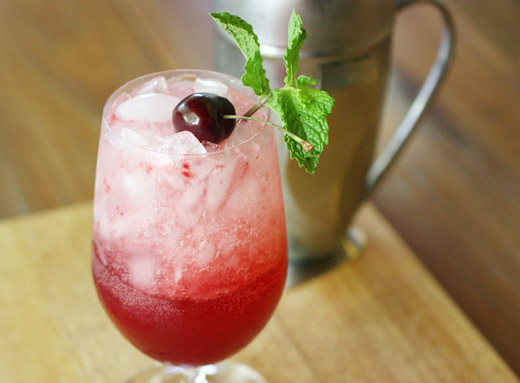
The name of this cocktail makes it sound more lethal than it really is. Porch Sitter might be a better title for it. It’s a fruity, zingy ice-cold drink for summer, and it’s a perfect excuse to sit down and put your feet up for a minute or two. I did some searching on the name Porch Crawler and learned it’s a common name for highly alcoholic drinks with some sweetness and fruit. This one just has a little rum, not a mix of different spirits, but it does have fruit. I had every intention of making this at some point last summer after cutting the page from the April 2011 issue of Food and Wine, but the weeks flew by and cherry season was over before I knew it. So this year, it had to happen. Fresh, pitted cherries are muddled with mint leaves and a halved serrano chile. When you taste it, you don’t really notice the chile at first since the fruit and mint get all the initial attention. Then, you realize there’s something else going on here. It’s just a hint of heat to make things interesting.

Stem and pit a handful of cherries, and place them in a cocktail shaker. Add a few mint leaves and a halved serrano chile. You can remove the seeds from the chile if you’d like to make it milder. Muddle those ingredients in the shaker, and then add some ice. Next, add rum, lemon juice, and simple syrup, and shake until cold. Strain the cocktail into a glass with ice, and top with club soda.

I suppose it’s possible you could end up needing to crawl if you consumed enough of these, but I’ll still argue it could use a better name. I wouldn’t change anything else about it though. And, I still have time to make a few more before cherries disappear for this year.


Monday, November 21, 2011

Boston Bog Cocktail

I tend to be a fiddler when it comes to cocktails, but it’s not that I pick up a stringed instrument after I’ve had a drink or two. What I mean is that I mix and taste and add a little more of this and then a little more of that and mix again and so on. That wasn’t the case this time though. I followed the instructions and actually really liked this just as it was with no fiddling necessary. This Boston Bog cocktail recipe came from the new book The American Cocktail from the editors of Imbibe magazine, and I received a review copy. It’s a great, little book that presents drinks from each region of the US. The West chapter includes Texas, and I was proud to see Austin’s own David Alan, the Tipsy Texan, mentioned along with his Loquacious cocktail made with loquats, Tito’s vodka, and Paula’s Texas Lemon. Many of the recipes include some specific, regionally-made products, but substitutions can always be made. For instance, one of the pages I bookmarked included the Big Bay Storm from the South chapter. It’s made with Gosling’s rum, Campari, and Cheerwine soda which is made in North Carolina. Here, another cherry cola could be used instead. I also want to try the O’Yahderhay which is a cocktail from Wisconsin made with brandy, vermouth, and a homemade syrup with the flavors from a kringle pastry popular in Racine. There’s also a Verde Maria, like a Bloody Mary, made with tequila and tomatillos, and a Stumptown Vanilla Flip with vanilla liqueur, espresso, and orange liqueur. There are a lot of fresh flavors in the cocktails in this book, and I’ve marked so many pages, I’ll be mixing my way through most of it.

With Thanksgiving on its way, I wanted to test a seasonally appropriate cocktail to be sure it would be a hit on Thursday. The Boston Bog is made with fresh cranberries and rum, and it sounded like the perfect option. For two cocktails, about 12 cranberries were muddled in a cocktail shaker. Then, three ounces of Appleton Estate Jamaican rum and an ounce of Rothman and Winter apricot liqueur were added. I made the ginger syrup in advance, and that involved dissolving Demerara sugar in simmering water and then adding chopped ginger. The mixture was pureed in a blender and then strained and chilled. One ounce of the ginger syrup was added to the shaker along with an ounce of lemon juice and some ice. It was shaken until well chilled and then double-strained into glasses. Each glass was garnished with a twist of orange peel.

The cranberries, apricot liqueur, ginger syrup, and lemon made a lovely combination, and I’m always a fan of rum. This was a serious kind of cocktail that should be offered in small portions, but the tart fruit flavors and sweet apricot and ginger syrup were well-balanced with the alcohol. So on Thursday, at some point after the parade and before carving the turkey, we’ll definitely being mixing more of these without changing a thing. Happy Thanksgiving!


Tuesday, September 13, 2011

Healthier PiƱa Colada

I've always been fond of rum, and fruity, rum cocktails are delightful whether they come with an umbrella or not. The only, little problem, as I see it, with these kinds of cocktails is that they tend to have very high calorie counts. I used to make pina coladas at home from time to time, and they usually ended up being dessert. I would combine frozen pinapple chunks, some Coco Lopez cream of coconut, rum, and ice and blend until smooth. Served with a wedge of fresh pineapple and maybe a spoon if it was extra thick, it was always deliciously sweet. These days, I pay more attention to how many calories I'm consuming in beverages, so when I saw an idea for a lighter, healthier pina colada in the August issue of Living, I had to try it. The recipe isn't available online, but it's very easy as I'll describe below. For this version, rather than using cream of coconut with added sugar and stabilizers for maintaining a consistent texture, all-natural coconut water is used instead. The result is much less sweet, and the flavor is purely of pineapple and coconut.

I chopped a whole pineapple into chunks and placed the chunks in the freezer for a few hours. You don't actually need to freeze the pineapple, but it adds to the icy appeal. To make the cocktails, just add two cups of pineapple chunks, three quarters of a cup of pure coconut water, one half cup of ice cubes, one tablespoon of sugar, a teaspoon of lemon juice, and one half cup of rum to a blender. Puree until smooth, and garnish with toasted coconut.

They were frothy and smooth and just sweet enough. Full of tropical flavors, this was just as fun as a traditional pina colada. And, with about a quarter of the calories, I can once again make these cocktails as often as I like.


Friday, January 7, 2011

Bermudian Rum Cake

I’ve actually had a Bermudian rum cake in Bermuda, but I’d never made my own until now. This one is from The Greyston Bakery Cookbook. It’s similar to a holiday cake that gets soaked in a liquor-filled glaze only this is much simpler. In this case, you only apply the glaze once rather than several times over days or weeks, and the cake batter is one of the easiest ever to whisk together. The rum and orange juice and zest in the cake and the finely chopped pecans that end up coating it give it fantastic flavor before the rum glaze is even applied. Rum cakes that are soaked multiple times can end up tasting very boozy and I do quite like the taste of rum, but it’s not overwhelming here. In the glaze, the rum melds with melted butter and brown sugar into a lovely butterscotch with just a hint of rum. Soaking the cake with the glaze also extends the life of the cake. It gets better as it sits, and it lasts a few days longer than it would otherwise. To gild each serving a bit more, I whipped cream with Grand Marnier to top the cut pieces.

This simple whisked batter started with flour, sugar, baking powder, and salt being combined in a large bowl. In a separate bowl, milk, orange juice, vegetable oil, eggs, orange zest, and rum were whisked together and then added to the dry ingredients. The batter was stirred to combine and then carefully poured into a bundt pan that had been buttered and sprinkled with toasted and chopped pecans. You want to pour the batter slowly to as not to dislodge the pecans. The cake baked for about an hour, was left to cool, and was placed on a serving platter, and that’s where I learned a lesson. You should place the cake on a rimmed platter. I somehow believed that the cake would absorb every single bit of the glaze, and I foolishly chose a flat platter. The glaze was made by melting butter in a saucepan, adding sugar and water and stirring while simmering for five minutes. The rum was added off the heat. The cooled cake, on a platter with a rim, is then pierced all over with a wooden skewer before you slowly spoon the glaze over top. Most of the glaze will be absorbed, but some does collect around the base of the cake and that could work its way to the edge of a platter without a rim and dribble all over your dining room table. Whip some cream with a little sugar and Grand Marnier to serve with the cake.

The finely chopped pecans held their place on the surface of the cake and gave it some crunch, and the Grand Marnier whipped cream added more orange flavor. Certainly, a rum cake in Bermuda comes with a much better view, but this homemade rum cake was fresher, lighter, and even more delicious. Obviously, the best solution would be to pack up a homemade cake and go back for another visit to Bermuda.


Saturday, July 17, 2010

Mai Tai

I wish my toes were in the sand as I write this. What would be better than sitting on a beach and sipping a Mai Tai? Unfortunately, I can’t get to a beach this week, so I’ll have to settle for sipping a Mai Tai while sitting in my backyard. When I read the article about Mai Tais on The Atlantic last month, I realized that this cocktail could be a vacation in a glass. A regular weekend quickly becomes more interesting when you have a fruity, tropical cocktail in hand. The article I read mentioned drinks that are like liquid candy and drinks that allow you to taste the rum and tartness. The recipe offered was of the latter type, and I had to try it. It’s made with lime juice, Cointreau, simple syrup, rum, and Orgeat syrup. I’d heard of Orgeat before, but I wasn’t sure I’d be able to find it locally. First, it’s pronounced or-zha not or-geet, and the important thing about it is its almond flavor. My first stop in my search for it was a well-stocked liquor store, where the person who helped me locate it mispronounced it. Not a good sign. The product I was shown was a big bottle full of artificial flavors, etc. I decided to keep looking. I checked online and learned that Monin brand makes an Orgeat syrup, and it has the exact same ingredients as their almond syrup. So, when I located Monin almond, I went with that.

Now, the recipe from The Atlantic was very specific about the type of rum to use as Appleton 21-year old was mentioned by name. I wasn’t feeling that picky since I had some good, aged rum in the house which we had poured into a decanter, and for the life of me I can’t remember what brand it is. The recipe also suggests floating Demerara rum on top as an option. I skipped that option. Aged rum, lime juice, Cointreau, simple syrup, and Orgeat or almond syrup were placed in a cocktail shaker with ice, it was given a good shaking, and it was poured over crushed ice in a glass. I did follow the instructions regarding garnishing with mint since the mint in my garden hasn’t died yet this year.

One sip of this, and you’ll imagine the sound of waves crashing nearby. It’s the Orgeat that gives it that tropical vibe. It blends with the tart lime and rum and adds a distinctive, happy, rounded flavor. My drink is ready and all I need is the surf, the sand, and a palm tree or two.


Wednesday, March 31, 2010

Butterscotch-Pecan Cake

I’m not always good at making decisions. That’s especially true when it comes to choosing a type of cake to bake for a special occasion. First, I was sure a lemon cake would be great, but that was before I became taken with the idea of a little raspberry cream number. Then, I realized I better pull out the files and check to see if there was something long-forgotten and hidden-away that might be perfect. Indeed, there was just such a cake. It was this butterscotch-pecan cake which first appeared in the November 2008 issue of Living, and I had forgotten all about it. Butterscotch cake with a smidgen of rum in it, butterscotch cream cheese frosting, and chopped pecans to finish it, and I was sold. This is a grand cake which was intended to be three layers tall. Somehow, three layers always seems like a lot of cake to me, so as usual, I only baked two layers, baked the remaining batter as cupcakes, and froze the cupcakes for another day. I won’t suggest that this is a quick and easy kind of cake. Well, there’s nothing difficult about it, but there are several steps involved, and some of those steps require cooling and waiting after completing them before moving on to the next. I will do my best to convince you to try this, though, because it is possibly the most delicious cake ever.

The cake batter was started with a simple mix of softened butter, dark brown sugar, eggs, vanilla, and rum. Once combined, flour mixed with baking powder, baking soda, and salt was alternately added with buttermilk. The cakes were baked and cooled. Then, what I’m going to call the best frosting ever was prepared. To make it, butter was melted and browned, then dark brown sugar, cream, and salt were added. It was brought to a boil while whisking and cooked for three minutes. That lovely, lovely mixture was transferred to the bowl of a mixer and left to cool. Once cool, additional butter was mixed into it. In a separate bowl, cream cheese was mixed with confectioners’ sugar, and then it was added to the butter mixture and mixed until smooth. The frosting then needed to be refrigerated to firm up a bit, but I recommend you taste it several times as it chills only because it’s incredible. Butterscotch cream cheese frosting should top everything from cinnamon rolls to toast. Ok, the cake was baked and the frosting was almost ready, but there was one other component to this cake. A butterscotch sauce was made by mixing sugar, butter, corn syrup, and salt in a small saucepan. This was cooked over medium-low heat until the sugar dissolved and then it was brought to a boil. Off the heat, cream was added, and then it was cooked for two more minutes and allowed to cool. This sauce was brushed over the cake layers before they were frosted. The layers were stacked, frosting was generously applied, and chopped, toasted pecans were added on the sides.

As I tasted the different parts of this at each step along the way, I repeatedly said that this was the best cake I’ve ever made. The frosting with sweet dark brown sugar and browned butter with a hint of salt mixed with cream cheese was scandalously good. There was no counting of calories while enjoying this cake. It’s too delicious for you to even care.


Wednesday, December 23, 2009

Rum Raisin Shortbread

I have one more cookie to show you before Christmas gets here. This is number three from the cookie swap I started talking about last week, and this is one I had wanted to try for a while. Last year for Christmas, I made a rum raisin pie, and the thought of those flavors in a cookie sounded like a great idea to me. The recipe is found in the Martha Stewart's Cookies book. I've said before that I'll eventually try every recipe in that book, and this gets me one cookie closer. As the name suggests, rum is involved in this recipe. However, there are no raisins as currants are used instead. For added interest, there's some orange zest and unsweetened coconut, and it all combines to make some very tasty cookies.

Although this is an easy recipe, you need to soak the currants in rum overnight before starting. Then, the dough was a simple shortbread to which the drained, rum-soaked currants, unsweetened coconut, orange zest, and some reserved soaking rum and vanilla were added. It was divided in half, and each portion was placed on parchment paper and rolled into a cylinder. At this point, the dough needed to be refrigerated for at least a couple of hours but could have been chilled for a couple of days or frozen for a couple of months. I left it for a few hours and then pre-heated the oven while slicing the cylinders into cookies. There’s something fun about slice and bake dough.

For such a simple cookie, there was a lot going on with its flavors. The rum and coconut were subtly delicious, while the orange zest grabbed more attention. Their small size made it easy to lose count of how many I’d eaten in one sitting, but who’s counting when it comes to cookies at this time of year?


Wednesday, November 4, 2009

Tapas, Part 2

I have two more tapas to continue the story from The New Spanish Table that I started other day. I would have loved to try the bacalao hash, but I haven’t found salt cod locally and will have to place an order online. The tuna-stuffed tomatoes and scallops with pistachio vinaigrette both sounded great too, but they’ll have to wait until our next tapas party. This time, I was determined to stuff some piquillo peppers, and try the black olive, anchovy, and caper spread. I was certain I had purchased piquillo peppers at my usual location of Central Market before, but of course, when I needed them this time they weren’t there. I called around and found they did have the lovelies at the south location of Central Market, so they were mine in the end. In the book, piquillos are described as “the caviar of capsicums.” The roasted, flat-packed peppers are mostly sweet with a little earthiness, and their small size makes them perfect for stuffing just a bite or two.

The stuffed piquillo recipe in the book is found under the title veal-stuffed piquillo peppers. In the intro to that recipe, von Bremzen explains that the classic version usually involves a stuffing of seafood with bechamel sauce, and she suggests alternate ideas instead of veal. I went the seafood route and made a shrimp stuffing. I chopped some shrimp, sauteed them in olive oil with a little chopped garlic, and then added a bechamel. Once cool, that mixture was stuffed into the piquillos, and the peppers were chilled in the refrigerator to set. Meanwhile, a sauce was made by sauteing finely chopped onion and garlic in olive oil, and to that, chopped piquillos and grated tomato were added. I’d never grated a tomato before, but you simply cut it in half, grate it on a box grater, and discard the skin. After the sauce with the tomato added had reduced, sweet and hot paprika and white wine were added. Last, a little cream enriched the sauce. Some of this sauce went into the bottom of a baking dish, the stuffed peppers were placed on top, and the remaining sauce was poured over the peppers. I should explain, an optional step in this recipe is to bread and fry the stuffed piquillos just before placing them in the baking dish with the sauce. I skipped that option and baked the naked, stuffed peppers in the sauce until warm. These little guys were delightful with chunks of shrimp in the smooth bechamel and the paprika and cream in the sauce. This was a plate and fork kind of tapa, and it was hands-down our favorite if we had to pick only one.

The olive spread was next. I already have a favorite black olive tapenade, but I wanted to try this one just to see how it compared. I was intrigued by the use of anchovy and a hard-cooked egg yolk here. The entire mixture included black olives, anchovies, capers, garlic, one cooked egg yolk, rum, yes rum, mustard, and olive oil. This was a rich and flavorful olive spread and the anchovies and rum gave it spunk. I like a good bit of parsley in an olive spread, so I sprinkled some on top. I already declared the stuffed piquillos our favorite item of the night, but there were no disappointments here. I’ll be making all of these again, and from now on whether I’m making this olive spread or my old stand-by, it will have some rum in it.


Blogging tips