Showing posts with label caramel. Show all posts

Tuesday, May 22, 2018

Alfajores

Of course, I love trying new baking recipes especially when I get to play with nonstandard ingredients. And, I really love it when I get to try making treats that are sweetened with things other than refined sugar. I bake fewer sweet things than I used to, and I mostly avoid refined sugar except on special occasions. I’ve had some mixed results with this type of baking. A honey-sweetened carrot cake and some maple syrup-sweetened cookies that I baked were really far better on the first day than the second. And, a vegan, date-sweetened caramel I tried didn’t deliver the thrill of traditional caramel. So, I was cautiously excited to try the recipes in the new book Sweet Laurel by Laurel Gallucci and Claire Thomas of which I received a review copy. I wanted to love the flavors, and I really wanted the recipes to work well. After being diagnosed with Hashimoto’s disease, an autoimmune digestive disorder, Laurel Gallucci became committed to creating delicious baked good with no grains, gluten, dairy, or refined sugar. She and her friend Claire opened the bakery Sweet Laurel to showcase these creations. They offer “indulgent yet healthful” treats made with the simplest ingredients. No gums, fillers, or soy is used in the recipes. In fact, all the ingredient lists are surprisingly short. The chapters cover quick breads and breakfast treats, cookies and bars, pies and tarts, layer cakes, fillings and icings, and decorating techniques. I quickly zeroed in on the doughnuts with various glazes. They’re baked doughnuts made with almond flour, coconut oil, eggs, and maple syrup, and the glaze options include chocolate, strawberry, turmeric lemon, and coconut butter icing. Then, there are Classic Snickerdoodles, and the only reason I haven’t baked them yet is because I would eat every one of them. The Zesty Lime Pie and the Caramel Chocolate Banana Cream Pie are both strongly tempting me as well. Among the cakes, there are classics like the The Chocolate Cake That Changed Everything that inspired the friends to open the bakery and an old-school Pineapple Upside-Down Cake with pieces of blood orange standing in for the usual maraschino cherries. I couldn’t wait to get baking, and my first recipe from the book was the Alfajores that happen to be vegan as well as grain-free and free of refined sugar. 

There are three parts to this recipe, and each can be made in advance to make the final assembly a bit quicker. First, I made the Shredded Coconut “Powdered Sugar” topping. Rather than sifting actual powdered sugar over the cookies, these are topped with pulverized, unsweetened coconut that looks like powdered sugar. The coconut was blitzed in a food processor until fine. Next, I made the Vegan Caramel filling. I opted to puree the ingredients in a blender for the smoothest possible texture, but a food processor could also be used. Almond butter, maple syrup, coconut oil, dates, vanilla, and a pinch of salt were pureed until smooth. It seemed like a nice, thick mixture for filing the cookies, but next time I will take the suggestion of adding two more dates to make it a bit thicker. The cookies couldn’t have been easier. The dough was a quick mix of almond flour, a little salt, melted coconut oil, and maple syrup. That’s it. The dough was placed between two big sheets of parchment paper and was rolled out to about an eighth of an inch thickness. Small rounds were cut and baked. While cooling, the cookies were dusted with powdered coconut. Once cool, half of them were flipped and topped with vegan caramel before being sandwiched. 

Above, I mentioned some other lackluster, vegan caramel I had tried in the past. This was not that. This vegan caramel had all of the yummy factor I expect from caramel. I could have sat down with the bowl of it and a spoon. Next time, I will make it a little thicker so the cookies can withstand more filling without sliding apart. And, the deliciousness remained for these cookies the second day and the day after that. I can’t wait to bake more things from this book.

Alfajores 
Reprinted from Sweet Laurel: Recipes for Whole Food, Grain-Free Desserts. Copyright © 2018 by Laurel Gallucci and Claire Thomas. Photography by Claire Thomas. Published by Clarkson Potter/Publishers, an imprint of Penguin Random House, LLC. 

Our favorite coffee shop is just blocks from where we grew up, and one of its featured treats is the alfajore, a melt-in-your-mouth Argentinian sandwich cookie. Traditionally made with shortbread, dulce de leche, and an abundance of powdered sugar, it’s the perfect cookie to pair with a cup of strong South American coffee. In our version, we switch out the dulce de leche for our vegan caramel, and coat the cookies in our coconut powdered sugar. Don’t forget to brew a pot of coffee! 

2 cups almond flour 
1⁄8 teaspoon Himalayan pink salt 
1⁄4 cup coconut oil, melted 
1⁄4 cup maple syrup 
Shredded Coconut “Powdered Sugar” for topping 
Vegan Caramel, for filling 

1. Preheat the oven to 350°F. Line a baking sheet with parchment paper. 
2. In a medium bowl, whisk together the flour and salt. In a small bowl, combine the coconut oil and maple syrup. A little at a time, add the dry ingredients to the wet, stirring until a dough comes together. 
3. Place the dough between two pieces of parchment paper and roll it about 1⁄8 inch thick. Remove the top piece of paper and, using a 1 1⁄2-inch round cookie cutter, cut the dough into circles and place on the prepared baking sheet. Bake for 7 to 9 minutes, until the edges begin turning golden brown. Transfer the cookies to a rack, dust heavily with “powdered sugar,” and cool completely while you prepare the vegan caramel. 
4. Gently spread 1 to 2 teaspoons of vegan caramel onto a cooled cookie, then sandwich together with another cookie. Repeat with the remaining cookies and serve. Store in a sealed container at room temperature for up to 5 days, or in the freezer indefinitely. 

Vegan Caramel 
We believe our early success has a lot to do with this recipe. There have been vegan caramel super fans since day one (seriously, one guy has a weekly order), and once you try it, you’ll know why. You’ll see it pop up in a few recipes in this cookbook, but we won’t judge if you eat this straight out of the jar with a spoon! Our favorite way of serving it is on top of sliced bananas, or with a piece of dark chocolate. You can buy ours at sweetlaurel.com, but here’s our secret recipe. 

1⁄4 cup almond or cashew butter or puree, storebought or homemade 
1⁄4 cup maple syrup 
2 tablespoons coconut oil, melted 
1 or 2 fresh dates, pitted 
1 teaspoon vanilla extract Pinch of Himalayan pink salt 

1. Place all of the ingredients in a blender or food processor and puree until smooth. 2. Transfer the caramel to a glass jar and place in the refrigerator to chill. The caramel will stiffen up in the refrigerator, so if your recipe calls for it to be spreadable, let the caramel sit at room temperature for 30 minutes to an hour, and give it a good stir before using. The caramel will keep for about 1 month, refrigerated. 

Shredded Coconut “Powdered Sugar” 
Makes 1/4 cup 

1⁄4 cup unsweetened shredded coconut 
2 teaspoons arrowroot powder 

1. In a food processor, blend the coconut and arrowroot until a fine powder forms. 
2. Sift the mixture over the doughnuts, generously dusting each, then serve.

I am a member of the Amazon Affiliate Program. 

Thursday, August 3, 2017

Cold-Press Coffee Ice Cream with Salted Caramel Sauce

I’ve been making homemade ice cream for years. And, I thought I had a handle on the parts of a custard and how the ingredients come together to freeze just right for ice cream. Thanks to the new book Hello, My Name Is Ice Cream: The Art and Science of the Scoop by Dana Cree, I now have a much, much better understanding of how all of that works. As I read my review copy, I enjoyed learning specifics like that fat helps to trap air as ice cream is churned and that dairy proteins bind to water in the base and prevent ice crystals from forming. I love this kind of information. I never really knew why some ice cream recipes call for corn syrup in addition to sugar, but here, it’s explained that monosaccharides in corn syrup, as opposed to disaccharides in sugar, bind more water which is again to prevent ice crystals. There are also explanations for the use of texture agents and how they affect the final result. By knowing the science behind what each item contributes, you get a clearer picture of what you could and what you should not change in ice cream recipes. You also learn how to create the creamiest texture and best flavors possible. For instance, fat in an ice cream plays an important role in how flavors are delivered. With a higher fat custard, flavors will develop more slowly as you taste them, and they will last longer on your palate. But, in the case of a lower-fat sherbet, the flavor is experienced more immediately. Depending on the flavor in question, you might want a slow, lingering effect or a quick burst. There’s also information about each step of making ice cream and what happens along the way. By curing or chilling an ice cream base before churning, the emulsion is strengthened and produces a better, less icy texture. The recipes are divided among Custard Ice Creams, Philadelphia-Style Ice Creams, Sherbets, Frozen Yogurts, and Add-Ins. Then, there’s a chapter for Composed Scoops that combine flavors, ripples, sauces, and toppings. There are delicious flavors offered in the book like Bourbon Butterscotch Ice Cream, Cheesecake Ice Cream, Bubblegum Ice Cream, Blood Orange Sherbet, and Key Lime Pie Frozen Yogurt. But, what I really appreciated was learning that a Philadelphia-style ice cream with no eggs is a better choice for flavors like chocolate or mint because you’ll quickly taste the subtleties of those ingredients. For coffee flavor that builds as the ice cream melts in your mouth, a custard base is the way to go. 

I have to explain how I chose the flavor combination shown here. When Kurt and I visit our favorite gelato shop, my go-to order is an affogato with salted caramel gelato. I love the hot espresso with the cold caramel gelato. Here, I kept the same flavors but switched the temperatures. I made the Cold-Press Coffee Ice Cream and topped it with a warm salted caramel sauce. The custard was made with cream, milk, sugar, and glucose. I used light corn syrup for the glucose. Egg yolks were tempered with the hot dairy and sugar mixture, and the custard was cooked until thick. After straining the cooked custard, coffee beans were added and left to steep while refrigerating the base overnight. The next day, the coffee beans were strained out, and creme fraiche was added before churning. The churned ice cream was placed in the freezer to harden for a few hours. I made the salted caramel sauce for serving and topped the scoops with chocolate-covered espresso beans. 

The coffee flavor was lovely in the rich custard, and the texture was perfectly smooth and chewy. Knowing the science behind ice cream making is eye-opening. To understand how all the ingredients interact and what each contributes makes me look at other recipes in a whole new way. It also makes me want to try every flavor in this book with all the ripples and swirls and crunchy, crispy toppings to go with them. 

Cold-Press Coffee Ice Cream 
Reprinted from Hello, My Name Is Ice Cream: The Art and Science of the Scoop . Copyright © 2017 by Dana Cree. Photographs copyright © 2017 by Andrea D’Agosto. Published by Clarkson Potter, an imprint of Penguin Random House, LLC.

Makes between 1 and 1 1/2 quarts ice cream 

Coffee was my mother’s favorite ice cream flavor, and one I pretended to like as a child out of sheer admiration for her. As I grew into a coffee-swilling adult, though, I too found a deep appreciation for this flavor. Most ice cream shops add concentrated coffee to their ice cream, making a recognizable tan-colored scoop. As a pastry chef, I learned to flavor coffee ice cream by infusing whole coffee beans into the dairy, giving me a pale-colored scoop with a deep coffee flavor. As cold-press came onto the coffee shop scene, promising a smoother, less acidic brew, it too changed the way I thought about flavoring my coffee ice cream. Heat changes coffee’s flavor, and as it brews, bitter, briny, acidic notes come with it. When I started making a cold-press coffee ice cream, I cooled my ice cream base completely before I introduced the beans. I let them infuse slowly, over the course of a full day and night. The resulting ice cream tastes the way coffee smells, and has the unique quality of being white. I stir in a small amount of tart creme fraiche at the end, and its acidic quality makes this coffee ice cream a very special version of a commonplace flavor—one you won’t forget. For a more classic-tasting coffee ice cream, or if you are short on time, go ahead and add the coffee beans to the milk and cream as they are heating up, and let them steep for 10 minutes before straining them out. You can also replace the creme fraiche with an equal amount of cream, added with the milk in the beginning of the recipe. 

Cream (20%)200g | 1 cup 
Milk (40%)400g | 2 cups 
Glucose syrup (5%)50g | 1/4 cup 
Sugar (15%)150g | 3/4 cup 
Egg yolks (10%)100g | about 5 large yolks
Cornstarch 10g | 1 tablespoon plus 1 teaspoon, mixed with 20g | 2 tablespoons of cold milk, whisked into the simmering dairy, then cooked for 1 minute. 
Coffee beans30g | 1/2 cup 
Creme fraiche (10%)100g | 1/2 cup

Prepare an ice bath. Fill a large bowl two-thirds of the way with very icy ice water and place it in the refrigerator. 

Boil the dairy and sugars. Put the cream, milk, glucose, and sugar in a medium heavy-bottomed saucepan, and place it over medium-high heat. Cook, whisking occasionally to discourage the milk from scorching, until the mixture comes to a full rolling boil, then remove the pot from heat. 

Temper the yolks and cook the custard. In a medium bowl, whisk the yolks. Add 1/2 cup of the hot dairy mixture to the yolks while whisking so the hot milk doesn’t scramble the yolks. Pour the tempered yolks back into the pot of hot milk while whisking. Place the pot over medium-low heat and cook, stirring and scraping the bottom of the pot constantly with a rubber spatula to avoid curdling. 

Chill. When you notice the custard thickening, or the temperature reaches 180°F on a kitchen thermometer, immediately pour the custard into a shallow metal or glass bowl. Nest the hot bowl into the ice bath, stirring occasionally until it cools down. Strain. When the custard is cool to the touch (50°F or below), strain it through a fine-mesh sieve to remove any bits of egg yolk. (This step is optional, but will help ensure the smoothest ice cream possible.) 

Infuse the coffee. Stir the coffee beans into the cooled custard, and transfer it to the refrigerator to infuse for 12 hours. 

Strain the custard and add the creme fraiche. When you are ready to churn your custard, strain out the coffee beans through a fine-mesh sieve. Take 1/4 cup of the cold custard and stir it into the creme fraiche until smooth, and then stir this back into the custard. 

Churn. Place the base into the bowl of an ice cream maker and churn according to the manufacturer’s instructions. The ice cream is ready when it thickens into the texture of soft-serve ice cream and holds its shape, typically 20 to 30 minutes. 

Harden. To freeze your custard ice cream in the American hard-pack style, immediately transfer it to a container with an airtight lid. Press plastic wrap directly on the surface of the ice cream to prevent ice crystals from forming, cover, and store it in your freezer until it hardens completely, between 4 and 12 hours. Or, feel free to enjoy your ice cream immediately; the texture will be similar to soft-serve. 

I am a member of the Amazon Affiliate Program. 

Monday, October 7, 2013

Chocolate Caramel Tartlets

All of a sudden, chocolate has jumped to the top of my favorite ingredients list. It’s because of the new book Mast Brothers Chocolate: A Family Cookbook. Since receiving a review copy of the book, chocolate is pretty much all I can think about. But, before we get to all the delicious-looking recipes, I should ask if you’re familiar with Mast Brothers chocolate? Rick and Michael Mast are in fact brothers, and they began making bean-to-bar craft chocolate in Brooklyn about six years ago. They source a variety of cacao beans directly from farmers, roast the beans themselves, and craft their chocolate with only added sugar and no emulsifiers. Not many chocolate companies actually craft chocolate from cacao beans, and most chocolate is made with added ingredients for flavor and/or improved texture. Most companies buy chocolate already formed, temper it, and make confections. The Mast brothers were inspired to learn the entire process and discover unique flavors from different types of cacao beans grown in different locations. The book has a nice rhythm to it with recipes that are each accompanied by a beautiful photo and are interspersed with stories about the brothers and how they started their craft chocolate business. They follow a few simple rules to keep their business on track like: “Master your craft-- Continuously improve the quality of your craft; Make everything delicious; Waste nothing; Connect customers to the source-- We are nothing without our farmers.” I liked everything I was learning about this company. One story that particularly stood out was about how they decided to sail a shipment of beans to New York. They didn’t want oil to be involved in the transport of their beans, so they spent months researching, planning, and scheduling a sailing cargo ship to pick up 300 bags of cacao beans from the Dominican Republic and deliver them to Brooklyn. That’s dedication to simplicity at its best. 

The recipes have a nice sense of simplicity about them as well. These aren’t tricky or complex chocolatier’s confections. And, it isn’t a requirement that Mast Brothers chocolate be used for them to work. But, they are all recipes for high quality, dark chocolate, cocoa powder, and cacao nibs. There are Classic Chocolate Brownies with almonds, hazelnuts, and pecans; Chocolate-Covered Pretzels with homemade, yeast-raised, pretzels; Chocolate Caramels with Sea Salt; Chocolate Chip and Ricotta Pancakes; various chocolate cookies; chocolate sauces; a couple of versions of hot cocoa; cakes; pies; and that’s just some of the sweet stuff. There are also savory uses of chocolate throughout the book. I’ve already tried the Cacao Nib Salad with Cocoa Balsamic Vinaigrette and was delighted. The vinaigrette was made by grinding cacao nibs, chopped rosemary, cocoa powder, salt, and pepper in a mortar with a pestle, and then balsamic vinegar, honey, and olive oil were added. It was tossed with a salad of frisee, arugula, spinach, and blood orange wedges, and topped with more cacao nibs. The flavors were balanced, the cacao nibs were nutty, and subtle cocoa flavor paired well with the blood orange. Some other savory recipes include mole sauce, of course, a cocoa dry rub, a Savory Chocolate Cream Sauce for pasta, and a Spiced Cocoa Butternut Squash Soup. It’s like I’m transfixed by these recipes. Whether the uses of chocolate are novel or classic, everything in book looks like something I want to make right now. 

First, I made the Chocolate Crunch because I had the ingredients in the house and could actually make it as soon as I read about it. It was a simple matter of melting chocolate with butter, adding peanut butter and honey, stirring in puffed rice cereal, pouring it into a pan and waiting for it cool. The result was like the best possible version of a Nestle Crunch bar. Next, I had to try the Chocolate Caramel Tart which I made as tartlets. The chocolate tart dough was made with cocoa powder, butter, flour, egg yolks, and just a little bit of sugar. It wasn’t a very sweet dough, and that worked well with the caramel filling. The crusts were blind-baked and left to cool. The caramel was made with cooked sugar, cream, butter, creme fraiche, and salt. I made four-inch tartlets, had enough dough for eight tartlet shells, and was able to fill six of them with caramel filling. The recipe is written for a twelve-inch tart, so I expected the crusts and filling might not match up perfectly. After the caramel filling set in the crusts, the tartlets were drizzled with ganache and sprinkled with flaky sea salt. As a huge fan of all things caramel, this was an ideal dessert for me. And, now I need to re-stock my chocolate supply and pick which recipe to make next. 

I am a member of the Amazon Affiliate Program.

Sunday, May 26, 2013

Coconut Curry Caramel Corn

Popcorn and I have a special relationship. We’ve spent a lot of time together over the years. For as long as I can remember, it’s been one of my favorite things to eat. I keep it simple. The perfect recipe is a huge bowl of salted popcorn, a couch, and something ridiculous to watch on tv. I used to make chile oil for the sole purpose of using it to pop popcorn, but these days, I use plain grapeseed oil, pop the kernels in a Whirley Pop, and sometimes add truffle salt. However, every once in a while I’m willing to try new things with this beloved ingredient. An occasional caramel corn is not out of the question. In fact, when I saw this Coconut Curry Caramel Corn in Susan Feniger's Street Food, I wasted no time in gathering everything I needed to make it. The recipe is also available online. Some sweet and spicy candied peanuts are made with finely chopped lime leaf and coconut milk, and those are mixed into the caramel corn. Then, spices like cumin seeds, mustard seeds, turmeric, and cayenne are mixed into the caramel before it coats the popcorn, candied peanuts, and some toasted coconut. Luckily, the recipe makes a lot because this was a very addictive snack. 

Making the candied peanuts was quick and easy, and they can be made in advance and stored at room temperature. You don’t want to walk away from the stove though. They need to be stirred and the heat may need to be turned down to prevent burning. Unsalted peanuts were mixed with coconut milk, dark brown sugar, finely chopped lime leaf, salt, and ground cayenne. The mixture was transferred to a saute pan and cooked over high heat for almost two minutes before stirring while continuing to cook for another five minutes or so. The nuts were then spread on a baking sheet and left to cool and crisp. Next, big pieces of shredded coconut were toasted in the oven while popcorn was popped. The popcorn, coconut, and candied peanuts were combined in a large mixing bowl. To make the caramel, butter, brown sugar, and corn syrup were combined in a saucepan and cooked while stirring until it reached 255 degrees F. Off the heat, salt, baking soda, cumin seeds, mustard seeds, turmeric, mace, paprika, cayenne, and cinnamon were added. The curry caramel was poured over and mixed into the popcorn mixture. Last, the caramel corn was spread on two baking sheets and baked for an hour at 250 degrees F and was stirred every twenty minutes. 

As I wasn’t able to stop eating this caramel corn, I noticed that one bite would seem sweet while the next seemed a little hot from the cayenne. Then, I’d notice the other spices more in the following bite before the sweet flavor returned again. It made it very hard to step away from the bowl of caramel corn. I think it will work just as well as my usual, simply salted popcorn in the recipe above with the couch and tv. 

I am a member of the Amazon Affiliate Program.

Monday, April 15, 2013

Burnt Caramel Cake

I was sure it was going to be a cake filled with lemon curd and topped with a toasted meringue frosting. Then, I changed my mind and considered a simple, vanilla angel food cake with strawberries on the side. And, there are two different pistachio cakes that I’ve wanted to try for ages. I have a hard time choosing when it comes to my birthday cake. In the end, my decision was made when I remembered the Burnt Caramel Cake in Basic to Brilliant, Y'all. I mean, caramel covering multiple layers of cake? Of course I had to make this. There are three cake layers rich with butter and eggs, and the icing is a cooked caramel made thick with butter and cream. In this book, every recipe has a tip for making it “brilliant.” For this cake, an embellishment of apple hazelnut compote is suggested as a filling between the layers which sounds lovely but in more of an autumnal way. I decided to dress it up with chopped, toasted pecans between layers instead, and I sprinkled big flakes of sea salt on top. The recipe is available online, but there’s a missing bit of instructions. It skips over adding the eggs which should be mixed in after the butter and sugar have been creamed. The instructions for the caramel icing are great though. This reminded me of the frosting I made for Kurt’s birthday cake which needed to be spread swiftly which I learned as I went. Here, Virginia Willis points out that if you place the bowl of caramel icing in a bigger bowl of warm water, it keeps the icing from setting quite so quickly. It’s a great tip and one I’ll remember next time I work with a similar frosting. Once on the cake, the caramel sets nicely and, the cake stores well at room temperature. 

It’s a simple cake to make which starts with softened butter that’s creamed with sugar. Next, four eggs were added one at a time and mixed into the butter. Flour that had been sifted with baking powder was added in three parts with milk being added alternately. The batter was divided among three pans, and the cakes baked for about 25 minutes. To make the icing, sugar was caramelized in a skillet while more sugar, butter, and cream were brought to a boil in a saucepan. The caramelized, or burnt, sugar was then poured into the cream mixture, stirred to combine, and cooked to reach the soft-ball stage. Off the heat, vanilla and salt were added. It was allowed to cool a bit before being whisked in a stand mixer. Placing the bowl of icing into a big bowl of warm water worked perfectly to prevent it from setting too quickly as the cake was assembled. Still, once the icing was spooned onto the cake, it needed to be spread quickly before setting. I had toasted and chopped some pecans in advance and sprinkled them on the two bottom layers after spreading the caramel icing. 

This is an old-fashioned, caramel-dream of a cake. It was like one giant, Southern praline wrapped around layers of buttery, vanilla cake. I'm not good at deciding on a flavor of ice cream when presented with several options either. This wasn’t a quick decision, but I think I finally chose well. 

I am a member of the Amazon Affiliate Program.

Friday, January 4, 2013

Sticky Toffee Pudding

I always assumed there was a complicated secret to making sticky toffee pudding. I had never attempted it and was sure it would be messy and annoying to prepare. But, this is exactly the kind of dessert I love: a tender cake with chewy dates, a buttery toffee caramel sauce, and some whipped cream for serving. It also happens to be a classic dessert for colder weather since the cake and sauce are served warm. I decided to throw caution to the wind and give it a try for Christmas dinner, and now I’m wondering why I thought this was going to be so difficult. The cakes are easy to make in ramekins. The sauce was a simple mix of ingredients that simmered on top of the stove. And, whipping cream and toasting walnuts for garnish isn’t too hard to do. The recipe I used is from Lost Desserts by Gail Monaghan. Some of the desserts in the book are less lost than others. There are things I’d never encountered before like Siedel Torte, Pruneaux au Pichet, and Crepes Verlaine. Then, there are more familiar although somewhat old fashioned things like Carrot Cake, Baked Alaska, and Schrafft’s Famous Butterscotch Sundae. I’m certain that sticky toffee pudding isn’t one that’s lost because I ordered a delicious version of it at King’s Highway at the Ace Hotel in Palm Springs last May. I guess that was also proof that it doesn’t have to be served in cold weather. At any rate, it does make an excellent dessert for Christmas or any other special wintertime meal.

To start the cakes, or puddings, you chop the dates and remove the pits as you go. They were then covered with boiling water, and vanilla, instant espresso powder, and baking soda were added. Eight ramekins were buttered and the oven was preheated. In a stand mixer, softened butter and granulated sugar were creamed, and eggs were added. Flour and baking powder were sifted together and slowly added to the egg mixture while mixing. Last, the date mixture was folded into the batter, the batter was divided among the ramekins, and the puddings baked for 20 minutes. The cooled puddings were removed from the ramekins and stored on parchment in an airtight container. They can be made in advance and refrigerated or even frozen. For the sauce, brown sugar, butter, salt, and cream were combined in a saucepan and brought to a simmer. Once the sugar was dissolved and the sauce thickened a bit, it was ready. This step could also be done in advance, and the sauce can be refrigerated and reheated just before serving. When it was time for dessert, the broiler was set to high. The puddings were placed on a baking sheet and topped with some of the sauce. The sheet pan was placed several inches under the broiler, and the puddings were warmed until the sauce was bubbly. The puddings were transferred to serving plates, topped with more sauce, and garnished with whipped cream and toasted walnuts. 

Obviously, I was delighted with this dessert and could have eaten the sauce by itself with a spoon, but still, there seemed to be not quite enough sauce since I ended up making a second batch to serve with the leftover puddings the next day. This is no place to skimp on buttery, caramel sauce. And, I’m delighted to find out how wrong I was about making them. They’re easy enough to whip up again whenever I want. 

I am a member of the Amazon Affiliate Program.

Tuesday, November 27, 2012

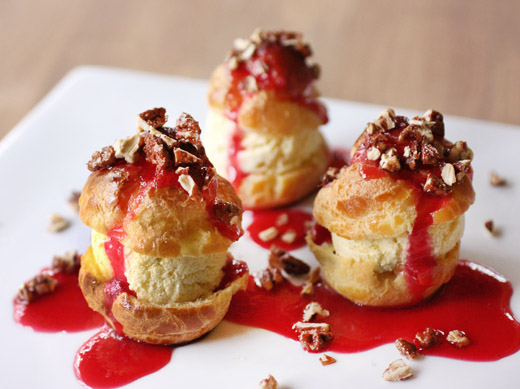
Profiteroles with Cranberry Caramel Sauce and Maple Spiced Pecans

After holding tryouts for Thanksgiving dessert, I of course ended up going in a completely different direction than any of the contestants. Let me explain how this happened. Kurt claims to not have much of a sweet tooth, but there are three similar sweets that he really likes. Those are Boston cream pie, eclairs, and profiteroles. I’d made the first two at different times in the past, but I’d never made profiteroles even though we always order it when we see it on a restaurant dessert menu. I had various ideas about how to change up the classic components of a profiterole to make it a more seasonal, Thanksgiving kind of dessert, and Kurt voted down almost all of them. He insisted plain, vanilla ice cream and standard chocolate sauce was the only way to go. There would be no pumpkin or cinnamon ice cream or spiced pate a choux or nutmeg dusting on top or any such thing. But, there was a Cranberry Caramel Sauce that I absolutely had to try. It’s from the October/November issue of Garden and Gun, and it belongs with a Pumpkin Bread Pudding recipe from Austin’s own Jodi Elliott of Foreign and Domestic. So long as the ice cream remained nothing but vanilla and the pastry puffs weren’t messed up with any spices, Kurt was willing to try a sauce other than chocolate. Then, I went ahead and made the Maple Spiced Nuts from the bread pudding recipe as well. One last, little change from the classic preparation wouldn't hurt.

This dessert was made up of four parts, so I started by making the vanilla ice cream in advance to have one part completed and ready. I used the vanilla ice cream recipe from Eggs by Michel Roux which is nicely rich with six egg yolks and perfumed with seeds from a vanilla pod. Next, I made the puffs according to Ina Garten’s recipe in Barefoot in Paris. I like that she suggests pulsing the eggs into the pastry dough in a food processor rather than stirring and stirring by hand. That recipe is also available online. The great thing about choux pastry puffs is that you can refrigerate them or even freeze them, and then just re-warm them for a few minutes in the oven before serving. The tops will re-crisp and the airy insides will be as puffy as when they first came out of the oven. The third part of the dessert was the cranberry caramel sauce which was a simple matter of cooking sugar, water, and corn syrup until amber and then adding cranberries and pure cranberry juice. The berries and juice were stirred into the caramel and the mixture was brought back to a boil until the cranberries had all popped. Off the heat, salt and vanilla were added. After letting the sauce cool a bit, it was pureed in a blender, and then I strained it before letting it completely cool. Last but not least, the pecans were tossed with maple syrup, corn syrup, sugar, salt, and a mix of cumin, cinnamon, ginger, nutmeg, and cayenne. The nuts were baked until toasted through and allowed to cool before I chopped them.

The hint of spiciness and bit of salt in the nuts was perfect with the tart and sweet sauce. And, I think plain vanilla ice cream was the way to go here since it allowed the flavors in the toppings to shine. In the end, we were both completely happy with these changes to the traditional profiterole for Thanksgiving dessert, but I don’t think I’d get away with messing with the classic eclair.

I am a member of the Amazon Affiliate Program.

Friday, May 4, 2012

Butterscotch Meringue Pie

I am a caramel person and a butterscotch person. They’re different but similar, but caramel is a little more photogenic. I accept that I’m not capable of making a butterscotch filling in its unfortunate color look good in a photo, but I won’t accept anything butterscotch that doesn’t taste great. I have a history with butterscotch puddings and pies. I've tried a few puddings that tasted as bad as they looked. And years ago, I attempted a butterscotch pie that left me completely disappointed. The filling was thin and runny, and once cut, the pie was useless. When I complained about this to my Mom, she mentioned that butterscotch pie was my Grandmother’s favorite. I had no idea. Grandma also loved meringue, and I didn’t previously know that either. Since Mom didn’t have Grandma’s recipe for a meringue-topped butterscotch pie, I became determined to find a good one. At last, that day has arrived. This pie is from Gesine Bullock-Prado’s new book Pie It Forward, and I received a review copy. This book is as fun to read as her last one, and the lighthearted nature of it makes you want to get baking and enjoy the results. It starts with a few different dough recipes and some great tips for working with dough and baking a perfect crust and then moves through sweet and savory pies and tarts. Going through the book, I kept longing for the start of different fruit seasons. There are gorgeous Blueberry Brown-Butter Tartlets, a Schwarzwald Tart that’s like a black forest cake in pie form, a German Apple Custard Tart, and a Buttermilk Peach Pie. One section is devoted to chocolate with a Fleur de Sel Caramel Almond Brownie Pie and Chocolate Orange Souffle Tartlets among others. At the end of the book, there are recipes for more challenging desserts involving multiple layers, fillings, jaconde sponges, and chocolate transfer sheets. They’re beautiful creations, and someday I’d love to try making the tall, striped Bee Sting with flavors of almond, chocolate, and honey.

When I spotted the Butterscotch Meringue Pie in the book, I knew I had to try that first. I have to tell you about the four parts of this pie because they were all fantastic. First, the crust was one of the flakiest I’ve ever made, and interestingly, it included some sweetened condensed milk which gave the dough great flavor. Then, after the crust was blind-baked, it was covered with a layer of caramel. I actually made the caramel twice because the first time I didn’t think it was dark enough. Gesine was kind enough to answer my question about the caramel being light in color on Twitter, and she suggested cooking it longer or to a higher temperature than noted in the recipe. The second time, I melted the sugar first and cooked it until amber in color, then added the butter and cream, and cooked the mixture while stirring until it reached 240 degrees F. That time, it was a good caramel color. After spreading the caramel in the pie crust, I couldn’t control the urge to sprinkle it with sea salt. Next came the butterscotch filling. It was a delicious custard of brown sugary butterscotch, and there’s really nothing you can do about its color. Butterscotch is always an unappealing, dull brown. That doesn’t matter here though considering that the filling was entirely covered by the meringue, and stop everything now if you have never made a brown sugar meringue. You must. It’s a pearly brownish color rather than a bright white, and the flavor is like fluffy, mild butterscotch. I swirled the meringue on top and torched it to a toasted brown. 

This was a decadent pie, and it was heaven for a butterscotch and caramel fan. I’m pretty sure it’s not exactly how my Grandma made her butterscotch pie, but I’m glad I’ve found such a great version to make for myself. And, now that berries and peaches are coming into season, I have more pies to bake. 

Butterscotch Meringue Pie 
Recipe re-printed with publisher’s permission from Pie It Forward
Makes 1 (9-inch, 23-cm pie)

For the crust: 
½ batch Simple Tart Dough (recipe below) 

For the caramel lining: 
1 cup (200 g) granulated sugar 
1/2 cup (120 ml) heavy cream 
2 tablespoons (28 g) unsalted butter 
1/2 teaspoon (3 g) salt 

For the filling: 
3/4 cup (165 g) dark brown sugar, firmly packed 
2 tablespoons (30 ml) vanilla bean paste 
1/4 cup (32 g) cornstarch 
4 egg yolks 1/2 teaspoon (3 g) salt 
1 1/2 cups (360 ml) whole milk, divided 
1 1/2 cups (360 ml) heavy cream 

For the assembly: 
1 cup (220 g) dark brown sugar, firmly packed 
4 egg whites 
pinch salt 

Procedure for the crust 
1. Preheat the oven to 350 degrees F (175 C). Roll the dough into a rough 11-inch (28 cm) round. Line a 9-inch (23 cm) pie plate with it and crimp the sides decoratively. Dock the bottom and freeze it for 20 minutes. 
2. Line the crust with parchment, fill it with pie weights or dried beans, and bake it for 15 minutes. Remove the parchment and pie weights. Bake the crust for 20 minutes more, or until it is golden brown and baked through. Set it aside to cool completely. 

Procedure for the caramel lining 
1. Combine the granulated sugar, cream, butter, and salt in a heavy-bottomed saucepan over low heat and cook, stirring, until the sugar has melted. Clip on a candy thermometer and heat until the caramel reaches 240 degrees F (116 C), then allow it to cool completely. 

Procedure for the filling 
1. Whisk together the brown sugar, vanilla, cornstarch, egg yolks, salt, and ½ cup (120 ml) of the milk in a mixing bowl. 
2. Heat the remaining milk and the cream in a saucepan over medium heat until it comes to a simmer. Slowly pour the milk-cream mixture into the sugar mixture, whisking constantly until smooth. 
3. Return the mixture to the saucepan and cook it over medium heat, whisking, until it thickens to the consistency of mayonnaise. Transfer the custard to a bowl, and cover the top with a piece of plastic wrap laid directly on the surface to prevent a skin from forming. Set aside to cool to room temperature. 

Assembly 
1. Pour the caramel into the cooled crust and smooth it along the bottom and sides, using a small offset spatula. Spoon the custard over the caramel and refrigerate the pie until the filling is cool and set. 
2. Begin making a meringue by combining the brown sugar and ½ cup (75 ml) water in a heavy saucepan over low heat, stirring until the sugar has melted. Attach a candy thermometer and heat the sugar mixture until it reaches 234 degrees F (112 C). 
3. While the sugar syrup is cooking, place the egg whites and salt in the bowl of an electric mixer fitted with the whisk attachment. Whisk until the egg whites are foamy. 4. Once the sugar syrup has reached temperature, turn the mixer to medium-low and pour the sugar along the inside of the bowl (not directly into the egg whites, to keep from scrambling the eggs). Increase the mixer speed to high and whisk until you achieve stiff peaks. 
5. Top the custard layer with the meringue, creating swirls and peaks with the back of a spoon. Gently brown the meringue with a kitchen torch. Do not use a broiler to brown the meringue, as this will melt the custard. 

Simple Tart Dough 
Makes 2 ½ pounds (1.2 kg) dough, enough for 3 to 4 (8- to 9-inch/20- to 23-cm) tarts or 12 to 16 mini tarts. 
(*Note: only one half batch of this dough is needed for the crust for the Butterscotch Meringue Pie) 

4 cups (500 g) all-purpose flour, cold 
2 cups (480 g) unsalted butter, cut into small pieces and chilled 
1 teaspoon (6 g) salt 
1/3 cup (75 ml) sweetened condensed milk 
1 egg, at room temperature, lightly beaten 

1. In the bowl of a food processor fitted with the blade attachment, pulse together the flour, butter, and salt until the mixture resembles cornmeal. 
2. In a small bowl, whisk together the condensed milk and egg. While pulsing, slowly pour this into the flour until the dough just comes together. 
3. Turn the dough out onto a lightly floured work surface and gently turn over a few times until it is smooth, the dry ingredients have been completely integrated, and the dough holds together. Take care not to overwork it. 
4. Shape the dough into a loose circle, cover it with plastic wrap, and allow to rest in the refrigerator for at least 20 minutes. 

I am a member of the Amazon Affiliate Program.

Monday, November 7, 2011

Rice Pudding, Three Ways

A few weeks ago, I was reading the June/July issue of Donna Hay Magazine which worked out perfectly. Since it's an Australian magazine, and our seasons are opposite, it's fine that the issues take longer to arrive here and June and July were long gone. By the time I read it, our weather had cooled off some, and I was ready to think about more wintery dishes. There were lots of lovely things made with root vegetables in one story, and another story about a dinner party around a roaring fire that ended with chocolate whisky truffles. I'll get back to those soon enough, but it was the rice puddings that I had to try first. That's such a basic, comfort food kind of dish, and why I'd never made it I don't know. What made me finally want to do it was the fact that there wasn't just one flavor presented in the story. There were eight, yes eight, versions from which to choose. And, I got a little excited when one of the eight was rhubarb and creme fraiche because I had cooked some extra rhubarb and stored it in the freezer earlier in the year. So, that one was for sure, and really, I wanted to try all of the other seven, but I narrowed it down to three. Once the basic rice pudding recipe was made, altering it or adding different toppings was easy enough. I scooped the plain pudding into ramekins, topped some with stewed rhubarb and creme fraiche, others with burnt caramel, and the remaining pudding was flavored with orange zest and topped with melted chocolate.

For the basic rice pudding, all that's required is combining arborio rice, whole milk, sugar, and the seeds and pod of one vanilla bean in a saucepan and bringing it to a boil. The heat was reduced, the pan was covered, and the rice simmered while being stirred occasionally for about 30 minutes. Since I'd already cooked some rhubarb and had it in the freezer, I just let it come to room temperature and spooned it over some rice pudding in ramekins. That was topped with creme fraiche. For both the burnt caramel and chocolate orange versions, some cream was to be added to the basic rice pudding first. Then, sugar was melted in a small saucepan, and the pan was swirled until the sugar became an amber caramel. It was drizzled over the rice pudding just before serving. Last, some orange zest was stirred into the remaining rice pudding, and dark chocolate was melted to top it.

The rhubarb was fruity and tangy with the vanilla rice pudding, but a spoonful of any fruit preserves would be great too. The orange zest paired well with the swirl of chocolate which was a good contrast to the vanilla pudding. Trying all three was a lot of fun and rice pudding could be gussied in many, many ways, but my favorite of all was the burnt caramel topping. It went perfectly with the simple, basic, vanilla rice pudding which is pretty delicious even left plain.


Wednesday, October 26, 2011

Caramel Crumb Bars

I don't usually show you the same thing twice, but these caramel bars are worth mentioning again. The first time they appeared, they were one of three cookies in a post and didn't get enough of the spotlight. I made them again recently for a bake sale, and now I'm giving them the attention they deserve. They're from The Modern Baker by Nick Malgieri, and he notes that if he had to choose a favorite cookie this would be it. That's a serious statement coming from someone who has baked as much as he has. I don't know that I could pick one favorite cookie. Maybe I could narrow down a few favorites I've baked this year or possibly an all-time top ten list. Can you name one favorite cookie? I did make one change to the bars this time. Rather than baking them in a nine by thirteen-inch pan, I used a nine-inch square pan. I wanted each layer to be a little thicker than they were last time. I left them in the oven for a few extra minutes, and the change in pan size seemed to work fine.

The dough is as easy as it gets. Butter, sugar, salt, vanilla, and flour were combined in a mixer, and then three quarters of the dough was patted into a pan that had been lined with parchment. The remaining dough was reserved for the crumb topping, additional flour was added to it, and it was worked into about one quarter inch crumbs. The pan with the dough was chilled. Meanwhile, the caramel filling was made in a saucepan from a mixture of butter, corn syrup, brown sugar, and condensed milk. It thickened and turned a nice, caramel color in about ten minutes. It was allowed to cool for five minutes before being poured onto the chilled dough. The crumb topping was sprinkled on top, and the bars baked for 35 minutes in a nine-inch square pan. Since I baked mine in a smaller pan for a few minutes longer, the edges became just slightly darker than I wanted. After the bars cooled and I removed them from the pan, I trimmed a thin slice off each edge. It was an added step to the process, but I really liked the thicker layers in this version.

The cookie base was crunchy, the caramel filling was gooey but held its shape well, and the crumb topping was buttery bliss. I'm easy to please when a cookie includes caramel or a crumb topping, and these have both. I might not mention these on this site for a third time, twice seems like enough, but I'll definitely be making them again and again.


Wednesday, October 27, 2010

Apple Ice Cream with Toasted Nuts and Caramel Sauce

Caramel apples are as classic as fall treats get, and caramel anything always gets my attention. However, biting into a big, gooey, caramel-coated apple can be a little messy, although that doesn’t stop me. Here, the same flavors were brought together in the form of an ice cream sundae eaten neatly with a spoon. The ice cream is packed full of tart, apple flavor with just a hint of an edge from the added cognac, and the caramel topping with pecans makes it a frozen caramel apple delight. This is from My Favorite Ingredients, a book I can’t seem to put down for long. The ice cream is very appley and not too decadent as it’s made with five pureed apples, a little cream, and no eggs. Of course, the caramel ups the decadence quotient, but I think caramel is always worth it in that regard.

The size or weight of the apples wasn’t specified, but I used three smaller, local apples and two larger fujis from the grocery store. They were peeled, cored, chopped and pureed in a blender with lemon juice, cognac, and some sugar. Once smooth, two-thirds of a cup of cream was added and blended into the mixture. That went into my ice cream maker to churn. The caramel sauce was made with sugar and water which was cooked in a saucepan until it reached a nice, amber color. Cream was added which makes it spatter violently, and then it was cooked while stirring until smooth. A little sea salt was added directly to the sauce. Toasted, chopped pecans garnished the sundaes, and I can never resist adding a few flakes of sea salt on top of caramel.

This dessert took Kurt by surprise. After his first bite, he proclaimed it to be very good. Then, he further commented on how nicely pronounced the appleness was in the ice cream. The fresh apple flavor really came through even with the caramel sauce on top, and those two things together, in a messy treat or a tidy one, are just meant to be.


Saturday, June 5, 2010

Candy Bar Cupcakes

I think I’ve started a tradition, and I think it’s a good one. You see, every year my spinning instructor starts dropping hints about his birthday a couple of weeks before it arrives. Last year, I took the hints and decided to bring some cupcakes to class on his big day. Having cupcakes in the spinning room was so wrong, so antithetical, so naughty, and so great. One year later, I had to do it again, and this time, I looked to Demolition Desserts for a completely decadent cupcake. The candy bar cupcake is intended to taste like a Snickers bar. It’s a brown sugar cake with caramel filling, a rich chocolate and peanut butter frosting with roasted peanuts on top, and a sprinkling of sea salt. A woman at the front of the room, near the tray of cupcakes, said: I love smelling chocolate while on a spinning bike. It is very good motivation.

The cakes themselves are made with dark brown sugar and were tender and nicely flavored by themselves. As they baked and cooled, the caramel sauce was made from water, cream of tartar, sugar, and light corn syrup. After that mixture came up to temperature, butter and cream were added, and then it was simmered briefly. I chilled the caramel in the refrigerator before piping it into the cupcakes. The technique is a simple one. You push a one-quarter inch tip on a bag filled with the sauce into the top of a cupcake and squeeze in the caramel until the top of the cake just begins to rise a bit. A little caramel dribbles out on top, and that’s fine. The frosting was next, and that was made with milk chocolate, bittersweet chocolate, heavy cream, peanut butter, and buttercream frosting. I thought it was a little strange that one of the ingredients in the frosting was a half cup of buttercream frosting from another page in the book. Instead, this recipe could have just called for enough butter, confectioners’ sugar, milk, and vanilla to make up one half cup. At any rate, I mixed a little buttercream separately and added it to the chocolate peanut butter frosting, and the finished product was delicious. That was swirled onto the cupcakes and topped with roasted peanuts and sea salt.

These were definitely adequately decadent. Using a natural peanut butter with no added sugar, the bittersweet chocolate, and a touch of sea salt kept them from being too sweet. And, the chocolate, peanut, and caramel mix was reminiscent of a Snickers bar in the best way. Now, I just need to find a way to propel a tray of cupcakes in front of me when I’m out running.


Blogging tips