Showing posts with label ice cream. Show all posts

Tuesday, September 17, 2019

Vegan Coconut Ice Cream and Vegan Banana and Nut Butter Ice Cream with Granola

I love eating ice cream any time of year, but during a particularly hot summer like the one we’re having, it becomes necessary as a food source. And, yes, I could enjoy a meal of just ice cream. I received a review copy of Jude's: A celebration of ice cream in 100 recipes just in time for the hottest part of summer and got to enjoy reading about frozen treats and tasting some of them. I loved learning how this ice cream company began. The current owners are brothers, and their father began the business in 2002 in their barn in Hampshire, England. The business is named after their mother. From the beginning, the focus was on achieving the best flavor by using the best ingredients including milk from a nearby farm. Soon, their ice creams were chosen by chefs for restaurant menus, and they were sold across the UK in supermarkets. There are classic and intriguing flavors, dairy-free options, and frozen desserts, toppings, and cocktails. Some flavors that caught my eye include the Honey Fig and Thyme Ice Cream, Matcha Ice Cream and Black Sesame Brittle, and the Beetroot and Ginger Ice Cream. When I first flipped through the pages, I was sure my first stop in the book would be the Summer Peach Sorbet, but then I read a suggestion about topping scoops with their granola and became fixated on that instead. For more elaborate desserts, there are two roulades. One is the Dark Chocolate and Vanilla Roulade, and the other is the Vanilla Arctic Roll with Apricot Creme Fraiche Ice Cream. You’ll also find tarts, cakes, and brownies to go with ice cream and even Mini Caramel and Guinness Floats. But, I kept thinking about that granola. It’s made with buckwheat kernals, sesame and pumpkin seeds, and coconut. I thought it would be a good, crunchy counterpoint to the Vegan Coconut Ice Cream. Then, I couldn’t resist making the Vegan Banana and Nut Butter Ice Cream too since it’s so easy. 

I started by making the granola, and the recipe is similar to my usual granola. This one is made with coconut oil and honey, and in addition to oats there are buckwheat kernals. Sesame seeds, pumpkin seeds, and unsweetened coconut were also added along with salt, cinnamon, and nutmeg. After baking until golden and crunchy and then cooling, dried cherries and raisins were to be added. I left them out to keep the mixture completely crunchy. And, I now intend to always add buckwheat kernals to any granola I make. For the Vegan Coconut Ice Cream, a little coconut milk was mixed with cornstarch to form a paste. Then, coconut milk was heated with coconut cream and maple syrup. The cornstarch paste and salt were added, and the mixture was stirred until thickened. It was then cooled and refrigerated overnight before being churned in an ice cream maker. I added a small splash of rum just before churning to prevent the ice cream from freezing too solidly. The Vegan Banana and Nut Butter Ice Cream was a quick puree of frozen bananas, peanut butter, almond milk, and confectioners’ sugar. The mixture was transferred to a container to freeze, and needs to be left at room temperature for 15 minutes or so to soften a bit before scooping. 

I served a scoop of each ice cream in a dish with dried banana chips on the banana ice cream, and granola on the coconut ice cream. Now that I’m writing about them, I’m craving them both again. I have my ice cream machine’s canister in the freezer as I type and am about to leave to gather ingredients. I can’t go much longer with no ice cream in the house. 

Vegan Coconut Ice Cream 
Recipe reprinted with publisher’s permission from Jude’s Ice Cream and Desserts. 

This vegan ice cream is so easy to create at home. It’s unexpectedly creamy, with a fresh coconut flavour that makes your mind instantly wander to tropical islands. We’ve used cornflour for extra smoothness and love serving it with toasted coconut flakes, which give nutty taste and texture, but if that’s not your thing, simply serve it straight up. 

SERVES 6 
MAKES 1 LITRE (1 3/4 PINTS) 

1 x 400g (14oz) can coconut milk 
1 tablespoon cornflour 
300ml (1/2 pint) coconut cream 
175g (6oz) agave syrup (or honey, for a non-vegan option) 
1/4 teaspoon fine salt  
Handful of coconut flakes, toasted, to serve (optional) 

Combine 1 tablespoon of the coconut milk with the cornflour to make a paste. Gradually add a further 2 tablespoons of the coconut milk, stirring constantly. Pour the remaining coconut milk into a saucepan over a low heat with the coconut cream and agave syrup. Bring slowly to a simmer, then stir in the cornflour paste and salt. Bring the mixture to the boil, stirring constantly until slightly thickened, then remove from the heat. Cover the pan, cool and chill in the refrigerator overnight, or if you don’t have time, for at least 2 hours. 

Pour into an ice-cream machine and churn to a soft set following the manufacturer’s instructions, or until the blade stops. Spoon the soft ice cream into an airtight, freezer-proof container and put in the freezer for at least 4 hours, or preferably overnight, until firm. Remove from the freezer and allow the ice cream to soften for 5–10 minutes before scooping. Serve with toasted coconut flakes, if using.

I am a member of the Amazon Affiliate Program. 

Thursday, August 3, 2017

Cold-Press Coffee Ice Cream with Salted Caramel Sauce

I’ve been making homemade ice cream for years. And, I thought I had a handle on the parts of a custard and how the ingredients come together to freeze just right for ice cream. Thanks to the new book Hello, My Name Is Ice Cream: The Art and Science of the Scoop by Dana Cree, I now have a much, much better understanding of how all of that works. As I read my review copy, I enjoyed learning specifics like that fat helps to trap air as ice cream is churned and that dairy proteins bind to water in the base and prevent ice crystals from forming. I love this kind of information. I never really knew why some ice cream recipes call for corn syrup in addition to sugar, but here, it’s explained that monosaccharides in corn syrup, as opposed to disaccharides in sugar, bind more water which is again to prevent ice crystals. There are also explanations for the use of texture agents and how they affect the final result. By knowing the science behind what each item contributes, you get a clearer picture of what you could and what you should not change in ice cream recipes. You also learn how to create the creamiest texture and best flavors possible. For instance, fat in an ice cream plays an important role in how flavors are delivered. With a higher fat custard, flavors will develop more slowly as you taste them, and they will last longer on your palate. But, in the case of a lower-fat sherbet, the flavor is experienced more immediately. Depending on the flavor in question, you might want a slow, lingering effect or a quick burst. There’s also information about each step of making ice cream and what happens along the way. By curing or chilling an ice cream base before churning, the emulsion is strengthened and produces a better, less icy texture. The recipes are divided among Custard Ice Creams, Philadelphia-Style Ice Creams, Sherbets, Frozen Yogurts, and Add-Ins. Then, there’s a chapter for Composed Scoops that combine flavors, ripples, sauces, and toppings. There are delicious flavors offered in the book like Bourbon Butterscotch Ice Cream, Cheesecake Ice Cream, Bubblegum Ice Cream, Blood Orange Sherbet, and Key Lime Pie Frozen Yogurt. But, what I really appreciated was learning that a Philadelphia-style ice cream with no eggs is a better choice for flavors like chocolate or mint because you’ll quickly taste the subtleties of those ingredients. For coffee flavor that builds as the ice cream melts in your mouth, a custard base is the way to go. 

I have to explain how I chose the flavor combination shown here. When Kurt and I visit our favorite gelato shop, my go-to order is an affogato with salted caramel gelato. I love the hot espresso with the cold caramel gelato. Here, I kept the same flavors but switched the temperatures. I made the Cold-Press Coffee Ice Cream and topped it with a warm salted caramel sauce. The custard was made with cream, milk, sugar, and glucose. I used light corn syrup for the glucose. Egg yolks were tempered with the hot dairy and sugar mixture, and the custard was cooked until thick. After straining the cooked custard, coffee beans were added and left to steep while refrigerating the base overnight. The next day, the coffee beans were strained out, and creme fraiche was added before churning. The churned ice cream was placed in the freezer to harden for a few hours. I made the salted caramel sauce for serving and topped the scoops with chocolate-covered espresso beans. 

The coffee flavor was lovely in the rich custard, and the texture was perfectly smooth and chewy. Knowing the science behind ice cream making is eye-opening. To understand how all the ingredients interact and what each contributes makes me look at other recipes in a whole new way. It also makes me want to try every flavor in this book with all the ripples and swirls and crunchy, crispy toppings to go with them. 

Cold-Press Coffee Ice Cream 
Reprinted from Hello, My Name Is Ice Cream: The Art and Science of the Scoop . Copyright © 2017 by Dana Cree. Photographs copyright © 2017 by Andrea D’Agosto. Published by Clarkson Potter, an imprint of Penguin Random House, LLC.

Makes between 1 and 1 1/2 quarts ice cream 

Coffee was my mother’s favorite ice cream flavor, and one I pretended to like as a child out of sheer admiration for her. As I grew into a coffee-swilling adult, though, I too found a deep appreciation for this flavor. Most ice cream shops add concentrated coffee to their ice cream, making a recognizable tan-colored scoop. As a pastry chef, I learned to flavor coffee ice cream by infusing whole coffee beans into the dairy, giving me a pale-colored scoop with a deep coffee flavor. As cold-press came onto the coffee shop scene, promising a smoother, less acidic brew, it too changed the way I thought about flavoring my coffee ice cream. Heat changes coffee’s flavor, and as it brews, bitter, briny, acidic notes come with it. When I started making a cold-press coffee ice cream, I cooled my ice cream base completely before I introduced the beans. I let them infuse slowly, over the course of a full day and night. The resulting ice cream tastes the way coffee smells, and has the unique quality of being white. I stir in a small amount of tart creme fraiche at the end, and its acidic quality makes this coffee ice cream a very special version of a commonplace flavor—one you won’t forget. For a more classic-tasting coffee ice cream, or if you are short on time, go ahead and add the coffee beans to the milk and cream as they are heating up, and let them steep for 10 minutes before straining them out. You can also replace the creme fraiche with an equal amount of cream, added with the milk in the beginning of the recipe. 

Cream (20%)200g | 1 cup 
Milk (40%)400g | 2 cups 
Glucose syrup (5%)50g | 1/4 cup 
Sugar (15%)150g | 3/4 cup 
Egg yolks (10%)100g | about 5 large yolks
Cornstarch 10g | 1 tablespoon plus 1 teaspoon, mixed with 20g | 2 tablespoons of cold milk, whisked into the simmering dairy, then cooked for 1 minute. 
Coffee beans30g | 1/2 cup 
Creme fraiche (10%)100g | 1/2 cup

Prepare an ice bath. Fill a large bowl two-thirds of the way with very icy ice water and place it in the refrigerator. 

Boil the dairy and sugars. Put the cream, milk, glucose, and sugar in a medium heavy-bottomed saucepan, and place it over medium-high heat. Cook, whisking occasionally to discourage the milk from scorching, until the mixture comes to a full rolling boil, then remove the pot from heat. 

Temper the yolks and cook the custard. In a medium bowl, whisk the yolks. Add 1/2 cup of the hot dairy mixture to the yolks while whisking so the hot milk doesn’t scramble the yolks. Pour the tempered yolks back into the pot of hot milk while whisking. Place the pot over medium-low heat and cook, stirring and scraping the bottom of the pot constantly with a rubber spatula to avoid curdling. 

Chill. When you notice the custard thickening, or the temperature reaches 180°F on a kitchen thermometer, immediately pour the custard into a shallow metal or glass bowl. Nest the hot bowl into the ice bath, stirring occasionally until it cools down. Strain. When the custard is cool to the touch (50°F or below), strain it through a fine-mesh sieve to remove any bits of egg yolk. (This step is optional, but will help ensure the smoothest ice cream possible.) 

Infuse the coffee. Stir the coffee beans into the cooled custard, and transfer it to the refrigerator to infuse for 12 hours. 

Strain the custard and add the creme fraiche. When you are ready to churn your custard, strain out the coffee beans through a fine-mesh sieve. Take 1/4 cup of the cold custard and stir it into the creme fraiche until smooth, and then stir this back into the custard. 

Churn. Place the base into the bowl of an ice cream maker and churn according to the manufacturer’s instructions. The ice cream is ready when it thickens into the texture of soft-serve ice cream and holds its shape, typically 20 to 30 minutes. 

Harden. To freeze your custard ice cream in the American hard-pack style, immediately transfer it to a container with an airtight lid. Press plastic wrap directly on the surface of the ice cream to prevent ice crystals from forming, cover, and store it in your freezer until it hardens completely, between 4 and 12 hours. Or, feel free to enjoy your ice cream immediately; the texture will be similar to soft-serve. 

I am a member of the Amazon Affiliate Program. 

Sunday, May 21, 2017

Strawberry Ice Cream Shortcakes with Cornmeal Drop Biscuits

During strawberry season, I always think of shortcakes. And while I had some of the very freshest, best milk and cream on hand, strawberry shortcakes with vanilla ice cream quickly became a fantastic idea. I volunteer with Slow Food Austin, and we recently hosted a tour at Richardson Farms where they’re operating a newly-opened dairy. This is a small, family-run farm that sits about an hour’s drive outside of Austin. To give you a sense of the scale of this dairy, the milking operation is set up for four cows at a time. 

We visited the pretty bovine gals as they waited their turn outside, and then we watched as they came in and the milking began. Richardson’s guarantees that all their cows are of the A2 genetic variety, and as they breed the next generation, they are also guaranteed to be A2. That designation refers to a type of beta-casein protein, and cows in the US can be A1 or A2. Larger farms could have some cows of both types and don’t typically check which is which. The A2 beta-casein is thought to be more easily-digestible and to lead to fewer adverse health issues than A1. It was fascinating to learn that the farm has taken the steps to ensure that all their milk is A2. During the tour, we also visited the hungry, little calves and fed them from bottles before touring the milk tank room and seeing the pasteurizing machine. Here in Texas, raw milk can only be purchased at a farm. It can’t be sold at farmers’ markets or in stores. So, while Richardson’s offers raw milk to customers who visit the farm, everything they sell elsewhere is low-heat pasteurized. While there, I was able to purchase raw milk that had just entered the tank from the cows I saw being milked, and I also brought home some raw cream. I couldn’t wait to put it to good use. 

I should mention, the farm also produces meat including beef, pork, and chicken. They sell eggs, and they mill their own whole wheat flour and cornmeal from non-GMO plants. When I read A New Way to Bake, the Cornmeal Drop Biscuits caught my eye, and I knew they’d be great platforms for strawberry shortcake. I made them with whole wheat pastry flour, Richardson’s cornmeal and raw milk, and some grass-fed butter. The batter was scooped onto baking sheets, and they baked until golden. For the ice cream, as usual I followed the recipe for Vanilla Gelato from Elizabeth Falkner's Demolition Desserts . I used more of that fabulous milk that was heated gently and added to egg yolks. The custard was then poured through a sieve into a measuring pitcher, and the beautiful raw cream was added with some salt. I chilled the base overnight before churning the ice cream. For the strawberries, I just stemmed and halved them, tossed them with a little sugar, and waited for the juices to run. 

After visiting the farm, seeing what they’re doing, and hearing the trouble they’ve gone to to make the best product they can, I wanted to tell everyone I know to go buy their milk. I hope they’re able to sell raw milk as an option at our farmers’ markets soon. And, I hope more people take an interest in this incredible milk made right here in central Texas. I can report the milk and cream were sublime in all the ways I used them: in a spring chowder, splashed into some cold-brew coffee, and in these biscuits and ice cream for strawberry shortcakes. 

I am a member of the Amazon Affiliate Program. 

Thursday, August 14, 2014

Milk Chocolate Ice Cream

I wasn’t kidding when I said that I want ice cream for every meal during the summer. And, this Milk Chocolate Ice Cream is simple enough to make that I really could have it for every meal. It’s from The Real Food Cookbook by Nina Planck, and I received a review copy. This is a book of uncomplicated, traditional dishes made with fresh, seasonal ingredients. Plank writes: “The ingredients are timeless, not trendy; the methods are classic rather than rule-breaking.” The recipes are personal. For instance, she tells us the story of how she has come to make Chicken Soup and how it’s never going to be the same as the chicken soup her husband remembers from childhood. The dishes also reflect her upbringing on a farm, her experience having created London’s first modern farmers’ market, and her focus on healthful, whole foods. The recipe for Deviled Eggs is more about using really good, farm-raised eggs than it is about particular seasonings or technique. There are drinks, salads, soups, main dishes, sides, breads, and sweets. I want to try the Ricotta Pesto while my basil plants are still going strong. And, the Griddled Red Peppers could be used in so many ways, it would be ideal to have a constant supply of them in the refrigerator. I’ve marked the page for the not-too-sweet Coeur a la Creme with Raspberry Sauce. With all the recipes in the Sweets chapter, you’ll find a preference for a little less sugar than usual and a nice simplicity to the approach. I was taken in by the Milk Chocolate Ice Cream because it’s intended to be like cold chocolate milk. This isn’t a turbo, intense chocolate experience. Instead, it’s an easy-going, milky chocolate ice cream. It’s perfect, summer comfort food. 

There are no eggs in this ice cream. Making it is simply a matter of heating cream and milk and dissolving a very small amount of sugar in it. I actually used honey rather than sugar. Once the milk and cream mixture was hot, a broken chocolate bar was added and stirred in until melted and smooth. I used a locally-made chocolate from artisanal, bean-to-bar Kiskadee Chocolates. Only three and a half ounces of chocolate is needed, and I used about half of an 85% cacao bar and half of a 60% cacao bar. The cream and milk mixture with the melted chocolate was cooled and then churned in an ice cream maker. To serve, this ice cream is best when allowed to soften. It could be served directly from the machine after churning, or if it’s been placed in the freezer, let it sit in the refrigerator for a bit before scooping. 

The title of this book gets it exactly right. This isn’t fancy food or unusual food or food for any particular trend. It is simply real food from a personal point of view. Whether you follow the recipes exactly or take inspiration to make them your own, there are a lot of great ideas here to add to your own cooking repertoire. 

Milk Chocolate Ice Cream 
Recipe reprinted with publisher's permission from The Real Food Cookbook.

In chocolate bars, I like austerity, and in chocolate mousse, intensity, but with ice cream the effect I want is akin to cold chocolate milk: in a word, milky. There may be more decadent chocolate ice creams, and there are certainly more complicated ones, but this is exactly what I’m looking for: it calls for simple ingredients I always have on hand, and it’s terribly simple. 

2 c cream 
1 c milk 
1 T organic whole cane sugar 
1 bar (100 g or 3.5 oz) 70% chocolate 

1. Put the cream, milk, and sugar in a pan. Mix well and heat gently. 

2. Break up the chocolate, drop it in the milk, and melt it completely, mixing well. 

3. Chill thoroughly. Mix it once more before you churn it; the chocolate sometimes settles. 

4. Churn it in your machine as instructed. 

I am a member of the Amazon Affiliate Program.

Sunday, July 13, 2014

Honeyed Buttermilk Ice Cream in Kataifi Nests

It’s gotten to be that time of year. It’s the season during which all I want to eat is ice cream. Ice cream or sorbet or granita for every meal would be fine with me. Luckily, I received a review copy of Jeni's Splendid Ice Cream Desserts so now I have some new options to keep my all-ice cream meals more varied. Here, you’ll find the same fabulous style of ice cream-making as that in Jeni Britton Bauer’s first book. There are unique flavor combinations, there’s some cream cheese in the ice cream base to give the texture more body, and there are also gluten-free, dairy-free, and vegan recipes. In this book, there are also cakes, tarts, biscuits, cookies, cream puffs, waffles, and empanadas. There are suggestions for sundaes and parfaits, ice cream bars, layered ice cream cakes, and even cocktails made complete with frozen treats. Last, you’ll find recipes for sauces and crunchy gravels, and of course, you can mix and match to create your own desserts. Let’s start with some of the ice cream flavors. The Cream Biscuits with Peach Jam Ice Cream has crumbled biscuits along with the jam mixed right into the ice cream. The Double-Toasted Coconut-Cajeta Ice Cream is suggested as a good option to make into a chocolate-dipped ice cream bar, and I’d love to try that. The sorbets have some lovely additions like sprigs of tarragon for the Grapefruit Sorbet and Jonesy old tawny port for the Melon Jonesy Sorbet. The desserts with multiple components include delicious-looking dishes like The Salty Grahama with Salty Vanilla Frozen Custard, Sliced banana, Whiskey Caramel Sauce, Salty Graham Gravel, and Whipped Cream; The Key Lime Parfait with Graham Cracker Ice Cream, Lime Curd, Chocolate Gravel, Whipped Cream, and a fresh cherry for garnish; and The Little Havana Cake with layers of Lady Cake, Guava Jam, Cajeta, Double-Toasted Coconut Ice Cream, Whipped Cream, and Meringues on top. Of all the tempting desserts, the first one I had to try was the Honeyed Buttermilk Ice Cream and the Kataifi Nests. 

The Kataifi Nests are delicate, little serving containers just the right size for one nice scoop of any ice cream or sorbet. I thought they’d pair nicely with a honey-sweetened ice cream. To make the nests, a package of kataifi, which is shredded phyllo dough, was thawed. Then, you just take a handful of strands of dough, and wrap them around one hand forming a circle. Set the circle on a baking sheet setting the loose ends into the circle. There will be stray strands of dough here and there, and that’s just what you want. Once you’ve formed as many nests as you need, they’re baked at 375 degrees F for about 15 minutes until golden. When they come out of the oven, they’re brushed with melted butter mixed with honey and sprinkled with flaky sea salt. They can be stored at room temperature in an air-tight container for a few days. For the ice cream, honey and cream were heated and stirred until the honey melted. Buttermilk was added, and the mixture was brought to a boil. A cornstarch slurry was made with a little buttermilk, and that was added to the boiling buttermilk mixture. It was cooked while stirring until thickened. In a heat-proof bowl, some cream cheese had been combined with salt, turmeric, and a pinch of cayenne powder. The hot buttermilk was slowly whisked into the cream cheese mixture, and then it was left to cool. I chilled it in the refrigerator overnight before churning the ice cream.

The sweet, salty, crunchy, honey-coated kataifi nests were ideal ice cream holders. And, the Honeyed-Buttermilk Ice Cream was just sweet enough and not too sweet with tanginess from the buttermilk. It was a lovely yellow color from the turmeric too. I topped the ice cream with some fresh, local mulberries. With all the other flavor options in this book and all the possibilities for embellishing them, I’ll have countless ways to satisfy my ice cream cravings. 

I am a member of the Amazon Affiliate Program.

Tuesday, July 16, 2013

Espresso and Chocolate-Hazelnut Swirl Ice Cream with Coffee Tuiles

I was torn between two ice cream flavors. So, rather than choose one over the other, of course, I went with both by combining them. I’d been inspired by the collection of coffee desserts in The Modern Vegetarian. I had my eye on the Cafe Latte Ice Cream and Coffee Tuiles. In the book, this is shown with long, pointy shards of espresso-flavored tuiles jutting up from the top of a scoop of ice cream. It’s dramatic and delicious-looking and was something I had to try. But, there was another ice cream on my mind as well. A Chocolate-Hazelnut Swirl number from the LA Times had taken up residence in my food thoughts, and it couldn’t be ignored. I decided: why not add the chocolate-hazelnut spread to an espresso ice cream rather than to vanilla? And, that’s how this flavor combination was born. When your ice cream is almost finished churning, you just spoon in some Nutella or homemade gianduia. It swirls its way through the ice cream and turns into cold, fudgy bites here and there. While the ice cream firms up in the freezer, the tuiles are easy to make since the batter is baked in one, big thin piece and then broken after it cools. 

To start the ice cream, I actually didn’t follow the exact recipe in The Modern Vegetarian. I have a favorite vanilla gelato that I always make that has more milk than cream and is a little lighter. I followed the usual procedure for making that vanilla base, but I steeped some instant espresso granules in the milk as it heated before straining it and proceeding with tempering eggs and making the custard. I used two tablespoons of instant espresso, but you could also use a quarter cup of roasted coffee beans. I let the milk sit and steep for 20 minutes or so, but with whole beans, you’ll want to give it an hour. While the custard chilled before churning, I made homemade gianduia with roasted hazelnuts, semi-sweet chocolate, cream, and butter. When the ice cream was churned, I added about three-quarters cup of the chocolate-hazelnut spread just before it was finished. The ice cream went into the freezer for a few hours before serving. The coffee tuiles were made from an easy batter started with three tablespoons of melted butter and two teaspoons of instant espresso granules. That was stirred until the espresso dissolved. Four and a half tablespoons of flour and a quarter cup plus one tablespoon of confectioners’ sugar were sifted together, and an egg white and the melted butter mixture were stirred into the flour with a wooden spoon. The batter should be beaten with the spoon until it forms a smooth paste. The batter was chilled in the refrigerator for ten minutes or so, and then it was spread very thinly on a silpat-lined baking sheet. It was baked at 350 degrees F for ten minutes. Check it after five minutes to see if it's set and browning at the edges yet. The baking time will depend on how thinly the batter was spread. Once cool, the big, thin cookie can be broken into shards. 

Those crunchy, coffee tuiles work perfectly as ice cream delivery devices. No spoons or gelato shovels are required when those are on hand. And, coffee and chocolate-hazelnut belong together. Why settle for one or the other when you can have both? My lack of decision-making skill worked to my advantage this time. 


Saturday, February 9, 2013

Lemon Ice Cream with Citrus Cornmeal Shortbread Cookies

You know I sometimes go a little crazy with cooking and baking with lemons. I’ve mentioned this before. It just happened again. Just recently, I made a lemon cream sauce for pasta, a few different kinds of lemon cookies, and lemon ice cream all in one weekend. Organic Meyer lemons aren’t always easy to find here but I got lucky one day, so I had a good excuse, right? You see, I do have two Meyer lemon trees, but they’ve had a tough couple of years. From the two trees, I only harvested one useable lemon this year. I blame the squirrels and birds, and well, I should probably keep a closer watch on the trees. So, when I find a good supply of Meyer lemons, I take advantage of it. This ice cream is from The Perfect Scoop, and it’s incredibly easy. Everything is whizzed up in the blender, and there are no eggs and no custard to cook. I love it when a recipe is this simple with a result that’s this delicious. It’s a creamy but tart ice cream that was fun to scoop up with a crunchy shortbread cookie. The cookies are from Martha Stewart's Cookies, and the recipe is also online. Orange zest is suggested for the cookie dough, but obviously, that got replaced with lemon zest here. There’s added flavor and a pretty, pale yellow color from cornmeal both mixed into the dough and rolled onto the edges before the cookies are cut. Together, the ice cream and cookies made a perfectly lemony dessert. 

I wasn’t kidding about how easy this ice cream is to make. You zest two lemons into a blender pitcher and add a half-cup of sugar. Just blend those together until the lemon zest is chopped very fine. Then, add one half-cup of lemon juice. I was using large lemons, so two was enough for one half-cup of juice. Also add two cups of half-and-half and a quarter teaspoon or so of salt. Blend until smooth, and chill for at least an hour before churning in an ice cream maker. The cookie dough is made by creaming together butter and confectioners’ sugar and then adding lemon zest and vanilla extract. Flour, yellow cornmeal, and salt are then added and mixed to combine. The finished dough is divided into two equal parts which are each rolled into a cylinder, wrapped in plastic, and refrigerated for an hour. The logs of dough are then rolled in cornmeal, and I added some sanding sugar as well, and then cookies are sliced and baked for about 30 minutes. 

Of course, other types of citrus could work here, or you could even mix more than one kind. But, once I’m thinking lemon, I tend to have a one-track mind. Right now, my trees are covered in blossoms, making me hopeful for lots of homegrown lemons next winter. I promise to make better use of those lemons than the squirrels or birds would. 


Tuesday, November 27, 2012

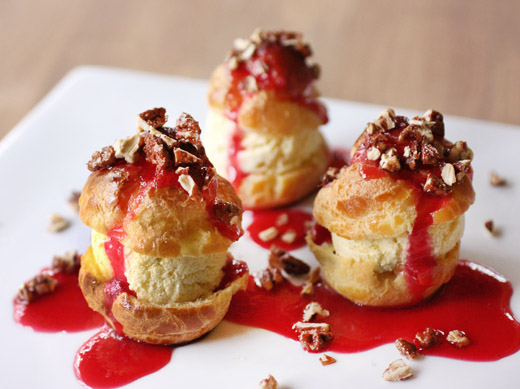
Profiteroles with Cranberry Caramel Sauce and Maple Spiced Pecans

After holding tryouts for Thanksgiving dessert, I of course ended up going in a completely different direction than any of the contestants. Let me explain how this happened. Kurt claims to not have much of a sweet tooth, but there are three similar sweets that he really likes. Those are Boston cream pie, eclairs, and profiteroles. I’d made the first two at different times in the past, but I’d never made profiteroles even though we always order it when we see it on a restaurant dessert menu. I had various ideas about how to change up the classic components of a profiterole to make it a more seasonal, Thanksgiving kind of dessert, and Kurt voted down almost all of them. He insisted plain, vanilla ice cream and standard chocolate sauce was the only way to go. There would be no pumpkin or cinnamon ice cream or spiced pate a choux or nutmeg dusting on top or any such thing. But, there was a Cranberry Caramel Sauce that I absolutely had to try. It’s from the October/November issue of Garden and Gun, and it belongs with a Pumpkin Bread Pudding recipe from Austin’s own Jodi Elliott of Foreign and Domestic. So long as the ice cream remained nothing but vanilla and the pastry puffs weren’t messed up with any spices, Kurt was willing to try a sauce other than chocolate. Then, I went ahead and made the Maple Spiced Nuts from the bread pudding recipe as well. One last, little change from the classic preparation wouldn't hurt.

This dessert was made up of four parts, so I started by making the vanilla ice cream in advance to have one part completed and ready. I used the vanilla ice cream recipe from Eggs by Michel Roux which is nicely rich with six egg yolks and perfumed with seeds from a vanilla pod. Next, I made the puffs according to Ina Garten’s recipe in Barefoot in Paris. I like that she suggests pulsing the eggs into the pastry dough in a food processor rather than stirring and stirring by hand. That recipe is also available online. The great thing about choux pastry puffs is that you can refrigerate them or even freeze them, and then just re-warm them for a few minutes in the oven before serving. The tops will re-crisp and the airy insides will be as puffy as when they first came out of the oven. The third part of the dessert was the cranberry caramel sauce which was a simple matter of cooking sugar, water, and corn syrup until amber and then adding cranberries and pure cranberry juice. The berries and juice were stirred into the caramel and the mixture was brought back to a boil until the cranberries had all popped. Off the heat, salt and vanilla were added. After letting the sauce cool a bit, it was pureed in a blender, and then I strained it before letting it completely cool. Last but not least, the pecans were tossed with maple syrup, corn syrup, sugar, salt, and a mix of cumin, cinnamon, ginger, nutmeg, and cayenne. The nuts were baked until toasted through and allowed to cool before I chopped them.

The hint of spiciness and bit of salt in the nuts was perfect with the tart and sweet sauce. And, I think plain vanilla ice cream was the way to go here since it allowed the flavors in the toppings to shine. In the end, we were both completely happy with these changes to the traditional profiterole for Thanksgiving dessert, but I don’t think I’d get away with messing with the classic eclair.

I am a member of the Amazon Affiliate Program.

Wednesday, June 27, 2012

Beer Nut Ice Cream

As I've been telling people about the flavors in the Humphry Slocombe Ice Cream Book, I keep hearing: "Wait, ice cream?" Yes, ice cream. This is the first book from the San Francisco ice cream shop, and I received a review copy. I first heard of Humphry Slocombe when I read Mission Street Food since their ice cream was served for dessert when MSF moved from the taco truck into the first restaurant. I knew they were known for unique flavors, and it was these recipes that sent me off in search of vadouvan curry and cubeb pepper. The curry powder is used in the Peanut Butter Curry ice cream, and the cubeb pepper is in Pepper and Mint Chip. Several of the flavors include a savory angle to accent the sweetness like Chocolate Smoked Salt, Strawberry Candied Jalapeno, and Candy Cap which is made with dried candy cap mushrooms. The thrill of this book is the surprising flavor combinations, but there are a few conventional options as well. There's a Tahitian V*nill@, Here's Your Damn Chocolate Ice Cream, Malted Milk Chocolate, and Blue Bottle Vietnamese Coffee. The shop's signature flavor is Secret Breakfast which combines bourbon and corn flakes in the form of chopped corn flake cookies. I can't wait to try that one. Since I couldn't decide which flavor to make first, I handed the book to Kurt and asked him to choose one. No surprise, he handed the book back opened to the Stout page. It's an ice cream made with reduced stout, brown sugar, and molasses, and there's a variation for turning it into Beer Nut Ice Cream by adding Frosted Peanuts. I congratulated Kurt on a great choice and put the ice cream canister in the freezer. 

In the recipe introduction, it's explained that they didn't expect this flavor to be as popular as it is. They write that the beer geeks keep asking for it and go on to describe the beer geeks as "the Trekkies of the food world." I loved relaying that quote to Kurt. It's also noted that this ice cream could be made with any beer, but stout becomes syrupy when reduced and works especially well. I chose a chocolate stout, but the chocolate flavor wasn't a part of the finished ice cream. After reducing with brown sugar, the stout tasted like butterscotch. Molasses and salt were added followed by milk and cream. When the mixture was back to barely a simmer, it was slowly poured into a bowl of egg yolks and sugar while whisking to temper the yolks. The custard-to-be was poured back into the saucepan and heated while stirring until thickened. It was poured through a strainer into a measuring pitcher set in an ice bath, allowed to cool, chilled in the refrigerator, and then churned in an ice cream maker. Meanwhile, I made the Frosted Peanuts. You just whisk together an egg white, some sugar, vanilla extract, and salt, and then add nuts. I used both peanuts and almonds, and coated them with the egg white mixture. Then, they were spread on a baking sheet and baked in a low oven for about half an hour. The nuts were stirred every 10 minutes while baking to prevent them from clumping. 

As the stout and brown sugar cooked and reduced, it smelled like delicious, malty butterscotch, and that's how the ice cream tasted too. The sweet-salty, crunchy nuts fit the flavor perfectly. For more beer ice cream, there's also a Guinness Gingerbread flavor in the book, and I'm already planning to serve that for dessert for Thanksgiving this year. And while I wait for fall, there are sorbets to try like Thai Chile Lime, Cayenne Cantaloupe, and Hibiscus Beet. For frozen desserts beyond the ordinary, this is the book for inspiration. 

Stout 
Recipes reprinted with publisher's permission from Humphry Slocombe Ice Cream Book

One 12-oz bottle stout, or any other strong beer you love 
1/2 cup brown sugar 
2 tbsp molasses (Note: If not using stout beer, skip the molasses.) 
2 tsp salt 
2 cups heavy cream 
1 cup whole milk 
3 egg yolks 
1 cup granulated sugar 

No, you can’t get drunk from beer ice cream. 

Well, maybe you can if you eat a few gallons of it, but in that scenario, you’d throw up from the fat and dairy well before getting a buzz from the beer. 

We mostly use stout in the shop—it gets rich and syrupy when reduced, permeating the air with a great yeasty smell—but you can use this basic recipe with any kind of beer. We like cheap beer, medium-priced wine, and expensive bourbon. Unfortunately, cheap, watery beer like PBR or Bud Light won’t work too well, because the lighter the beer, the less pronounced the flavor. We’ve come to favor any variation of stout, but if you’re a real beer fanboy, you can try other kinds of beers that have strong, distinct flavors. (For example, IPA gets its own flavor during Beer Week; we don’t offer it during the rest of the year, though, because the hops are very pronounced. It’s not for everyone, but beer geeks love it. 

We thought beer ice cream would be more or less a novelty that comes and goes, but the legions of beer geeks proved us wrong. They’re like the Trekkies of the food world, and their passion never ceases to amaze. Now beer is in our regular rotation. Lick your beer; we promise to hold your hair back if you have too much. 

In a large, heavy-bottomed, nonreactive saucepan over medium heat, combine the beer and brown sugar and cook, stirring often, until reduced by half, 15 to 20 minutes. It should be slightly sticky to the touch. 

Add the molasses (if using) and salt and stir to dissolve the salt. Add the cream and milk and cook, stirring occasionally, until hot but not boiling. 

Fill a large bowl or pan with ice and water. Place a large, clean bowl in the ice bath and fit the bowl with a fine-mesh strainer. 

Meanwhile, in a medium bowl, whisk together the egg yolks and sugar until well blended. 

Remove the cream mixture from the heat. Slowly pour about half of the hot cream mixture into the yolk mixture, whisking constantly. Transfer the yolk mixture back to the saucepan with the remaining cream mixture and return to medium heat. Cook, stirring constantly with a rubber spatula and being sure to scrape the bottom of the saucepan so it doesn’t scorch, until the liquid begins to steam and you can feel the spatula scrape against the bottom of the pan, 2 to 3 minutes. 

Remove the custard from the heat and immediately pour it through the strainer into the clean bowl you set up in the ice bath. Let cool, stirring occasionally. 

When the custard has totally cooled, cover the bowl tightly and chill in the refrigerator for at least 1 hour or preferably overnight. When you are ready to freeze the custard, transfer it to an ice cream maker and spin according to the manufacturer’s instructions. Eat immediately or freeze for up to 1 week. 

Fun Fact: Before the New York Times profile on Humphry Slocombe was published, we had to submit to a bunch of fact-checking. Jake spent hours on the phone with the marvelous Anaheed Alani. Somewhere along the way, she mentioned that her favorite ice cream was a beer-and-peanut flavor from a Manhattan shop. To thank her for her work, Jake sent a pint of the ice cream that would later become, in tribute, Anaheed’s Beer Nut. We hope it’s her new favorite. To make it for yourself, prepare Stout as directed and stir in ½ cup Frosted Peanuts after spinning the custard in your ice cream maker. 

Free Advice: Since the beer ice creams are all so high in alcohol (compared to other ice creams that is), they probably won’t freeze completely in your ice cream machine—depending on what kind of machine you have, of course. Don’t fret; freeze as best as you can in the machine and finish it off in the freezer. Transfer to an airtight container, cover, and freeze until it reaches the desired consistency. 


Frosted Peanuts 

Makes 2 cups 

1/2 cup sugar 
1 egg white 
1/2 tsp vanilla extract 
Pinch of salt 
2 cups roasted, unsalted peanuts 

We use Frosted Peanuts in our Tin Roof sundae and in our Beer Nut ice cream, but there are about 391 other uses for them, including just snacking on them. 

Preheat the oven to 250°F. 

In a medium bowl, lightly whisk together the sugar, egg white, vanilla, and salt. When everything is smooth and mixed, stir in the peanuts. 

Spread out the coated peanuts on a Silpat or parchment lined baking sheet. 

Bake, stirring every 10 minutes so the nuts separate and do not stick together in one big clump, until the nuts are dry, about 30 minutes. Transfer immediately to a plate to cool. Keep for up to 2 weeks in an airtight container. 

I am a member of the Amazon Affiliate Program.

Friday, March 16, 2012

Pistachio Gelato

I wasn't lying when I said I'd be making pistachio gelato soon. Now, I'm thinking I need a bigger ice cream maker because frozen treats like this one never seem to last long. The recipe is from the book The Country Cooking of Italy, and true to traditional gelato-making, it’s lower in butterfat and sugar than ice cream. In the book, there’s a brief story about the arrival of sorbets and gelatos in Italy and a mention of ice cream sandwiches. It was in Sicily where gelato was first scooped into a brioche roll and was typically eaten that way in the morning. Why have I never had gelato in brioche for breakfast, and how soon can I change that? In describing gelato, Andrews writes: “(it) has a distinctive texture, creamy but sometimes faintly grainy.” With this pistachio gelato, that was definitely true. It’s made with pistachio flour which I could have ordered online, but instead, I ground whole pistachios in a food processor. I sifted the ground pistachios, but I suspect a purchased pistachio flour would have been a little finer. So, yes, my pistachio gelato was slightly grainy, but what struck me most about it was how rich and creamy tasting it was considering that there were no eggs and no cream.

If you’re able to find pistachio flour, then by all means, use it. But, grinding pistachios in a food processor is an easy task. As I mentioned, I sifted the ground pistachios before using them. One cup of the sifted ground pistachios was used, and that was placed in a big measuring pitcher and set aside. This particular gelato was thickened with corn starch. So, cornstarch and sugar were placed in a heat-proof bowl with some milk, and the mixture was whisked to combine. More milk was heated to a simmer in a saucepan, and the cornstarch mixture was whisked into it. That mixture was heated, while stirring, until it thickened which took about ten minutes. The thickened milk mixture was then poured over the ground pistachios while whisking. This was left to cool and then refrigerated overnight. The next morning, the pistachio mixture was poured through a sieve before being poured into the ice cream maker.

The flavor was completely pistachio, and I loved that plenty of green remained in the mixture after straining out the ground nuts. This does freeze very firm, so it’s best to move it from the freezer to the refrigerator about an hour before you plan to scoop it. Then, it’s surprisingly velvety and rich-tasting for what a simple concoction it is.


Friday, October 21, 2011

Mint and Chocolate Brownie Chunk Ice Cream

So, taste is subjective, and it’s also subject to change. Back in the day before I made most of the ice cream we have at home, Kurt and I used to stand in front of the freezer section of the grocery store and negotiate about which flavor to choose. He would quickly rule out my favorite, butter pecan, and I would not even let him point to his favorite which was mint chocolate chip. If I remember correctly, we usually ended up with dutch chocolate or cherry garcia. Each of our favorites had to wait for special occasions like our birthdays or something like that. It’s been years since Kurt has even mentioned mint chocolate ice cream, but I thought I’d whip up a special treat just for him and maybe, just maybe, I’d come around to this flavor combination in a homemade version. The fresh mint ice cream recipe is from The Perfect Scoop, and in the perfect pairings paragraph, adding chunks of chewy-dense brownies, also in the book, is suggested. The great thing about the brownies is that they really do remain chewy after being frozen. Little chunks of them were folded into the churned ice cream before letting it set up in the freezer. The ice cream itself was lovely and fragrant from the fresh mint leaves, and steeping the leaves in the milk even tinted it just barely green.

The brownies were made by melting unsweetened chocolate and butter and then adding sugar, eggs, and vanilla. A scant bit of flour along with some salt was added to the batter, and I omitted the chocolate chips and optional nuts. The brownies baked until just set, and then when cool, they were cut into small chunks. To begin the ice cream, milk, sugar, some cream, and a pinch of salt were combined and warmed in a saucepan. Two cups worth of mint leaves were added to the milk mixture, the pan was covered, and it was left to steep for an hour. The mint was strained out of the milk mixture, and the milk mixture went back on the stove to be warmed again. Then, the usual procedure for a custard took place. Five egg yolks were tempered with the warm milk mixture, the whole combination went back on the stove until thick enough to coat the back of a spoon, and then it was strained into a bowl with additional cream. The custard was cooled and then churned in an ice cream maker. Last, the finished mint ice cream was layered in a dish with chunks of chewy brownies, and it was frozen until firm.

Steeping the mint leaves in the milk gave it even more flavor than I expected. The freshness of the mint flavor with the richness of the custard took me by surprise. I liked it. And, those chunks of chewy brownie pieces were way better to my mind than those hard, waxy-tasting chocolate chips in the store-bought stuff that Kurt used to like. Kurt, on the other hand, was confused. This was not the mint chocolate ice cream he remembered from years ago. This was something completely different, and it was very good. But, for the record, he liked those hard bits of chocolate chips.


Blogging tips