Showing posts with label flour. Show all posts

Monday, January 30, 2012

Oatmeal-Maple Scones

Do you have a favorite breakfast treat? I think I have a pretty equal appreciation for baked goods in the breakfast category. I might be a little more interested in popovers and croissants than muffins, but I certainly don’t shun them. Cinnamon rolls and Danish never disappoint me either. For that matter, I can be made very happy with some toasted, good bread and a fresh nut butter. Then, there are scones. They’re rich but not gooey, just sweet enough but not too much, and they accompany a hot cup of tea or a frothy cappuccino perfectly. And, Kurt is admittedly partial to scones above all other breakfast breads. He notices when it’s been a while since I’ve baked scones and starts dropping hints. Thankfully, though, neither of us is picky about shape, size, or flavor when it comes to scones. That means I can experiment with any scone recipe that sounds interesting, and I found another one from the book Flour that looked like it was well worth a try. After sorting through bags of leftover nuts, dried fruit, and grains, I found everything I needed to make them. I did substitute walnuts for the suggested pecans, but that was the only change I made.

The dough for these scones comes together in the usual way, but here, it’s made in a mixer. Flour, oats, baking powder, baking soda, salt, golden raisins, and toasted and chopped nuts, walnuts in my case, were mixed in the bowl of a stand mixer until combined. Cold butter, cut into small pieces, was scattered on top and mixed for half a minute to break it into even smaller pieces and begin to incorporate it. In a separate bowl, cream, maple syrup, and an egg were whisked, and then that was mixed into the flour and butter until the dough just formed. Interestingly, the scone dough itself is only sweetened with the maple syrup and no additional sugar was added. Off the mixer, you should use a rubber spatula to move the dough around and make sure all the dry ingredients at the bottom of the bowl are worked into the dough. Rather than cutting the dough into shapes, here, it was scooped from the bowl into mounds on a baking sheet. The portioned scones on the baking sheet could have been frozen at this point and then baked directly from the freezer, but I put them straight into the oven. As the scones cooled, they were topped with a glaze made from confectioners’ sugar, maple syrup, and water.

They had great texture from the oats and nuts and the chewy raisins, and they were filled with maple flavor. I liked the crispy edges on these scones that resulted from the dough being dropped on the baking sheet rather than the scones being cut. And, I liked how easy that made them to make. This was a winner of a scone variation, and now I have one more for the rotation when I hear those hints.


Thursday, October 13, 2011

Buttermilk Biscuits with Parsley and Sage

I feel like I’ve been keeping this from you. It wasn’t on purpose of course, but I’ve made these twice before and am only just now getting around to telling you about them. These biscuits are as easy to make as they are delicious, and I highly suggest doubling the recipe which I’ve done each time I’ve made them. There’s chopped, fresh sage in the biscuit dough, and then when they come out of the oven, they’re brushed with melted butter and sprinkled with chopped parsley. They’re as rich and decadent as buttermilk biscuits should be, and they’re pretty with flecks of herbs inside and out. I found these biscuits in the book Flour by Joanne Chang. The first time I made them, I was looking for something savory to take to the Austin Bakes bake sale earlier this year in April. I was delighted with them, and since they’re quick to prepare, I made them again for the bake sale that just happened a few weeks ago. There’s no cutting butter into flour by hand. The entire process takes place in a mixer. And, once the biscuits are formed, they can be placed in the freezer until you’re ready to bake them. I’m already thinking about how convenient that would be for Thanksgiving dinner.

So, you start the dough by placing the flour, baking powder, baking soda, and salt in the bowl of a stand mixer and mix briefly to combine. Then, you add butter that’s been cut into pieces, and mix until the butter breaks down some. In a small bowl, buttermilk, cream, egg, and chopped sage are whisked together and then added to the mixing bowl, and that is mixed into the flour and butter just until the dough comes together. As you transfer the dough to a work surface, you can work in any loose flour in the bottom of the mixing bowl. After patting the dough into a one-inch thick rectangle, I cut square biscuits to make things easy. Of course, you could use a round cutter, but I like the efficiency of only shaping and cutting once. Since I doubled the recipe and cut smallish squares, I ended up with 20 biscuits. They baked for 40 minutes, and then the tops were bushed with melted butter and sprinkled with chopped parsley. I sprinkled some coarse sea salt on them as well.

Like every recipe I’ve tried from this book, it works beautifully. My only disappointment with these biscuits is that each time I've baked them, I only kept a couple of them at home. I was happy to take them to the bake sales, but next time, I’m making a batch just for us.


Tuesday, August 23, 2011

Granola Bars

Clearly, I use hiking as an excuse to make homemade granola bars. Last year, I made fruit and nut energy bars which we took with us while hiking in Arizona, and just recently I tried the granola bars from the Flour book for a state park hike closer to home. It's hot here, and it's dry, and it doesn't seem like either of those conditions will be changing any time soon. So, we ignored all of that and went to Pedernales Falls State Park for a hike, a picnic, and some splashing through very little water. As you can see in the photo below, the riverbed was nearly dry in places courtesy of our ongoing drought. It made it easy to walk up and back from one side to the other in several places along the river, but it also made for disappointing splashing after our hike. At least we had plenty of water with us for drinking and plenty of snacks. This version of granola bar is a layered affair with a quickly-made jam between a crunchy bar and a seed-filled topping. Overall, they're a little more tender than other granola bars I've tried, and they taste more like an indulgent treat than a healthy snack.

About that jam, all that's involved is adding water and sugar to a mix of dried fruit, bringing it a boil, and then letting it sit for about an hour. Once the dried fruit softened, the mixture was pulsed in a food processor to make a chunky jam. Dried apples, cranberries, and apricots were suggested, but I didn't find dried apples at the grocery store, so I used dried mango instead. The jam can be made in advance and stored in the refrigerator. When the food processor was cleaned and ready to go again, the base of the bars was made in it with flour, oats, brown sugar, coconut, salt, cinnamon, and butter. After being pulsed together, two-thirds of that mixture was spread in a nine inch by thirteen inch baking pan, and it was baked for about 30 minutes. For a crisper base layer, you could go for a longer baking time. The baking pan was removed from the oven, and the bottom layer was topped with the jam. The remaining granola mixture was refrigerated while the base layer baked, then, when cool, it was broken into chunks and mixed with flaxseeds, sunflower seeds, and hemp seeds. There was supposed to have been millet, and I was sure I had some millet in one of my grain and flour bins at home, but since it wasn't actually there, I used hemp seeds instead. That crumb mixture was sprinkled on top of the jam, and the pan went back into the oven for an additional 50 minutes.

Even though these bars were full of healthy oats, seeds, and fruits, they tasted far more decadent than you would expect. The jam layer and crumb topping helped disguise the bars' granola-ness too. Our hike might have been in unrelenting heat next to a nearly dry river, but there were no complaints about the snacks that day.


Tuesday, April 5, 2011

Lemon-Strawberry Cake with Lemon Buttercream

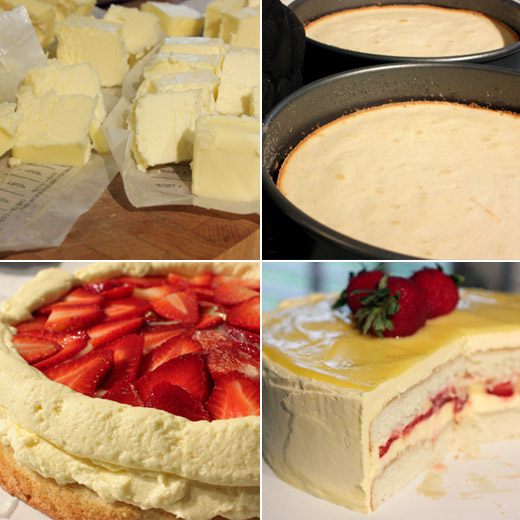
Even though I always start pondering cake options weeks in advance of my birthday, I usually end up choosing something lemony or berry-filled or both, unless I decide on butterscotch. I always have to try something different, it’s never the same cake twice, but the flavors are usually similar. I’ve been enjoying baking from Flour since receiving a review copy last fall. Not only has everything from the book been completely delicious, the recipes have also just worked really well. Even if you have a standard approach to apple pie, and I did, the one from this book might change your mind about it. The techniques resulted in the best apple pie I’ve ever made. So, I’ve come to trust this book, and I’m thrilled that Joanne Chang is working on a second one. I knew there would be a good option for a birthday cake in Flour. The name of the cake in the book is lemon-raspberry cake with lemon buttercream, but I had fresh, local strawberries to use instead. It’s intended as a three layer cake with lemon curd mixed with buttercream and berries between each layer. I cut the quantity down to two layers for the cakes and stored the extra buttercream and lemon curd in the freezer for another use. This was a special occasion cake, meaning there are a few parts to making it, although none of them are difficult.

I started by making the lemon curd in advance, and I used meyer lemons for the juice. The next day, I made the cakes which began by creaming together butter and sugar and then adding vanilla and lemon zest. A mixture of flour, baking powder, and salt were added alternately with milk. Last, egg whites were beaten until they held peaks, and they were folded into the cake batter. While the cakes baked and cooled, I gathered ingredients for the French buttercream. First, a sugar syrup was made in a saucepan, and it was brought to 238 degrees F. Eggs and egg yolks were mixed in a stand mixer until pale, and then the syrup was slowly added to the eggs while mixing on low speed. Once all the syrup was added, the speed was increased to medium, and it was mixed until fluffy and cool. Next came the butter, and this was an obscene amount of butter. Three cups of butter were cut into chunks, and the chunks were slowly added while mixing until the buttercream became smooth and lovely. A pinch of salt was added, and the frosting was completed. One last item to make was the lemon syrup which was a mix of lemon juice, sugar, and water which was brought to a boil to dissolve the sugar and then left to cool. That lemon syrup was brushed on top of each cake layer before the filling and toppings were added. A little of the lemon curd was mixed with a little of the buttercream to make the filling that was placed between the cake layers. And, I need to pause for a moment while I remember that mixture of lemon curd and buttercream because it was delightful. I placed some of it in a plastic bag so I could pipe a quick circle of the mixture around the edge, and that held the berries in place preventing berry juice from running on the outside of the cake. Sliced strawberries were placed on the curd-buttercream layer inside the circle barrier. The other cake layer went on top, it was brushed with lemon syrup, and the remaining plain buttercream was used to frost the top and sides of the layers. Last, some lemon curd was spread on top of the cake, and I decorated with a few whole strawberries.

The cake met my requirements perfectly for lemony-ness and berry flavor. Lemon curd, buttercream, and fresh strawberries couldn’t possibly disappoint. The cake layers themselves were light as can be, and the brushed-on lemon syrup kept them from becoming dry. With the strawberries, it was a cake for spring, and I bet the lemon flavors would be great with blueberries too. I’m not sure I can top this, so I might have to bake the same cake again next year.


Wednesday, February 23, 2011

Joanne Chang, What Are You Reading?

Growing up in a traditional Chinese household, Joanne Chang didn’t experience sweet desserts after meals until she was introduced to them by friends. Luckily for us, she did indeed develop a sweet tooth which led her to a serious interest in desserts and pastries. Sure, she dabbled in consulting after graduating with honors from Harvard with an Applied Mathematics and Economics degree, but soon enough, she began her career in food. After working at a few restaurants in Boston, she took the opportunity to work as a pastry cook at Payard Patisserie in New York before returning to Boston to open her own bakery. The name of that bakery, Flour, comes from the idea that even the most complex things start with basic elements. Today, there are three locations of Flour Bakery and Cafe, and Joanne is also an owner of Myers + Chang with her husband Christopher Myers. Last October, her book Flour was released, and I’ve been having a great time baking from it. The book will be celebrated this Sunday at the The Beard House in New York where Joanne will prepare a sweet and savory brunch including her famous sticky buns, smoked salmon tartines, bacon quiche, and brioche doughnuts with chocolate pudding. I managed to steal a moment of her time this week to ask, what are you reading?

Joanne:

Thai Street Food by David Thompson- a truly gorgeous book. As inspiring as Hot, Sour, Salty, Sweet was to me when we first opened Myers+Chang. The recipes are all authentic and he doesn't take shortcuts. His exploration of the street foods of Thailand make you want to jump on the next plane to SE Asia. The photos are mouthwatering and the people watching from the book's vantage point is like being there.


My Bread by Jim Lahey- I love his method of bread baking and have had such success with it at home. I love bread and My Bread allows me to enjoy it more easily at home.


Tartine Bread by Chad Robertson- I'm as in love with this book as I am with Tartine, the pastry book. The methodical and professional explanation of how to make bread are terrific for someone like me who knows a bit about bread but wants to learn more.


The Sweeter Side of Amy's Breads by Amy Scherber- Amy's Breads is my must-see place whenever I go to NYC. Of course the breads are great but over the years I've fallen in love with Amy's scones and cookies and cakes, all of which are in this book. She has a great matter of fact way of explaining the recipes and stories behind them that I always enjoy reading.


Blood, Bones and Butter by Gabrielle Hamilton- My husband got an advance copy and I read it in one sitting. Prune is one of my favorite restaurants in NYC and I found Gabrielle's life story fascinating. She's lived about a million lives in one and she's the real deal.


Thank you for participating, Joanne. Check back to see who answers the question next time and what other books are recommended.

Previous WAYR posts:
Jaden Hair
Michael Ruhlman
Monica Bhide
Michael Natkin
Sara Roahen
Andrea Nguyen
David Lebovitz
Rick Bayless
Tara Austen Weaver
Mollie Katzen
Deborah Madison
Soup Peddler
Sara Kate Gillingham-Ryan
Robb Walsh
Kim Severson
David Leite
Dan Lepard
Carolyn Jung
Joan Nathan
Melissa Clark
Dianne Jacob
Zoƫ Francois
Yotam Ottolenghi
Lucinda Scala Quinn
Barbara Lynch
Addie Broyles
Cheryl Tan


Friday, January 28, 2011

Heart-Healthy Dried Fruit Scones

It’s the start of a new year and time to eat a little lighter, but we do like our scones. I’m a little surprised that this is only the fifth time I’ve posted about scones because Kurt and I both enjoy them in all flavors, shapes, and sizes. They can be decadent though. So, I was happy to try this slimmed down recipe from Flour since I’m becoming convinced this book can do no wrong. Joanne Chang set out to make less indulgent scones that didn’t rely on extra sugar for flavor. Instead, these are packed with dried fruit and frozen cranberries, and the not-too-sweet dough is made with a little canola oil instead of a lot of butter. They’re also topped with a vanilla glaze which gives them instant visual appeal. I even went one step further and used some whole wheat flour in place of some of the all-purpose. The result was a scone that’s good enough to look forward to each morning without a trace of guilt.

These scones were also very easy to make. There was no butter to cut into the flour, and the dough wasn’t even rolled out or cut to form the scones. To start, I mixed whole wheat flour with all-purpose flour, sugar, baking powder, baking soda, salt, and cinnamon in a big bowl. Then the fruit was added, and that included dark raisins, golden raisins, chopped dried apricots, I used chopped dried pineapple instead of dried apples, dried cranberries, chopped candied ginger, and I used frozen cranberries since fresh ones are no longer available. In a small bowl, eggs, yogurt, and buttermilk were whisked together, and then that was stirred into the flour mixture. The dough was scooped one-half cup at a time onto a baking sheet, and the scones were ready to bake. There was a note in the recipe stating that once the scones are scooped onto a baking sheet, they can be frozen and then baked directly from the freezer. So, I made them in advance and baked them from the freezer so we could have freshly baked scones for breakfast. They just require about five extra minutes in the oven if frozen. After baking and cooling, a confectioners’ sugar and vanilla glaze was spooned over each one.

The mix of fruit was delightful with the cranberries’ tartness and the ginger’s zing. The crumb of the scone was lighter, less dense, and a little like a cross between a scone and a muffin. Obviously, they’re not as rich as an ordinary scone, but when we’re feeling like being less decadent, I now have a trusted alternative to enjoy.


Tuesday, December 14, 2010

Cornmeal-Lime Cookies

I'm always drawn to a cornmeal-lime cookie, but I'm not always happy with what I get. Some versions tend to be dry and often the lime is barely discernible. Well, I can stop trying every version that comes along, because I've found one that delivers big in texture and taste. These cookies are from the new book Flour, and I told you I'd be mentioning it frequently around here. They bake up puffed and light with a tender, almost cake-like crumb, they have great cornmeal flavor, and the lime is both noticeable and delicious. The thick glaze that's brushed onto each cookie adds a sweet, tart layer on top with bits of lime zest adding decoration. I made some of these at the recommended size of about one quarter cup of dough per cookie, and I made a some at a smaller size. The smaller sized cookies worked fine and still had the same tender texture. What I really should have done was double the recipe, and next time I definitely will.

Making the cookies started with the standard creaming together of butter and sugar. Lime zest was added with eggs and vanilla followed by a whisked-together mix of flour, cornmeal, baking powder, and salt. As I mentioned, the cookies were formed from one quarter cup scoops of dough, and the scoops were slightly flattened with the palm of my hand. Do you use an ice cream scoop for placing cookie dough on baking sheets? I started doing that years ago, and I use scoops for muffins too. Some scoops break easily or the sliding arm that glides through the scoop seems to constantly pop out of its track. If you've ever had that problem, I may have the solution for you. Food scoops work better than ice cream scoops, and they come in all different sizes. I used the 2.07 ounce scoop here. The large cookies baked for about 25 minutes, and the slightly smaller ones I made baked for about 20 minutes. The glaze was made with confectioners' sugar, water, fresh lime juice, and lime zest. Once the cookies were cool, the glaze was brushed onto the tops, and they were left to dry.

I noticed a look of surprise that came upon each person who tasted these cookies, and they surprised me too. They're simple cornmeal-lime cookies, but they're different and better. That light texture and the great flavor make them the best of their kind that I've tried. I know I'll be baking these repeatedly, but first I have to find out what else there is to discover in this book.


Saturday, December 11, 2010

Cranberry-Maple Pecan Breakfast Cake

I had high hopes for this breakfast cake. With tart cranberries, sweet maple syrup, and lots of pecans, I imagined this was going to be a keeper. This is from the new book Flour by Joanne Chang, the pastry chef and owner of the two Flour Bakery and Cafes in Boston, and I received a copy to review. This was one of those books that had me turning pages and walking toward the kitchen at the same time. It's full of irresistible looking treats and informative tips in each recipe. Chang's background includes an education in applied mathematics and economics, but her love of pastries inspired an eventual career change. She worked in other restaurant kitchens, including a stint in New York with Francois Payard, and then opened her own bakery in Boston. Her philosophy is one of "simple things are best" because even complex pastries start with the basics. Hence, the name Flour for her bakery. Those simple things throughout the book range from breakfast treats to cookies, cakes, pies, and tarts, and then there are other sweets and breads. I have a feeling I'll be mentioning this book frequently around here. I've already baked two items from it, and both were very well-received.

For this breakfast cake or pound cake or whatever you'd like to call it, maple pecans were made by warming pure maple syrup and toasted and chopped pecans in a saucepan. The goal was to stir the mixture and allow the pecans to absorb the syrup. Then, the pecans were cooled while the batter was mixed. Flour, sugar, baking powder, baking soda, salt, and butter were mixed, and the instructions include the amount of time for mixing with a stand mixer and a hand-held mixer depending on what equipment you are using. I like a thorough recipe like that. Then, in a small bowl, buttermilk, eggs, vanilla, and more maple syrup were whisked together before being added to the flour mixture. The liquid ingredients were added in two parts, and again mixing times were given. Last, fresh cranberries and the maple pecans were folded into the batter, and the batter was scraped into a parchment-lined loaf pan. It baked for just over an hour and filled the house with maple goodness all the while. Once it cooled, the cake was removed from the pan and topped with a thick maple syrup and confectioners' sugar glaze.

In the notes for this recipe, Chang writes that "the cake tastes remarkably like pancakes," and it really does. The maple flavor permeates the cake, and the pecans and cranberries accompany it well. I was so thrilled with the cake when I first tasted it, I declared it Christmas breakfast-worthy. And, if you have any left for the day after Christmas, it just gets better.


Blogging tips