Showing posts with label kale. Show all posts

Friday, December 8, 2017

Wild Greens Jam

The holiday season is upon us, and I’m knee-deep in ordering gifts, deciding which cookies to bake this year, and making a wreath for our front door. Bear in mind that crafting is not actually on my list of enjoyable hobbies, but two trips to the craft store, one to the hardware store, and an online order later, the homemade wreath is almost ready to hang. Speaking of gifts, I have one for two of you! I want to tell you about the book Unforgettable: The Bold Flavors of Paula Wolfert's Renegade Life of which I received a review copy. And, I have one book to offer to each of two winners. Just leave a comment on this post with your email address so I can contact you, and I’ll pick the winners next week on Friday, December 15th. (The winners will need to provide a mailing address in the US or Canada.) 

You’re going to enjoy this story of Paula Wolfert’s career in food. She started writing about Moroccan food before several of the key ingredients could even be found in the US. Her focus has always been on authentic international cuisines, and her recipes don’t tend to cut corners. I was intrigued to learn that before she wrote her first cookbook, she was the series editor and organizer of an epicurean subscription program called International Home Dining that was part of Columbia House. She created a different box each month for an international-themed dinner that included recipes and ingredients for a unique meal. During this time, “Paula developed another element of what would become her visionary cookbook-writing style: unapologetically complex recipes, engaging descriptions to capture their flavors in vivid detail, and mail-order sources to bypass the limited American supply chain.” That is my favorite kind of food- and cookbook-writing. Wolfert’s first cookbook was Couscous and Other Good Food from Morocco written in 1973, and her ability to learn the stories behind the food and draw the techniques and recipes from the cooks as she did for this book became her way of researching all of her food topics. She wrote about the cooking of Southwest France before Americans knew much about cassoulet, and then moved on to writing about sumac, pomegranate molasses, and Aleppo, Marash, and Urfa peppers in Eastern Mediterranean. So many ingredients and dishes we take for granted these days were introduced to cooks in the US by Paula Wolfert. She’s now living with a condition of mixed dementia, and this book was written while she could still contribute memories of her life and career. After reading about how she traveled, learned, and cooked her way through so many cultures, I’m looking forward to adding a couple more of her titles that are missing from my cookbook collection. 


This book moves through Wolfert’s life chapter by chapter, and there are recipes at the end of each. There’s Mussels Saganaki from Thessaloniki, a Mint and Egg Salad suggested as an accompaniment to Turkish kofte, and Tuscan White Beans with Sage and Garlic for clay pot cooking. Some other dishes I want to try are the Leblebi which is a Tunisian soup served over chickpeas and bread cubes with an egg on top and the Sprinkle Pie made with greens and feta with a light cornmeal crust. Since this time of year is definitely greens season here, I had to try the Wild Greens Jam recipe. This dish is firmly in the savory category despite jam being in the name. The greens are cooked until very tender and mixed with spices and olive oil to end up in a spreadable or spoonable form. It’s made with a mix of greens, and purslane and mallow are suggested. Sadly, once the other greens appear at our farm stands and farmers’ markets, purslane is gone for the fall. I used a mix of collards, kale, and arugula. The greens were cleaned, stemmed, and chopped before being steamed. Parsley leaves were added to the greens along with unpeeled garlic cloves, and everything steamed for about 15 minutes. After cooling, the greens were squeezed in a towel and then chopped finely. The garlic was peeled and pureed with cilantro leaves. That mixture was then sauteed in a large skillet with olive oil, and smoked paprika, ground cumin, and cayenne were added. The chopped greens were then added and cooked for another 10 minutes until the liquid evaporated. Lemon juice was stirred into the greens with a little additional olive oil, and the mixture was served with preserved lemon and oil-cured olives for garnish. 

The silky greens with bright pops of citrus from the preserved lemon made a great combination. I spooned the jam onto crostini and made sure to top each one with an olive. Now, there’s so much more to explore that Paula Wolfert brought to life through her books. To be entered to win a copy of Unforgettable, just leave a comment here with your email address so I can contact you. I’ll pick the winners next week on Friday, December 15th. (The winners will need to provide a mailing address in the US or Canada.) 

I am a member of the Amazon Affiliate Program. 

Monday, December 5, 2016

Kale Potato Cakes

I thought I was fairly familiar with the styles of cuisine from different regions in the United States. I’ve read about Low Country and Southern foods and their differences and similarities. But, it wasn’t until I read my review copy of Victuals: An Appalachian Journey, with Recipes by Ronni Lundy that I was introduced to the foods of the Appalachian Mountain South. There was something familiar about the family recipes here. The use of home-grown vegetables, the mentions of the distinct flavors of fresh beans and just-dug potatoes, and the simplicity of the preparations reminded me of my grandparents’ cooking. I should mention, this is more than a cookbook. Ronnie Lundy grew up in eastern Kentucky and weaves the stories of this region with true understanding. The picturesque writing details the landscape along with the history of the towns and the people who have lived there. She writes: “I try to imagine what this journey was like on foot, as native people made it, and as many of the early settlers did, possessions stripped to not much more than tools for survival and seeds for planting. Switchbacks flanked by walls of rock and furiously rushing creeks are gorgeous, but equally perilous… I realize that while this was a passage of risk and hardship, it was also one of great possibility.” The book encourages travel as much as eating. She also writes of how things have changed over time and about some of the newly established restaurants in the area. The recipes represent traditional family fare as well as a few of the more recent restaurant dishes. There’s Shelley Cooper’s Speckled Butter Bean Cassoulet with Rabbit Confit from Dancing Bear Appalachian Bistro in Townsend, Tennessee alongside all the recipes for “the absolute best summer supper” including Mountain Green Beans and Taters, Skillet Corn, sliced tomatoes, and Buttermilk Cucumber Salad. You’ll also find Skillet Fried Chicken and Milk Gravy, Fried Apples, Buttermilk Brown Sugar Pie, and Colin Perry’s Sorghum and Apple Sticky Pudding. All the recipes come with a story and a place in time in this pocket of the country. 

Now that our weather has cooled off, I was ready for a good, comfort food kind of dish that makes use of fresh greens. I brought home a pretty bunch of kale from Boggy Creek Farm to make the Kale Potato Cakes. Yukon Golds were peeled, quartered, and boiled until tender. Meanwhile, the kale was washed, stemmed, and chopped. The kale was sauted in olive oil until wilted. The drained potatoes were mashed a bit before the cooked kale was added. Chopped green onions were added as was shredded Asiago cheese. Four beaten eggs were then mixed into the mashed potatoes. The mixture was formed into three-inch patties that were crisped on both sides in hot olive oil in a skillet. The potato cakes were served with Old-School Tomato Gravy made with sauteed onion, flour for thickening, and canned diced tomatoes. 

The crispy potato cake edges give way to tender, fluffy interiors, and the Asiago cheese flavors them well. The tomato gravy was delicious with them, but they were also perfectly lovely with no sauce at all. I’m inspired to find my way to this area of the country and drive along the mountain roads described in the book. I want to find the artisanal salts being made from newly revived salt mines and taste some of the many varieties of apples that grow there. Then, I want to bring home some sorghum syrup and make that Sticky Pudding. 

I am a member of the Amazon Affiliate Program. 

Thursday, March 27, 2014

Gumbo z’Herbes with Fried Oysters

The first time I made gumbo, I remember wondering if there was such thing as a vegetarian version. Years later I learned that, yes, there is actually a tradition of a vegetarian gumbo. It’s called Gumbo z’Herbes or Green Gumbo. It’s less common than meat- and seafood-filled gumbos, but it came about as a type of gumbo to serve during Lent or specifically on Good Friday. I’d been thinking about making this while local greens are in season, and I finally did it, fittingly during Lent. This is more of a soup than thicker gumbos, and it’s filled with whatever greens you have on hand, herbs, green onions, and in this case, chopped turnips. The recipe I followed is from Crescent City Cooking by Susan Spicer, and every time I use this book I find more dishes from it that I need to try. I liked that she gilded the dish a bit with the addition of fried oysters. And, why not? You wouldn’t want to serve a gumbo that’s entirely virtuous, right? Naturally, it starts with the trinity of vegetables which includes onion, celery, and green bell peppers. And, this is where things get scandalous. I prefer just about any other possible color of bell pepper to green. Here, I used a mix of green and orange, and I don’t feel too guilty about it. Chef John Besh recommends red bell pepper for his etouffee; so I’m not alone in this. Now, for the turnips, I was hoping it wasn’t too late in the season to find some at the farmers’ market, and luck was on my side. At our Wednesday market, I found the cutest, little white, Japanese turnips grown by Animal Farm. The flavor is mild and lovely, and they were perfect for the gumbo. 

Although this is a Lenten, vegetable-based kind of gumbo, the recipe does call for chicken stock. I made some vegetable stock to use instead. To begin, you need to make a roux in a wide, heavy pan like a Dutch oven, and making roux is one of those cooking-related tasks that I really enjoy. I love watching the color slowly transform from beige to brown while stirring and stirring. For this recipe, the roux was taken to a peanut butter color. At that point, the trinity of finely chopped onion, celery, and bell pepper was added. Next, finely chopped garlic, those lovely little chopped turnips, and some chopped green onions were added and allowed to cook for about five minutes. For the greens, I used washed and torn kale leaves and spinach leaves along with the leaves from the turnips. All the greens nearly overflowed from the pan, but they cook down in no time. Once the greens were wilted, thyme leaves and file powder were added followed by the vegetable stock. The stock was added slowly, brought to a boil, and reduced to a simmer. A bouquet garni of parsley stems, a bay leaf, and thyme sprigs was added to the stock, and it was left to cook for an hour. If you’re making the fried oysters, the oyster liquor can be added, and Worcestershire sauce is suggested for seasoning as well. To make the oysters, they were first dusted with cornmeal and then quickly fried just until golden. The oysters I brought home for this were tiny, so they only cooked in the hot oil for about two minutes. The gumbo was served with white rice, the fried oysters, some extra chopped green onions, and hot sauce on the side. 

I now know that regardless of the main ingredient in a gumbo, it’s always a fun and delicious dish. The trinity cooked in a brown roux never fails, and I never get enough of liberally dousing a gumbo with Crystal hot sauce. The greens and turnips cooked to a completely tender state and took on the flavors of the herbs and aromatics. I still love a good seafood gumbo, but I think this vegetable version, with or without the oysters, deserves more attention than it gets. 

I am a member of the Amazon Affiliate Program.

Thursday, December 5, 2013

Polentina alla Toscana

Cooking doesn’t have to be complicated. Everyone has favorite things to eat that are the simplest things to make. David Tanis’ latest book, One Good Dish, is a collection of some of his favorites. I received a review copy of the book. He writes in the intro: “There are many good reasons to stay home and cook. And, even though we may not always have the energy to invest in a complex meal, making one simple, delicious dish (maybe two) is certainly manageable. One good dish, carefully prepared and eaten with pleasure, is an end—and a delight—in itself.” Indeed, the book is full of dishes for snacks, small meals, soups, sides, entrees, sweets, and drinks that look delightful. The inspiration comes from childhood memories and food from all around the world. There isn’t a strict adherence to traditional approaches. Instead, these are dishes borrowed for flavors, possibly adapted for ease, and made simply delicious. For instance in the chapter for dishes made with bread, the Waffle-Iron Grilled Cheese was Tanis’ favorite childhood sandwich made by his aunt. Here, it’s shown in his current, preferred version with grown-up cheeses and good bread. The Vietnamese Vegetable Baguette is based on the concept of the bahn-mi, but this one is built with just the pickled vegetables and topped with avocado and hard-cooked eggs. In the snacks chapter, there’s a Tomato and Egg Salad that I can’t wait to make next summer. It’s just a thick slice of tomato topped with homemade mayonnaise and a quartered, medium-cooked egg. I already tried and loved the Mackerel Rillettes. I’ve seen many versions of similar spreads made with smoked salmon, but this was the first I’d seen made with smoked mackerel. It was buttery, lemony, and herby with great smoked fish flavor. I served it with crostini on Thanksgiving. One more dish I want to try soon is the After-Dinner Dates. There are two versions. One involves stuffing pitted dates with whipped creme fraiche flavored with orange and lemon zest and then sprinkled with chopped pistachios. The other version is made with almond paste. 

Since we seem to actually be having chilly weather this year, and it came early, another dish I wanted to try was the Polentina alla Toscana. It’s a hearty, vegetable soup thickened with polenta. It starts like a lot of soups with onion, carrots, celery, and fennel being cooked. Next, leeks and a bay leaf were added. Then, just a quarter cup of polenta was added before the stock was stirred into the vegetables. It simmered for about an hour. Separately, kale was sauteed with chopped garlic and red pepper flakes and was then used to top the soup after it was ladled into bowls. The final garnish was chopped rosemary and a drizzle of olive oil. It was perfect soup for a cold day. 

There’s an ease about these recipes that draws me straight to the kitchen. But, in addition to being straightforward to prepare, the dishes are also interesting and varied. It’s the kind of book that will make you think about your favorite dishes and how to make them even better, and it will give you several more dishes to add to your favorites list.

Polentina alla Toscana 
Recipe reprinted with publisher’s permission. Excerpted from One Good Dish by David Tanis (Artisan Books). Copyright © 2013. Photographs by Gentl and Hyers. 

Serves 4 to 6 

Some soups, once encountered, live on in both memory and a cook’s personal repertoire. This very traditional Tuscan soup impressed me when I first encountered it in Florence. I loved the way a little polenta could be used to thicken, ever so slightly, a vegetable soup. There was something special too about the deep, dark kale and fruity olive oil that were added to the bowl. My version is faithful to the original, so good that there was no need to embroider.  

1/4 cup extra virgin olive oil, plus more (optional) for drizzling 
1 large onion, diced 
1/2 pound carrots, peeled and diced 
4 celery stalks, diced 
1 large fennel bulb, trimmed and diced 
Salt and pepper 
1 medium leek, trimmed and cut into 1/2-inch squares 
1 bay leaf 
1/4 cup polenta 
6 cups chicken broth 
1/2 pound kale, preferably Tuscan 
1/2 teaspoon grated or finely chopped garlic 
Pinch of red pepper flakes 
Leaves from 1 rosemary sprig 

In a heavy pot, heat 2 tablespoons of the olive oil over medium-high heat. Add the onion, carrots, celery, and fennel, season generously with salt and pepper, and cook, stirring, for 5 minutes or so, until barely softened. Add the leek and bay leaf and cook for 2 minutes. 

Add the polenta, stirring to distribute it, and raise the heat to high. Add the chicken broth and bring to a boil, then reduce the heat to a gentle simmer and allow the soup to simmer for about an hour; the broth should be just slightly thickened. Taste and adjust the seasoning. 

Meanwhile, wash and roughly chop the kale. Drain in a colander but do not dry. Heat the remaining 2 tablespoons olive oil in a wide skillet over high heat. When the oil is hot, add the greens, stirring as they begin to wilt. Add the garlic and red pepper flakes and season with salt and pepper. Turn the heat to medium, cover, and cook until the greens are tender, about 5 minutes more. Set aside. 

To serve, ladle the soup into bowls and top with the kale. Sprinkle with the chopped rosemary (finely chop it at the last minute), and drizzle with more olive oil if desired. 

I am a member of the Amazon Affiliate Program.

Saturday, December 1, 2012

Warm Fennel and Parmesan Dip

This is a great time of year to add another dip to your repertoire, especially a warm dip with cheese scattered on top that turns golden as it bakes. And, this is one of the simplest out there. Rather than mixing the primary ingredients with mayonnaise or sour cream as is customary, this dip is made up of pureed, roasted fennel and garlic. There are only four ingredients in this dip if you don’t count the salt and pepper, but those are four very flavorful ingredients that make the end result seem a lot more complicated. I saved this recipe from the Thanksgiving dinner story in the November 2010 issue of Living magazine. The dip was served as a starter along with kale chips with sea salt and lemon which were made in the usual way by chopping kale leaves, tossing with olive oil and salt, and then roasting until crisp. The twist was that when the kale chips came out of the oven, they were topped with lemon zest. I liked the idea of having crispy, lemony chips with the warm, rich dip. So, I served the dip already spread onto little toasted pieces of bread with a kale chip nestled on top and more chips piled in the middle of the platter of toasts.

You start by trimming and removing the core from three fennel bulbs and then chopping them into thick wedges. The fennel wedges are then browned in a skillet with extra-virgin olive oil. Four or five peeled, whole, and slightly smashed garlic cloves are added as the fennel browns. Then, the fennel is turned, seasoned, the skillet was covered with foil, and it’s placed in a 400 degree F oven for about 30 minutes. The fennel and garlic should become completely tender and sweet. Next, the roasted fennel and garlic was transferred to a food processor and pureed until smooth. Grated parmigiano reggiano was added and mixed in, and then you should taste for seasoning. The puree was scooped into a small baking dish and topped with more grated parmesan before it went back into the oven that had been turned up to 450. After about 20 minutes, the dip was warmed through, and the cheese on top was invitingly browned. I toasted some sliced, homemade, sourdough baguette as the dip baked, and popped the kale chips into the oven as the dip cooled a bit.

Mellow roasted garlic and fennel with the big flavor of parmesan makes for a delicious mix. With that much flavor, you'd never guess how short the ingredient list actually is. And, the hit of lemon on the kale chips was a nice, perky contrast to the savory dip. Since it’s easy to make the dip in advance, chill it, and bake it just before serving, this will definitely be a go-to recipe for holiday parties.


Wednesday, June 20, 2012

Asian-Flavored Kale and Cabbage Slaw

Things do change over time. Several years ago, when Kurt and I signed up for our first CSA, we both dreaded the mounds of greens that appeared each time we picked up our share. I used to have to rack my brain trying to think of ways to use them all. Then, at some point, I changed my mind about greens. I became a kale advocate, a collards enthusiast, an escarole devotee. Now, when they're out of season during the hottest part of the summer, I actually miss them. To me, a pasta dish doesn't seem complete without some sauteed greens, and even fried eggs look lonely on the plate without something green and leafy accompanying them. Needless to say, I was delighted to receive a review copy of the new book Wild About Greens by Nava Atlas because I now feel the same way. This book covers everything from cleaning and prepping greens to hearty dishes, salads, soups, and juices and smoothies. Even though I've been using greens and enjoying them for a while now, I found several intriguing new ideas to try. Next time I receive mustard greens from our CSA, they'll go into Balsamic-Glazed Chickpeas and Mustard Greens. Other dishes I can't wait to try include the Vietnamese-Style Bean-Thread Noodles with Spinach and Napa Cabbage, simply sauteed greens with Spicy Peanut Sauce, and Italian-Style Braised Chard with Tomatoes. I'm already a convert to putting greens in a berry smoothie, and next I want to try the Spinach Pina Colada Smoothie and the Kale and Pear Smoothie with hemp seeds. First though, I had to make use of some local kale before it's gone for the summer, and the Asian-Flavored Kale and Cabbage Slaw was a great place to start. 

This is an easy, raw salad that would fit nicely into a picnic menu. I followed the recipe and left things simple, but I kept thinking of all the things that could be added to this. One change I did make was to use savoy cabbage rather than the suggested napa cabbage, and that was only because savoy was available the day I was shopping and napa wasn't. The dressing for the slaw was made first, and that was a mix of olive oil, dark sesame oil, apple cider vinegar, soy sauce, and agave nectar. Next, the kale leaves were cleaned and chopped into thin strips. For a raw kale salad, the leaves need to be squeezed a bit or massaged to soften them. You just oil your hands and work the oil into the chopped kale until the kale turns a bright green. It only takes a minute or two. Then, the rest of the vegetables were added, and those included shredded savoy cabbage, grated carrots, and some sprouts and I used radish sprouts. The vegetables were tossed with the dressing, sesame seeds were added and combined into the slaw, and then the slaw was topped with pumpkin seeds. As I spooned the slaw into a serving bowl, I thought about how next time I might add some sliced red bell pepper or some slivers of spicy serrano chiles. Some chopped green onions wouldn't be out of place here, and cubes of tofu on top would make a meal of it. Or, leave it just as it is for a fresh, crunchy slaw with big flavor from the sesame oil and soy sauce in the dressing.

It wasn't so long ago that rushing to the farmers' market in hopes of getting some late-season kale would have seemed crazy to me, but I'm glad to be a greens fan now. If I'd had this book back when we started our first CSA, I probably would have become a fan much sooner. 

Asian-Flavored Kale and Napa Cabbage Slaw 
Recipe reprinted with permission from Wild About Greens © 2012 by Nava Atlas, Sterling Publishing Co., Inc. Photographs by Susan Voisin.

6 to 8 servings 

This salad was inspired by Barbara Pollack, a longtime reader of my books. She forewarned me that it’s addictive, and she’s right. 

For the dressing: 
1 tablespoon olive oil or other healthy vegetable oil 
1 tablespoon dark sesame oil 
2 tablespoons vinegar (apple cider, rice, or white wine) 
2 tablespoon reduced-sodium soy sauce or tamari 
2 tablespoons agave nectar or other liquid sweetener 
5 or 6 Leaves kale, preferably lacinato (curly kale will work too) 
3 cups firmly packed thinly shredded napa cabbage 
1 cup grated carrots 
1 cup sprouts, any variety 
1⁄4 cup toasted pumpkin or sunflower seeds, or 1⁄8 cup of each 
3 tablespoons sesame seeds 
Freshly ground pepper to taste 

Combine the dressing ingredients in a small bowl and whisk together. Strip the kale leaves from the stems. Slice the stems very thinly or discard. Cut the kale leaves into very thin strips and place in a large serving bowl. Oil your hands lightly and massage the kale for 30 to 45 seconds, until the leaves are bright green and soft. 

Add the remaining salad ingredients, then toss well with the dressing. Let the salad stand for 15 minutes. Taste and adjust the tang, saltiness, and sweetness with more vinegar, soy sauce, or sweetener to your liking, then serve. 

I am a member of the Amazon Affiliate Program.

Monday, November 22, 2010

Spaghetti Squash with Turkey Meatballs

How about a dish of turkey with squash that has nothing to do with Thanksgiving? When I was digging through my files to locate the mini cranberry meringue pies the other day, I also found this healthy, autumnal meal from last October's issue of Living magazine. I have to admit, I haven't always been the biggest fan of spaghetti squash, but I think I've finally come around to really liking it. Here it's treated just like actual spaghetti with the meatballs piled on top of it, and with the sauteed mushrooms and greens, the sweetness of the squash is balanced. Now, you could go all the way with the theme and make a red sauce to top the spaghetti squash, but this dish was kept light with a sauce of simply simmered broth and extra vegetables.

A nice, big spaghetti squash was split down the middle lengthwise, seeds were removed, and it was roasted until tender which took about 45 minutes. When it was cool enough to handle, the skinny strands of squash were scraped with a fork into a colander and allowed to drain. Meanwhile, onion and garlic were sauteed and allowed to cool. Half of them were mixed into the ground turkey meatballs, and the other half were reserved for the sauce. The meatballs were browned in a large saute pan and then removed to a plate. Next, sliced mushrooms were sauteed, the reserved onion and garlic mixture was added to them, the meatballs were placed back in the pan, everything was covered with some stock, and it was left to simmer for a few minutes. Last, greens were added, and they could have been any greens but I used some local kale, and they were left to wilt before serving. The spaghetti squash was placed on plates and topped with the meatballs, mushrooms, greens, and sauce and hit with some grated parmesan.

I can't even remember how I last prepared spaghetti squash and why I then avoided it for so long, but I'm very glad I finally tried it again. With a dish that looks so much like standard spaghetti and meatballs, you don't even stop to consider that what you really have is a light and healthy, vegetable-heavy meal in disguise. And, now, enough of this talk of turkey with no mention of the big holiday. It's time for Thanksgiving week.


Tuesday, September 28, 2010

Kale Salad with Roasted Butternut Squash and Spiced Pecans

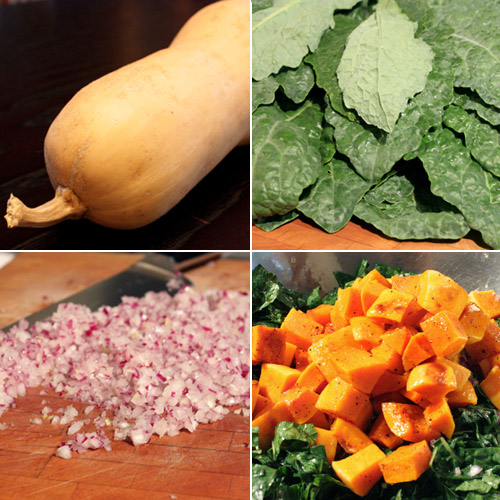
When I was invited to a hog roast last weekend, my first thought was to bring a salad. There was going to be a lot of pork on offer, so something green and leafy would at least be a good contrast. This hog roast was a celebration of local food with the hog itself coming from a nearby farm. I had just received my first butternut squash of the season from my CSA, and I found a couple of varieties of kale and red onions at the farmers’ market the morning of the party. And, I had ideas about raw kale. The week before, I attended a Health Starts Here cooking class at Whole Foods, and I posted a few photos from the class on Facebook. One of the dishes demonstrated was a raw kale salad, and the cut leaves were tenderized and wilted by squeezing the dressing into them by hand. I went with different flavors for my salad, but that technique made all the difference. This was something I made up as I went along without really measuring, but I’ll do my best to list approximate quantities in a recipe below.

I used dinosaur kale, but any variety would have been great. I cut the thick parts of the ribs from the leaves and then chopped the leaves into little ribbons. The ribboned leaves were washed and spun dry in a salad spinner, and then they went into a big bowl with finely chopped red onion. I poured some aged balsamic vinegar over the kale and reached in to scrunch away. You want to work the vinegar into the leaves, and the squeezing and scrunching will soften the kale. For the pecans, I imagined a little spice on them would add a faint bit of heat and interest to the salad. I whisked some chimayo chile powder, salt, and sugar into an egg white and then tossed the pecans in that mixture. Once well coated, they were toasted in the oven for about 20 minutes. The pecans and cubes of butternut squash and a small splash of olive oil were tossed with the kale to complete the salad.

The pig was the star of the night. When it was brought in for carving, it had everyone’s attention. I even tasted a piece of cheek and a bite of belly. It was a fine roasted hog, and the salad was indeed a good side dish. The sweet, spicy, and savory items balanced the bitter greens, and the leaves were slightly wilted with a little crispness intact. I’ve already decided I’m making this salad again for Thanksgiving and probably a few times between now and then.


Kale Salad with Roasted Butternut Squash and Spiced Pecans
a lisa is cooking original

1 small butternut squash
4 tablespoons extra virgin olive oil
1 1/4 cups pecans
1 egg white
1/2 teaspoon chimayo chile powder or cayenne to taste
1 teaspoon sugar
2 bunches kale
1 small red onion, finely diced
2-4 tablespoons aged balsamic vinegar (I used 18 year aged from Con'Olio.)
salt and pepper to taste

*note: the size of a bunch of kale will vary, so taste as you go and adjust as needed when adding the vinegar and olive oil to the salad.

-Pre-heat oven to 400 degrees F. Peel the squash, cut in half and remove seeds. Cut squash into 3/4-inch cubes. On a large baking sheet, toss cubed squash with 2 tablespoons olive oil and season with salt and pepper. Roast for 15 minutes or until squash is tender and allow to cool. The squash should be tender but not mushy. It should hold it's shape when tossed in the salad but still be cooked through. (The squash can be roasted a day in advance and stored in the refrigerator.)
-In a large mixing bowl, whisk one egg white with chimayo chile powder, sugar, and a good pinch of salt. Whisk just until the egg white is foamy. Toss the pecans in the egg white mixture and stir to coat the pecans well. Using your hands, place pecans on a parchment-lined baking sheet leaving excess egg white in the mixing bowl. Toast in the 400 degree oven for 15-20 minutes checking from time to time to be sure the pecans are not getting too brown. (The pecans can be toasted a day or two in advance and stored in an airtight container.)
-Cut thick parts of ribs from leaves of kale. Then, cut leaves in half lenghthwise and then into ribbons crosswise. Soak cut leaves in a large bowl of water. Swish to remove grit, and then allow grit to fall to bottom of bowl. Pick leaves up out of water and place in basket of a salad spinner and spin dry. Placed washed leaves in a large mixing bowl. Add finely diced red onion. Pour two tablespooons aged balsamic over kale and onion and squeeze and scrunch the leaves with your hands. You want to tenderize the kale and work the vinegar into the leaves.
-Add roasted squash cubes, toasted pecans, two tablespoons extra virgin olive oil, and salt and pepper to taste, and carefully toss to combine so squash cubes remain whole. The oil used in roasting the squash along with the pecans add richness to the salad, so nut much additional olive oil is needed. I used about two tablespoons, but taste as you add.


Blogging tips