Showing posts with label soup. Show all posts

Monday, December 10, 2018

Lentil Soup with Cauliflower and Cheese

Today is Terra Madre Day. It’s a day for celebrating good, clean, and fair food. This is a Slow Food celebration that focuses on protecting our environment and on the link between food and climate change. It’s a day to cook Food for Change. And, that can be one delicious way to work toward solving climate change. Full disclosure: I volunteer as the president of the Slow Food Austin chapter. Slow Food partnered with Camellia Beans and Meatless Monday to bring attention to vegetarian cooking for this occasion. After bringing home locally-grown cauliflower, onion, leeks, carrots, and thyme, a hearty soup with those ingredients plus lentils sounded perfect for a chilly night. I found this Lentil Soup with Cauliflower and Cheese on the Martha Stewart website. The broiled and browned parmesan on top made it comfort food in a bowl. I hope you’ll consider enjoying some Food for Change and Meatless Mondays or more days! 


Here’s a list of some of my other favorite lentil dishes: 
Lentil Croquettes with Yogurt Sauce 
Braised Root Vegetables with du Puy Lentils and Red Wine Sauce 
Lentils with Tomatoes and Gorgonzola 
Watermelon Curry on Black Lentil Cakes 
Bulgur and Green Lentil Salad with Chickpeas and Preserved Lemon 
Lentil and Pickled Shallot Salad with Berbere Croutons 
Mushroom and Lentil Pot Pies with Gouda Biscuit Topping 

If you have a favorite lentil dish, please share a link in the comments.


Tuesday, July 3, 2018

Summer Corn Soup

There was a time when I lived to shop. Nothing was better than spending a day immersed in clothing, shoes, and accessories to try on, compare, and decide what to take home. At some point, I became much lazier about shopping. Now, I’d much rather open several tabs in a web browser to compare and decide and order online. But, one thing that would make me want to shop in person is the prospect of a great lunch or dinner as part of the outing. Have you ever dined in a department store or clothing store? I have a couple of times. In both cases, the restaurants gave a feeling of providing for your every need. You can shop awhile, take a break, have a snack or a meal, and everything you could want is right there. That sense of generous hospitality was evident in the new book The Freds at Barneys New York Cookbook by Mark Strausman of which I received a review copy. The book is full of crowd-pleasing dishes from Freds, the restaurant inside Barneys, that can now be found in the Madison Avenue, Chicago, Beverly Hills, and Downtown New York stores. In creating Freds, the goal was to give visitors the feeling of being “in the midst of the bustle of life” and in the “warm, inviting center of that particular universe.” The food is intentionally uncomplicated and comforting with salads, sandwiches, and soups that happen to be fashionably presented to suit the surroundings. There are also Italian classics, brunch dishes, dinner entrees, and desserts. Everything is carefully prepared despite the volume of food that’s served each day in these restaurants. And, all of the recipes from the Belgian fries to the stocks and sauces are included here. I think I would have a hard choosing from the menu. From the salads alone, I would be hard-pressed to choose among The Palace Warm Lobster Salad with Freds Bistro Dressing, the Beverly Hills Asian Chicken Salad, and the Vegan Salad with Salsa Verde Vinaigrette. Then, with multiple variations on club sandwiches and the turkey sandwich topped with Russian dressing and slaw on an onion roll, I couldn’t decide. Or, should I order the crab cakes, Grilled Hen of the Woods Mushrooms in a Balsamic Glaze with Arugula and Shave Parmesan, or the Upper East Side Filet of Sole with Sauteed Carrots? The same issue would happen with the soups. There’s New Jersey Summer Heirloom Tomato Soup, Lobster Bisque with Saffron Aioli, and Freds Gazpacho. I had some fresh corn from my CSA, and that made my decision for what to cook first from the book much easier than ordering from the menu would be. Summer corn soup with local corn, potatoes, and onion was a great choice. 

You could keep this soup completely vegan by using vegetable stock and olive oil and skipping the butter and cream. I did use homemade vegetable stock and olive oil, and shucked corn on the cob was cooked in it until tender. The corn was removed and left to cool, and chopped potatoes, onions, and celery were added to the stock. The corn kernels were cut from the cobs, and the cobs went into the stock to add more corn flavor while the other vegetables simmered. After about 35 minutes, the corn cobs were removed, and the corn kernels were added to the soup. The soup was then blended in batches to make a smooth puree. The puree was returned to the stockpot, and here cream or milk or almond milk can be added. I had some creme fraiche on hand and used that. The pureed soup was heated through with the creme fraiche mixed in, and salt and pepper were added to taste. 


In the Soups chapter, there’s a mention of garnishes and how they add an important “little something” with flavor and texture. I went a little crazy with the garnish here and used some roasted cubes of pattypan squash, chopped fresh tomato, a few corn kernels I set aside, and ribbons of fresh basil. If possible, the garnishes made the soup even more summery. The corn flavor was like a bowl of sunshine as it was. Now, when I shop in a web browser, I can whip up something from this book and still enjoy the mix of shopping and great food. 

Summer Corn Soup 
Recipe reprinted with publisher’s permission from The Freds at Barneys New York Cookbook

This creamy soup is a recent and very popular addition to the Freds menu. It can easily be adapted to be vegan without losing the creaminess that makes it so satisfying. Chef’s tip: Freeze some of the water when you cook corn and use it in the stock for this soup. 

Serves 4 

2 quarts Vegetable Stock or Chicken Stock 
5 tablespoons unsalted butter (can substitute olive oil) 
1⁄4 teaspoon kosher salt 
6 ears fresh summer corn, husked and cut in half 
2 small potatoes, peeled and diced 
2 yellow onions, diced 
2 stalks celery, diced 
1 large leek, white part only, trimmed, well-washed, and diced 
1⁄2 cup heavy cream or 1 cup whole milk (can substitute 1 cup almond milk) 
Freshly ground black pepper 

Place the stock, butter, and salt in a large stockpot and bring to a boil. Add the corn and cook until tender, about 5 minutes. Remove the corn from the stock, set aside to cool, then use a sharp knife to shave the kernels off the cobs. Set the kernels aside, but do not discard the cobs. Return the pot with the broth to medium-high heat. 

Add the corn cobs, potatoes, onions, celery, leek, and cream. Bring to a boil, reduce the heat to low, and simmer gently until the potatoes are soft, 35 to 45 minutes. Fish out the cobs and discard. Add the corn kernels to the soup. Using a food processor, blender, or immersion blender, puree the soup until smooth. (Depending on the size of your machine, you may need to do this in several batches.) Be especially careful as you do this because the soup is very hot. 

If the soup is too thick, add additional stock and heat thoroughly. Adjust seasoning and serve.

I am a member of the Amazon Affiliate Program. 

Thursday, December 8, 2016

Broad Bean and Fennel Seed Soup + GIVEAWAY

Let’s take a quick trip to Sicily today. It’s the largest island in the Mediterranean, has been influenced by many cultures passing through and spending time over the centuries, and offers an immense variety of fresh produce and seafood. I was recently transported there while reading my review copy of Sicily: Recipes from an Italian island by Katie and Giancarlo Caldesi. The two of them operate two Italian restaurants and a cooking school in England. As they tasted their way around Sicily in hopes of finding some great, secret recipes, they repeatedly learned the “secret” for the best dishes was an obsession with the absolute freshness of the ingredients. The book’s chapters introduce you to Palermo and Its Street Food, Antipasti, Soups, Contorni, Pasta Rice and Couscous, Meat and Poultry, Fish, and Dolci and Cocktails. I had a hard time deciding what to make first. I was immediately curious about the Cauliflower in Red Wine in which parboiled cauliflower is sauteed with anchovies and garlic before the mixture is simmer with red wine and tomato paste. Next, I was pulled in by the Orange and Basil Risotto recipe involving zest and juice of an orange. Of course, there are several pasta dishes I want to try like the Sardine and Wild Fennel Sauce for spaghetti or busiate. But, in the end I decided on a soup so I could use a new stewpot I received from Lagostina. The pot is made for cooking polenta or minestrone with those words debossed on the lid, and it’s great-looking with the roundness of its shape and the curved handles. It comes with a wooden spoon for stirring and a metal ladle for serving, and the retail price is $199.95. Lagostina’s philosophy is to “attach the greatest importance to the aesthetic quality of our products because in Italy beauty is everywhere.” And, you could win one of these beauties! Just leave a comment on this post before 12/16/2016 when I’ll randomly pick one winner. 

To use this lovely stewpot, I decided to make the Broad Bean and Fennel Seed Soup. The broad beans, or fava beans, used here are in their dried form. I have a bag that I use from time to time for falafel. The beans have had their skins removed, and some are split. They need to be soaked overnight before beginning the soup. The soaked and drained beans were combined with a white onion cut in half, crushed fennel seeds, finely chopped celery, extra-virgin olive oil, water, and some white wine. The mixture was brought to a boil and then simmered until the beans were tender. Then, you have options to consider. You can serve a more brothy soup, or you can puree it, or you can puree some of it to thicken the soup slightly. Pureed cooked beans like this are sometimes served with sauteed greens. My choice was to puree some of the soup to thicken it and leave some of the beans whole and then top it with sauteed greens. It was also garnished with lemon zest, a drizzle of olive oil, and freshly ground black pepper. 

The beans provided a very mild base for the soup, and the fennel seeds and lemon added more decisive flavor. With the garlicky, sauteed greens on top, this was the right kind of soup for a chilly evening. Watching it simmer in that pretty pot made the experience even better. To be entered to win one just like it, leave a comment with your email address so I can contact you. The winner must provide a mailing address in the US. Good luck!

Broad bean and fennel seed soup 
Recipe reprinted with publisher’s permission from Sicily: Recipes from an Italian island

Dried broad (fava) beans have a distinctive, earthy flavour and a velvety texture unlike their former fresh selves. Do try them, I think the taste is perfectly lovely. In the south of Italy you can find a broad been purée probably introduced by the Romans, cooked from dried like this and served with the wilted green vegetable cicoria, another wonderful combination and easily reproduced with spinach. 

In Sicily, you will see the word maccu on menus all over the island; it comes from the word macare, to squash. Broad beans have been a staple of the peasant diet for centuries since they can be eaten fresh and raw in spring with young soft cheeses, boiled briefly through summer and dried for use in autumn and winter. In this case, dried broad beans are soaked overnight, then boiled and squashed to make a mash. If you use split broad beans they will have already been peeled and will take less time to cook. Leave it rough and ready like the ancient peasant soup that it was, or purée it for a sophisticated starter like our friend Marco Piraino, who showed me this recipe. He garnishes it with chopped samphire, drops of good olive oil and a little lemon zest. To make it more filling (it’s already pretty substantial!), put toasted bread drizzled with olive oil into soup bowls and ladle the soup on top, or leave the soup a little rough and mix in some just-cooked short pasta. The maccu sets firm when cold and can be cut into slices, breaded and fried. 

Serves 6 

500 g (1 lb 2 oz/2 cups) dried broad (fava) beans, with or without skins 
1 white onion, cut in half 
2 teaspoons fennel seeds, roughly crushed in a pestle and mortar 
1 celery stalk, finely sliced 
2 tablespoons extra-virgin olive oil 
1.6 litres (54 fl oz/6 3/4 cups) water 
4 tablespoons white wine 
salt, to taste 

To serve 
2 tablespoons extra-virgin olive oil 
a little chopped samphire or finely grated lemon zest 
freshly ground black pepper 

Cover the beans in cold water and soak overnight. The following day, drain the beans and discard the water. Slip the beans from their skins if not already peeled. 

Put all the ingredients together in a medium saucepan and bring to the boil. Turn the heat to low and let the beans bubble away until they are tender and easily squashed, up to 2 hours, adding a little more water if necessary. Keep a couple of tablespoons of the whole beans to one side for garnish. Puree the soup as much or as little as you like with a stick blender. Pour into warm bowls and garnish with the reserved beans, a swirl of olive oil and the lemon zest or chopped samphire. Finish with a twist of black pepper. 

Variations: As a vegetable side dish: As the beans are cooking, don’t add extra water but let the mixture become thick. Puree the mixture to a rough or smooth texture and use it as you would mashed potato. In the south of Italy you will often see this served with garlicky sauteed spinach or chard leaves on top. 

For sliced maccu: After blending the soup pour it into a lined loaf tin and allow to cool. Put it into the fridge overnight and it will set firm. It can then be cut into 1.5 cm (1/2 in) slices and dipped in flour, egg and breadcrumbs and fried in hot oil until browned. Drain it on kitchen paper and serve straight away, dusted in a little salt. 

I am a member of the Amazon Affiliate Program. 

Monday, November 7, 2016

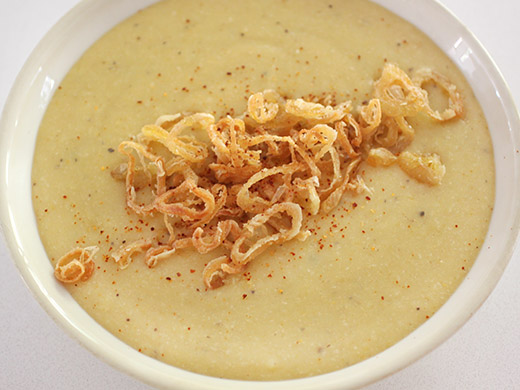
Pureed Plantain Soup with Crispy Shallots

Have you booked a trip to Cuba? Are you intrigued to visit now that it’s become just slightly easier to do so? I’d love to see everything before any major real estate development takes place, but I don’t have a trip planned at this point. In the meantime, I’ve been reading a review copy I received of the new book Cuba!: Recipes and Stories from the Cuban Kitchen. I’m fascinated with the fincas, or farms, where land that’s less than ideal for growing food is being slowly turned into productive areas with traditional, earth-friendly techniques. Soil is being revived with crops that return nutrients to the ground, and only natural fertilizers are used. The stories in the book are based on just a few visits to Cuba by the authors. The recipes cover Cuban basics, snacks, sandwiches, stews, meat dishes, seafood, sweets, and drinks. There are a few that I wasn’t sure are entirely authentic, classic, Cuban dishes like the Caribbean Black Bean Burger and the Mojito Cake. I did love seeing the Jibarito, though, and I can’t wait to make that again soon. I always seem to be drawn to recipes with plantains. This time, the Pureed Plantain Soup got my attention because it’s a texture I’d never tried with plantains. 

I love making pureed soups due to the ease of chopping the vegetables roughly since perfect size and shape doesn’t matter as much. The soup was started by sweating chopped onion and garlic. Green plantains were peeled and chopped into large chunks and added along with chicken stock. The soup simmered for about thirty minutes or so until the plantains were very tender. Then, it was ladled into the blender in batches to be pureed. After pureeing, it was returned to the stock pot to rewarm, and lime juice was added. While the soup was cooking, shallots were thinly sliced, dredged in cornstarch, and slowly fried in olive oil. The real trick to frying shallots is to take plenty of time and fry over low heat. You can watch the slices and decide how dark you want them to brown. When ready, the shallots were drained on a paper towel-lined sheet pan and seasoned with salt. The soup was served with a generous portion of crispy shallots on top. 

There was no warning in the book, but this soup thickens considerably once it cools. It occurred to me that it was actually a bit like polenta. I added water and whisked to combine to reheat it after refrigerating. But, I thought I might make this again and treat it intentionally more like polenta by letting it become thick. The mild flavor of pureed plantain with the onion, garlic, and lime would be great as a backdrop to a mix of spicy seafood. 

I am a member of the Amazon Affiliate Program. 

Thursday, June 9, 2016

Roasted Pepper and Chickpea Soup

You might not immediately think that summer and soup go together, but give me a chance to explain. I’m declaring this a perfect soup for summer because it’s so easy to make, because the ingredients can all come from the pantry or freezer, and because it would be as good chilled as it is hot. This was a treasure I discovered in my recipe files. I keep physical files of magazine pages I’ve cut out over the years. All the pages are filed according to type of recipe like soup, cake, pasta, etc. It had been ages since I’d gone through them. A couple of times a year, I flip through the recipes to pull out ones that I’ve since tried from other sources and to find inspiration from ideas I’d forgotten. This soup was a long-overlooked gem, and it’s from the October 2012 issue of Food and Wine. In its original format it’s even easier than how I prepared it, but I’ve never met a recipe I couldn’t make more complicated. In the magazine, it was made with store-bought hummus. Instead, I used canned chickpeas, lemon, and garlic. But, what I realized is that this soup is ideal for the night you return from a trip or return from a day in the outdoors or return home after having so much summer fun you don’t want to cook anything difficult. It’s a puree of roasted red peppers from a jar, chickpeas from a can, lemon and garlic from the panty, and store-bought chicken stock. The toppings are chopped roasted red peppers, cooked rice, and optional sliced chicken from the freezer. 

Piquillo peppers are suggested in the original recipe, but they’re not always easy to find. I used regular, jarred roasted red peppers. They were drained and all but one was added to the blender pitcher. The extra pepper was diced for topping the finished soup. I also rinsed and drained one can of chickpeas and added that to the blender pitcher as well. The juice of one lemon and three chopped cloves of garlic were added along with two cups of chicken stock, and the mixture was pureed. I prefer the blender for pureed soups for a smoother texture than a food processor would create. I had some Texas-grown, long-grain rice that I cooked while warming the soup puree. Salt and black pepper were added to the soup, and I added Espelette pepper for a little spice as well. I had some leftover grilled chicken from the freezer than I thawed and sliced for topping the soup. 

I mentioned this would be a good cold soup, and I think that’s due to the lemon. In a cold version, some crab meat or pickled shrimp would make good topping options, although those would make this less pantry- and freezer-friendly. Still, however you top it, this soup is meant for summer. 


Friday, October 10, 2014

Sour-and-Hot Mushroom Soup

Hot-and-sour soup is one of my favorites. Unfortunately, it’s not easy to find versions of it with no pork when ordering at restaurants. There are plenty of recipes for vegetarian versions of the soup to make at home, but I was particularly drawn to this mushroom-forward take. This is from Every Grain of Rice by Fuchsia Dunlop, and since I usually mention when I’ve received copies of books I want to point out that this is one I purchased. I was browsing the cookbook section at the bookstore which I can spend hours doing, and when I started looking through this one I lost count of how many dishes I wanted to run home and try. There’s a rainbow of sticky note flags marking pages in this book. The dishes are true to authentic Chinese cooking, but they’ve been made very accessible to home cooks in the West. Not too many ingredients are hard to find, and often those are optional. I’ve made the Tiger Salad which is a mix of cucumber, cilantro, green chiles, Chinkiang vinegar, and sesame oil. I made the Salt-and-Pepper Squid and added Shrimp lightly dusted in potato starch, fried, and topped with stir-fried garlic, green onion, and red chile. I tried the Sweet and Spicy Cold Noodles with sesame paste, sesame seeds, chile oil, and topped with shredded chicken. Everything has been outstanding. I can’t wait to take a stab at Dumplings in Chile Oil Sauce, the Stir-Fried Oyster Mushrooms with Chicken, and the wonderfully simple Silken Tofu with Avocado. This book hasn’t spent much time on the shelf and probably won’t. Now, back to this soup I started talking about. It’s described as subtler than the hot and sour soups from Chinese restaurants in the West. The sour comes from Chinkiang vinegar, and the hot was to be delivered by white pepper. I have a preference for black pepper and crushed red pepper, so I made a very unauthentic change to the dish by using those instead. However, I did seek out dried day lily flowers which were an optional item in the ingredient list. 

The recipe includes both fresh and dried mushrooms. We usually have a pretty good selection of types of fresh mushrooms at our local grocery stores, but on the day I was shopping for this dish shitakes were available but no oyster or enoki. I bought dried oyster mushrooms instead. The dried mushrooms and the dried day lily flowers were to soak in hot water for an hour before using. Meanwhile, I started cutting the ginger into tiny slivers. The fresh mushroom caps were also cut thinly, and the tofu was cut into thin shapes similar in size to the mushroom pieces. To start the cooking, oil was heated in a wok and ginger was sizzled until fragrant. The dried mushrooms which had been sliced thinly as well along with the fresh mushrooms and lily flowers were added next. The mixture was allowed to cook until the mushrooms were almost cooked through, and then, warm chicken stock was added and brought to a boil. The tofu was added and carefully stirred to prevent breaking it too much. Light and dark soy sauce were added, and after a short simmer, the vinegar and pepper were added. Off the heat, sesame oil was stirred into the soup, and it was topped with green onions. 

This was a fantastic hot-and-sour soup or sour-and-hot soup. The fresh and dried mushrooms gave it great flavor, and there was a nice mix of textures with the lily flowers and tofu. It lacked the shreds of cooked egg that often appear in a hot-and-sour soup, but there was enough going on here that I didn’t miss them. I’d like to just keep cooking page after page of this book, so a feast of a dinner party might be in order. 

I am a member of the Amazon Affiliate Program.

Wednesday, January 29, 2014

Tortilla Soup

I didn’t know about tortilla soup before I moved to Austin, but I quickly became a big fan. It’s one of those things, like chili, that everyone makes in his or her own way. Several local restaurants serve different versions of it. Sometimes, it’s a brothy soup with chunks of tomatoes, chiles, and chicken that gets topped with crispy tortilla strips, shredded cheese, and chopped avocado. Other times, the soup is thickened with tortillas cooked in the broth. And, one version that I like a lot is made thick with a puree of softened, dried chiles that sends it in the direction of mole sauce as soup. What I’d never tried, however, was a silky, pureed tortilla soup with the addition of butter. It’s a recipe from Chef Rene Ortiz of Austin, and it appeared in Food and Wine magazine last May. This was so different from other tortilla soups that I followed the instructions for the toppings to the letter. Since the soup is nicely rich with butter, it doesn’t need the usual, gooey, melted, shredded cheese. Instead, this was topped with avocado, cilantro leaves, sliced jalapeno, tortilla strips, and just a few crumbles of queso fresco. 

The soup is started by sauteing white onion and garlic. Next, tomatoes are added, and since it’s not tomato season, I used canned. Chipotles in adobo were added as well, and you might want to start with two and decide if you’d like more or not. The recipe suggests four which make the soup nicely spicy with a layer of smokiness. Chicken stock is added with the tomatoes and chipotles, and good soup results from good stock. I made a stock with chicken legs, lots of vegetables, and a few dried chiles I had in the pantry. As the soup simmers, you can fry tortilla strips for garnish. Any shape will work from strips to shoestrings to little squares. After the soup has cooked away for 30 minutes or so, it’s then pureed in batches in a blender with butter. One stick of butter was cut into pieces, and a few were added to each batch to be pureed. Either let the soup cool before pureeing, or blend in small batches that only fill the blender pitcher about one-third to one-half of the way. Then, if the soup is hot, remove the plastic inner piece of the pitcher lid, and hold a towel over the opening as you pulse the blender on and off. That way, steam can escape, and the pitcher lid won’t shoot off the top when you start the motor. Once all the soup is pureed, it’s ready to be re-warmed and then served with toppings including shredded chicken, crispy tortilla strips, avocado chunks, sliced jalapeno, cilantro leaves, and crumbled queso fresco. 

The smoke and chile heat from the chipotles were lovely. And, lots of crunchy, corn tortilla strips are a great contrast to the silky texture of the soup. I don’t think I could choose an all-time favorite version of tortilla soup since I like them all so much, but I have found yet another unique, delicious, and easy-to-make approach to add to my list of options. 


Thursday, December 5, 2013

Polentina alla Toscana

Cooking doesn’t have to be complicated. Everyone has favorite things to eat that are the simplest things to make. David Tanis’ latest book, One Good Dish, is a collection of some of his favorites. I received a review copy of the book. He writes in the intro: “There are many good reasons to stay home and cook. And, even though we may not always have the energy to invest in a complex meal, making one simple, delicious dish (maybe two) is certainly manageable. One good dish, carefully prepared and eaten with pleasure, is an end—and a delight—in itself.” Indeed, the book is full of dishes for snacks, small meals, soups, sides, entrees, sweets, and drinks that look delightful. The inspiration comes from childhood memories and food from all around the world. There isn’t a strict adherence to traditional approaches. Instead, these are dishes borrowed for flavors, possibly adapted for ease, and made simply delicious. For instance in the chapter for dishes made with bread, the Waffle-Iron Grilled Cheese was Tanis’ favorite childhood sandwich made by his aunt. Here, it’s shown in his current, preferred version with grown-up cheeses and good bread. The Vietnamese Vegetable Baguette is based on the concept of the bahn-mi, but this one is built with just the pickled vegetables and topped with avocado and hard-cooked eggs. In the snacks chapter, there’s a Tomato and Egg Salad that I can’t wait to make next summer. It’s just a thick slice of tomato topped with homemade mayonnaise and a quartered, medium-cooked egg. I already tried and loved the Mackerel Rillettes. I’ve seen many versions of similar spreads made with smoked salmon, but this was the first I’d seen made with smoked mackerel. It was buttery, lemony, and herby with great smoked fish flavor. I served it with crostini on Thanksgiving. One more dish I want to try soon is the After-Dinner Dates. There are two versions. One involves stuffing pitted dates with whipped creme fraiche flavored with orange and lemon zest and then sprinkled with chopped pistachios. The other version is made with almond paste. 

Since we seem to actually be having chilly weather this year, and it came early, another dish I wanted to try was the Polentina alla Toscana. It’s a hearty, vegetable soup thickened with polenta. It starts like a lot of soups with onion, carrots, celery, and fennel being cooked. Next, leeks and a bay leaf were added. Then, just a quarter cup of polenta was added before the stock was stirred into the vegetables. It simmered for about an hour. Separately, kale was sauteed with chopped garlic and red pepper flakes and was then used to top the soup after it was ladled into bowls. The final garnish was chopped rosemary and a drizzle of olive oil. It was perfect soup for a cold day. 

There’s an ease about these recipes that draws me straight to the kitchen. But, in addition to being straightforward to prepare, the dishes are also interesting and varied. It’s the kind of book that will make you think about your favorite dishes and how to make them even better, and it will give you several more dishes to add to your favorites list.

Polentina alla Toscana 
Recipe reprinted with publisher’s permission. Excerpted from One Good Dish by David Tanis (Artisan Books). Copyright © 2013. Photographs by Gentl and Hyers. 

Serves 4 to 6 

Some soups, once encountered, live on in both memory and a cook’s personal repertoire. This very traditional Tuscan soup impressed me when I first encountered it in Florence. I loved the way a little polenta could be used to thicken, ever so slightly, a vegetable soup. There was something special too about the deep, dark kale and fruity olive oil that were added to the bowl. My version is faithful to the original, so good that there was no need to embroider.  

1/4 cup extra virgin olive oil, plus more (optional) for drizzling 
1 large onion, diced 
1/2 pound carrots, peeled and diced 
4 celery stalks, diced 
1 large fennel bulb, trimmed and diced 
Salt and pepper 
1 medium leek, trimmed and cut into 1/2-inch squares 
1 bay leaf 
1/4 cup polenta 
6 cups chicken broth 
1/2 pound kale, preferably Tuscan 
1/2 teaspoon grated or finely chopped garlic 
Pinch of red pepper flakes 
Leaves from 1 rosemary sprig 

In a heavy pot, heat 2 tablespoons of the olive oil over medium-high heat. Add the onion, carrots, celery, and fennel, season generously with salt and pepper, and cook, stirring, for 5 minutes or so, until barely softened. Add the leek and bay leaf and cook for 2 minutes. 

Add the polenta, stirring to distribute it, and raise the heat to high. Add the chicken broth and bring to a boil, then reduce the heat to a gentle simmer and allow the soup to simmer for about an hour; the broth should be just slightly thickened. Taste and adjust the seasoning. 

Meanwhile, wash and roughly chop the kale. Drain in a colander but do not dry. Heat the remaining 2 tablespoons olive oil in a wide skillet over high heat. When the oil is hot, add the greens, stirring as they begin to wilt. Add the garlic and red pepper flakes and season with salt and pepper. Turn the heat to medium, cover, and cook until the greens are tender, about 5 minutes more. Set aside. 

To serve, ladle the soup into bowls and top with the kale. Sprinkle with the chopped rosemary (finely chop it at the last minute), and drizzle with more olive oil if desired. 

I am a member of the Amazon Affiliate Program.

Thursday, March 14, 2013

Roasted Carrot Soup with Dukkah Spice and Yogurt

Some people get earworms, songs stuck in their head, and can’t think of any other music because of that tune that won’t go away. I have this issue with recipes instead of music. Is that a recipeworm, foodworm, brainworm? I don’t think I like any of those names for the condition. I’ll keep working on that. This soup was one of those recipes that took up residence in my head and wasn’t going to leave. I saw it in the December issue of Bon Appetit and thought of it every time I saw carrots. It’s an incredibly easy soup to make, but this is one of those times when simple is perfect. You roast chopped carrots and then puree them with vegetable broth, and that’s the soup. But, what makes those carrots especially tasty is the melted butter that’s drizzled over them before they’re roasted. The power of butter to elevate flavor is a marvelous thing. I happened to have a few spring onions that had just arrived from my CSA, so I roasted and pureed them with the carrots which added one more layer of flavor to this simple soup. Then, it’s all about the garnishes. A nice, little dollop of thick yogurt and a sprinkling of dukkah, and this was a recipeworm, for lack of a better name, that was worth having. 

To make the dukkah, you toast shelled pistachios in a dry skillet and then let them cool on a plate. Next, you toast sesame seeds, coriander seeds, cumin seeds, fennel seeds, and peppercorns in the same skillet. I chopped the pistachios by hand and ground the spices and sesame seeds with a mortar and pestle with some salt before combining them. This spice and nut mixture can be made in advance and stored at room temperature. The carrots were peeled, cut into big chunks, and placed on a baking sheet. I trimmed spring onions, cut them in half and tossed them on the baking sheet with the carrots. Just two tablespoons of butter was melted and drizzled over the vegetables before they were roasted in the oven for about 25 minutes. The roasted vegetables were transferred to the blender and pureed with vegetable broth. The puree was reheated in a large saucepan before being served with thick yogurt and the dukkah. 

This soup with the toppings is delicious all by itself, and I discovered it’s also a very good soup for dunking grilled cheese sandwiches. I’m glad this stuck in my head until I finally tried it. Now, I need a better name for this condition. Any suggestions? 


Monday, January 28, 2013

Wild Rice and Mushroom Soup

Last fall, I read The Man Who Changed the Way We Eat: Craig Claiborne and the American Food Renaissance after receiving a review copy and learned all about Craig Claiborne’s life. I didn’t realize that his approach to food writing was so revolutionary at the time. After studying at the Ecole Hoteliere de Lausanne in Switzerland, he sought out “the sublime” in cuisine, service, and dining experiences, and that’s what inspired his writing. He found disappointment in a lot of restaurants, but when his expectations were met, he was thrilled to share what he’d found. He had sophisticated taste that required teaching his readers about unfamiliar foods while not alienating them. After writing pieces for Gourmet, he became the food editor at The New York Times in 1957. His first NY Times Cookbook was published in 1961, and I have the revised edition from 1991. I’d never sat down with this cookbook before since there isn’t a lot of introductory info or many recipe headnotes. But, after reading about Claiborne’s life, I was interested in finding out what recipes were in this book I’d had for several years. There are complicated and fancy things like Truffled Pate and Lobster L’Americaine, but there are also plenty of simple salads, pastas, vegetable dishes, and homey desserts. Most of the recipes have no notes or explanations about their origin, but the wild rice and mushroom soup did. It’s actually called Julie Wilson’s Wild Rice and Mushroom Soup, and Claiborne wrote that it’s “one of the greatest soups ever created.” He also pointed out that it’s a “bit time-consuming,” and he was right about that, but it was definitely worth the effort. I marked this page back in October and just got around to trying this lovely soup. There’s a version of this recipe online at the NY Times, and the quantities are slightly different from those in the book, but otherwise it’s the same. 

This soup can easily be vegetarian if vegetable stock is used, but the recipe was written with chicken stock. There are a few steps that require waiting or simmering, but those things can be happening at the same time. You start by rehydrating dried mushrooms with hot water. While those sit for at least 20 minutes, you can start cooking the wild rice which takes almost an hour. I found some nice, long grains of wild rice from Minnesota, and it was cooked in boiling water with a little butter. Next, onion, garlic, and leeks can be chopped while waiting on the mushrooms and rice. Once the dried mushrooms were hydrated, they were drained into a bowl so the soaking liquid could be saved. The mushrooms were rinsed under running water to remove any grit, and they were squeezed dry before being chopped. Tough stems were discarded. The soaking liquid was poured through a sieve lined with cheesecloth and reserved. Moving right along, olive oil was heated in a Dutch oven, and the onion, garlic, and leeks were sauteed until tender. The chopped, dried mushrooms were added followed by flour. This mixture was cooked for a few minutes before white wine, stock, salt and pepper, some Tabasco (I prefer Crystal), and the mushroom soaking liquid were added. This was brought to a boil and then left to simmer for an hour. Yes, this soup takes some time. At this point, it could be refrigerated until the next day. After simmering, the soup was pureed in batches in a blender. It went back into the Dutch oven and half-and-half was added. As it was re-warmed, fresh mushrooms were sliced and sauteed in butter. Once cooked, they were sprinkled with lemon juice and sherry. The cooked, fresh mushrooms were added to the pureed soup along with the cooked wild rice. Thyme and parsley were added, and the soup was ready to be served. 

Wild rice has always been one of my favorite grains, and I don’t cook it often enough. I love the chewy texture, and it’s a perfect match with mushrooms. This is a hearty and slightly decadent soup, but it’s a meal of a soup. There are layers of flavor from the dried mushrooms to the wine to the herbs added at the very end. I’m glad to have learned more about Craig Claiborne’s life, and I look forward to cooking more things he recommended.

I am a member of the Amazon Affiliate Program.

Friday, January 20, 2012

Southwest Seafood Chowder

I’m not sure that this is a chowder. It might be a mix of Manhattan chowder, bouillabaisse, cioppino, and maybe chili if that’s even possible. But, that’s not what’s important here. This was one of those recipes that had me doing a happy dance in the kitchen as I tasted while I cooked. It's from the March 2011 issue of Food and Wine. A soup base was built from torn pieces of ancho chiles, onion, garlic, and fennel seeds that simmered in white wine before crushed tomatoes were added. Long before any seafood made its way into the soup, it already tasted like it was intended to be there. The flavor from the fennel seeds was like a splash of Pernod in bouillabaisse. The soup base was pureed and then potatoes, red onion, chopped fennel bulb, and corn formed the building blocks of the chowder before shrimp, halibut, and clams were added. The aroma from the stove was already fantastic from the earthy chiles, aromatics, and fennel, and then some smoked paprika made it even better. There was a lot going on in this soup, but all of those flavors were mingling very harmoniously. I was pretty sure I had a winner of a meal on my hands, and soon enough, that suspicion was confirmed. I should explain that Kurt doesn’t always freely offer his opinion of meals. Usually, I have to ask, and usually, his answer is that “it’s good” or “it’s fine.” Clearly, I have a more emotional attachment to food to say the least. This time, with no prompting whatsoever, he proclaimed his delight, saying something like “now this is great flavor,” and coming from him, that’s extremely high praise.

There are multiple steps to making this so-called chowder, but there’s a perfect stopping place if you’d like to start prepping in advance. You begin by cooking chopped yellow onion, some smashed cloves of garlic, torn pieces of ancho chiles, and fennel seeds in oil in a large pot. When the onion is browned, some white wine is added and simmered until reduced by half. Canned crushed tomatoes and water are then added, the mix is brought to a boil, and it is simmered again until the vegetables are very tender. You should allow the mixture to cool slightly, and meanwhile, whole milk is added for a touch of richness. This soup base is then pureed in batches, and after pureeing, you could stop here and store the soup in the refrigerator until you’re ready to continue. Next, clams are steamed in water and then removed from their shells and chopped when cool enough to handle. The clam cooking broth is then strained, added to the pureed soup base, and that is set aside. Chopped potatoes are cooked in oil until browned, and then minced red onion, finely diced celery and fennel bulb, and thawed, frozen corn kernels are added followed by smoked paprika. After the cooking the vegetables briefly, the soup base is returned to the pot and brought to a boil. Last, shrimp, chunks of halibut, and the chopped clams are added to the soup and simmered just a few more minutes.

It’s a little unusual to find a hearty soup with big, earthy flavors and lots of spice that includes seafood, and it’s just as unlikely to see Southwestern flavors mixed with fennel seed and chopped fennel bulb. Somehow, it all worked together beautifully. The potatoes made it hearty and substantial, the anchos delivered some subtle spice, and the seafood was fresh and light among everything else. This is one for the permanent file.


Saturday, November 26, 2011

Spicy Vietnamese Chicken Noodle Soup

Only on very rare occasions does Kurt make meal suggestions. I suppose I’m lucky that most of the time he’s happy to partake in whatever meal I’m planning to concoct. So, it’s a bit of a surprise when he does mention something particular he’d like to have. A few weeks ago, he started talking about how we hadn’t gone out for pho in a long time and then suggested I should try making it or something similar. Since I probably won’t hear another food request from him for the next year, I jumped at the opportunity to deliver on this one. I remembered a soup from Dorie Greenspan’s Around My French Table that she describes as a mix of two of her favorite Vietnamese soups: pho ga which is a clear broth soup with noodles and la sa ga which is a curried coconut milk soup. She orders both frequently at Kim Lien in Paris. The combined soup in the book brings together the chicken broth, shredded meat, and noodles with coconut milk and lots of great flavors from lime, chiles, ginger, and spices. It’s easy to prepare since the chicken poaches in the broth and coconut milk of the soup, and while it’s cooking, you can ready the noodles and garnishes.

The first step of this soup is to make a spice packet with cilantro stems, star anise, coriander seeds, and peppercorns in some cheesecloth tied with kitchen twine. I always have cilantro in my herb garden in the fall, so I picked enough stems to use and saved the leaves for a garnish. The spice packet was added to a soup pot with chicken broth, coconut milk, finely chopped onion, sliced garlic, minced ginger, and some dried chiles. The mix was seasoned with fish sauce, a little brown sugar, and a pinch of salt. It was brought to a boil, and then boneless, skinless chicken breasts were added. The heat was reduced so the soup would simmer while the chicken cooked for about 20 minutes. Meanwhile, I cooked some rice vermicelli, grabbed some Thai basil leaves, also from my herb garden, cut some lime wedges, and opened the bottle of chile oil. Once the chicken was cooked through, it was removed from the soup, allowed to cool, and shredded. Just before serving, I tasted the soup and added lime juice and more fish sauce. To serve, I placed some noodles and chicken in each bowl, ladled the soup into the bowls, and added garnishes.

To store the leftover soup, it worked well to place the noodles, chicken, and soup in three separate containers. That way, the noodles didn’t absorb any more liquid from the soup, and the soup could be re-heated by itself. With the spices, aromatics, chiles, coconut milk, and all the great garnishes, this soup was big on flavor. It hit all the notes Kurt was looking for in a soup, and the noodles and chicken made it a substantial meal. Now, I wonder when he’ll have another special request and what it will be.


Monday, October 24, 2011

Gingered Acorn Squash Soup + Book Giveaway

The new book from Louis Lambert, Big Ranch, Big City Cookbook: Recipes from Lambert's Texas Kitchens, begins with a discussion of chefs’ culinary styles. For Lambert, what he most loves to cook has everything to do with his upbringing in the West Texas town of Odessa and the kinds of food his family always brought to the table. Lambert graduated from The Culinary Institute of America and then worked in New York, Dallas, and San Francisco. It was in San Francisco at Wolfgang Puck’s Postrio where he had a revelation about cooking. He began to see that many of the dishes he prepared in this urban, refined restaurant were very similar to what he grew up eating on a Texas ranch. He knew he could recreate his favorite foods from home with a few new techniques to dress them up for restaurant dining. And, that’s exactly what he’s done at his restaurants in Austin and Fort Worth. I received a review copy of this new book, and I have great news for two commenters on this post. Two lucky people who comment on this post by Friday, October 28th 2011 at noon CST and who can provide a US mailing address, will be chosen to each receive one copy of the book. Just leave a comment, including your email address so I can contact you, and I’ll randomly pick two winners on Friday.

I have to mention what Robb Walsh wrote in the Forward of this book. His first introduction to Louis Lambert and his cooking was by way of an article in Martha Stewart Living in 1996. The article was about West Texas food and Marfa. I remember that article too, and I remember the recipes. I still have them in my files. The dishes in this new book are just as memorable. This is Texas food with some influences from Mexico here and ideas inherited from Louisiana there, and everything has been given some kind of fresh, new twist. The red grapefruit and avocado salad is reminiscent of Lambert’s grandmother’s salad from years ago, but here, it’s been updated with watercress, pine nuts, and goat cheese. The fried green tomatoes are topped with a crab salad made with a Creole remoulade. There’s a posole recipe, but this version is made with shrimp and green chiles, and wild Texas ducks are used for duck rillettes. Of course, there’s a meat chapter including adobo-grilled t-bone with red chile and cheese enchiladas, bock-braised beef short ribs, and crispy wild boar ribs with fresh plum barbecue sauce. But, it’s not a red meat-heavy kind of book. There’s also a Poultry chapter, a Seafood chapter, Tex-Mex, Vegetables and Sides, Breads, and Desserts. I appreciated how every once in a while a recipe caught me by surprise, and that was the case with the gingered acorn squash soup.

With ginger in the title of the recipe, I knew there would be a nice spice flavor in the soup. Then, I read about the pineapple in it which adds just a hint of fruitiness. The roasted acorn squash, sauteed onions, and homemade stock give the soup a rich savoriness, and then the ginger and pineapple add little punches of different flavors. Sometimes, when making a soup, the garnishes can seem like a step or two too many but not here. The sour cream with honey, buttery brioche croutons, and a sprinkling of an anise-flavored herb like tarragon or Mexican mint marigold were so well-suited to this soup I urge you not to skip them. This was a hearty, fall soup, and in small portions would be a lovely way to start a Thanksgiving feast. In fact, the entire Thanksgiving meal could come from this book by using the Mexican chocolate chile rub on turkey instead of chicken, whipping up a big bowl of the loaded garlic mashed potatoes, baking the ricotta spinach gratin, and for dessert, I’d pick the gingered pear fried pies.


Gingered Acorn Squash Soup
Reprinted with permission from Big Ranch, Big City Cookbook: Recipes from Lambert's Texas Kitchens by Louis Lambert and June Naylor, copyright 2011. Published by Ten Speed Press, a division of Random House, Inc.

Makes 8 servings

2 acorn squash 
(approximately 6 cups cooked squash),
quartered and seeded
3 tablespoons unsalted butter, melted
2 tablespoons brown sugar
1/4 teaspoon ground allspice
2 tablespoons olive oil
1 small white onion, diced small
3 tablespoons finely diced fresh ginger
1/2 cup small-diced fresh or canned pineapple
1 teaspoon salt
1/4 teaspoon white pepper
4 cups chicken stock
1 cup heavy cream
1/2 cup sour cream
2 tablespoons honey
Fresh chopped tarragon, for garnish

Preheat your oven to 400°F.

Arrange the cut squash on a baking sheet and brush the cut sides with the melted
butter. Season each piece by sprinkling on the brown sugar and allspice. Bake the
squash until the flesh is tender, about 30 minutes. When the squash has cooled enough to handle, scoop out the flesh and set aside.

Heat a heavy soup pot over medium-high heat and add the olive oil. Add the onion
and ginger to the pot and cook until the onion becomes soft, about 4 minutes. Add the pineapple, salt, and white pepper and cook for another 2 minutes. Stir in the chicken stock, heavy cream, and squash and bring to a simmer. Slowly cook the soup, stirring occasionally, for 20 minutes. Remove the soup from the heat and, using an immersion blender, puree the soup until smooth. You can also blend the soup in batches in a blender or food processor.

To make the garnish, stir together the sour cream and honey in a small bowl. To
serve, ladle the hot soup into warmed bowls and drizzle the top of each with the sour cream mixture. Garnish with freshly chopped tarragon.

(Note: When I made this soup, I made one small change to the ingredients by using only one half cup of cream instead of a full cup.)

You can follow information about Louis Lambert and Big Ranch, Big City on Facebook and TwitterTwo lucky people who comment on this post by Friday, October 28th 2011 at noon CST and who can provide a US mailing address, will be chosen to each receive one copy of the book. Just leave a comment, including your email address so I can contact you, and I’ll randomly pick two winners on Friday.

UPDATE: The winners were #7 and #11. Thank you everyone who entered!


Blogging tips