



Showing posts with label salmon. Show all posts

Monday, June 20, 2016

Poached and Pickled Salmon

The dish I’m showing today would be perfect for celebrating Midsummer. I’ve never been to Sweden or any part of the Nordic region, but I’d love to visit during the Midsummer festival and enjoy daylight all night long. As usual, I’ve been virtually traveling with a cookbook, and this time it’s The Nordic Cookbook by Magnus Nilsson. I received a review copy of this hefty book that covers traditional and contemporary foods from Finland, Sweden, Norway, Denmark, the Faroe Islands, Iceland, and Greenland. Nilsson set out to show the similarities as well as the differences between each part of the Nordic culture. Several dishes are found in multiple locations and go by different names in each place, and some are unique to one area. He accepted that the book could never be a complete record of all the recipes from this large area, but it was intended to inform the reader about this food culture and provide guidance in creating some of that food. It also includes beautiful photos of the areas that were visited during the research phase. There’s a simplicity to the ingredients and most preparations, and flavors are brightened by vinegars, horseradish, and herbs. I loved all the potato recipes including several potato salads, soups, creamed potatoes, gratins, potato cakes, and Potatoes Hasselbacken. Why have I never made those? I learned the dish was invented in the 1950s at a restaurant that became a cooking school called Hasselbacken. There are meat and poultry dishes, sausage and charcuterie, breads and waffles and dumplings, cakes and pastries, and a chapter for little cookies and other sweets that I imagine would be perfect on a holiday cookie tray. I really enjoyed reading about all the various fish dishes with fresh, pickled, smoked, and dried variations. I really like pickled shrimp, so I had to try the Poached and Pickled Salmon since fresh wild salmon season is in full swing. 

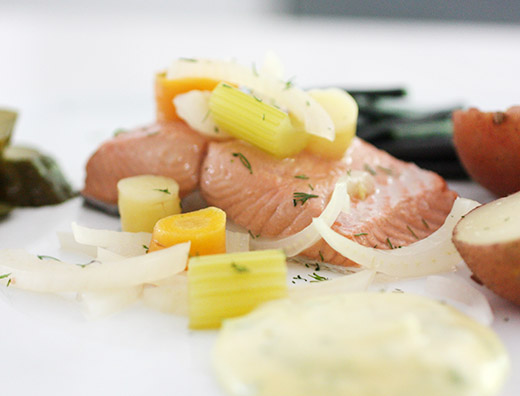
In the end, the dish is a bit of a decomposed salad, and you can mix and match whatever items you’d like to serve with the salmon. Making the salmon itself was as easy as it gets. Fresh salmon fillets were cut into portions and placed in a heat-proof dish. Water was brought to a boil with salt, red wine vinegar, white vinegar, chopped carrots, sliced fennel, sliced onion, chopped celery, thyme springs, bay leaves, parsley stalks, and peppercorns. I'm thrilled to finally get to use my own thyme growing right outside once again. After boiling for a minute, the hot water, with vegetables and herbs, was poured over the salmon, and it was left to cool to room temperature. This steeping step was how the salmon was cooked. Once cool, the salmon was left in the liquid with the vegetables and herbs and refrigerated overnight. The next day, I made a homemade mayonnaise with dill to serve with the salmon. Fresh, new potatoes and purple long beans from Boggy Creek Farm were my cooked accompaniments to the salmon. And, I sliced some lacto-fermented cucumber pickles I had in the refrigerator as well. The chilled salmon was served with the carrot and fennel alongside the boiled potatoes and blanched beans with a dollop of dill mayonnaise and some pickle slices. Each bite of salmon and potato was swiped through the rich mayonnaise. 

The flavor of the salmon was mildly pickled, and I might add more vinegar to the steeping liquid next time. But, the mayonnaise was bright and lively with the vinegar in it and the dill. Those fresh, boiled potatoes went so well with the other parts of the dish. And, it could be presented in different ways. The salmon could be flaked rather than left as a fillet, or all the parts could be combined for a less-deconstructed salad. However it’s served, it’s a great way to celebrate summer. 

Poached and Pickled Salmon 
Recipe reprinted from The Nordic Cookbook by Magnus Nilsson with publisher's permission (Phaidon, $49.95 US/$59.95 CAN, October 2015) 

This is a real summer dish, often served with Boiled Potatoes, Dill Mayonnaise, and Quick Pickled Cucumber. The pickled vegetables are delicious and should also be served with the fish. The salmon is not pickled in the sense that herrings are pickled and won’t keep for very long but should be eaten within a week if stored in the refrigerator. In a restaurant, where you would fillet a whole salmon to make this dish, it’s a good idea to cook the salmon bones and head together with the pickling liquor. If you do so, it will produce a light and very delicious jelly when it cools down. If you decide to try this at home, then add the bones, head and any salmon scraps you have to the pickling liquor, but leave out the vegetables. Bring it slowly to a simmer, then let it sit for 5 minutes before proceeding as described below. If you like the idea of the jelly, but you have no fish bones, then add 2 leaves of gelatin per 1 litre/34 fl oz (4 1/4 cups) of finished pickling syrup. 

Preparation and cooking time: 30 minutes 
Pickling time: overnight 
Serves: 4 

800 g/1 3/4 lb salmon fillet, cut into 4 pieces 
50 g/2 oz (1/4 cup) sugar 
2 tablespoons salt 
100 ml/3 1/2 fl oz (1/3 cup plus 1 tablespoon) red wine vinegar 
100 ml/3 1/2 fl oz (1/3 cup plus 1 tablespoon) Attika (12%) vinegar or white distilled vinegar 
2 carrots, cut into 5 mm/1/4 inch slices 
1 red onion, thinly sliced 
1 small fennel bulb, sliced 
1 celery stalk, chopped 
1 sprig thyme 
2 bay leaves 
12 white peppercorns 
1 handful parsley stalks 

Place the salmon pieces in a pot and keep at room temperature to warm up slightly. Pour 2 litres/3 1/2 UK pints (8 1/4 cups) water into another pot and add the sugar,salt and vinegars. (Remember that it needs to be saltier than you would think because it is supposed to season the salmon. 2 tablespoons fine salt could be a starting point point but you will have to taste your way forward.) Bring to the boil, then add the vegetables and aromatics and continue boiling for 1 minute. Pour the pickling liquor over the pieces of salmon in the other pot and leave to cool to room temperature. 

Refrigerate the salmon in the pickling liquor overnight. Serve the salmon cold. 

Dill Mayonnaise 
I hate mayo that is not thick enough; it should be stiff! If not, it goes very liquid from dilution as soon as it comes in contact with any type of moist food you are eating or mixing it with. Add more oil if it isn’t really thick. If you are using it in a sauce that has more liquids in it, or a salad, it could be on the verge of splitting from containing a lot of oil when you mix it with the remaining ingredients. The water content in the thing you are mixing the mayo with will make it perfect as it dilutes it a bit. 

Preparation time: 20 minutes 
Serves: 4 

2 egg yolks 
1 tablespoon Dijon mustard 
2 tablespoons white vinegar 
250 ml/8 fl oz (1 cup) neutral oil 
salt and white pepper, to taste 
a handful of chopped dill leaves 

Put the egg yolks in a bowl. Whisk in the mustard and vinegar then season with a pinch of salt and a little white pepper. Add the oil, a drop at a time, beating slowly but constantly, until no oil remains and the mayo is nice and thick. Stir in chopped dill. Season to taste. 

I am a member of the Amazon Affiliate Program. 

Monday, August 6, 2012

Quinoa Flake Crusted Salmon with Chile Citrus Sauce

A couple of times this summer, I’ve mentioned wild Alaskan salmon, and that’s what’s shown here again today. This time, I want to share a little information about why this salmon is such a good choice for sustainability. The Alaska Constitution includes a statement regarding protecting natural resources and specifically that “fish...be utilized, developed, and maintained on the sustained yield principle.” The Alaska Department of Fish and Game manages salmon runs by checking numbers of salmon moving upstream to spawning grounds. Sonar counters and fish wheels are used to count, and aerial surveys are performed as well. When enough salmon have reached the spawning grounds to maintain the population, only then are areas opened for commercial fishing for specified lengths of time. This process has made Alaska a “model of seafood sustainability.” Once again, I was delighted to receive some wild, sockeye salmon from the Copper River/Prince William Sound Marketing Association. This time, the salmon came from Prince William Sound which sits between Cook Inlet and Yakutat Bay on the east side of Kenai Peninsula. This salmon was frozen and vacuum packed before being shipped. The color was the same deep, lovely red, and once thawed, the texture was exactly the same as fresh salmon. I had just read about a salmon dish that I wanted to try in The Elements of Taste, so I was ready to get cooking.

Although it’s from book with some serious ideas about flavor that has several serious, chef-style recipes, this dish is actually very simple to prepare. In the book, it’s made with a rice flake crust. I wasn’t able to locate rice flakes, but I did find quinoa flakes and used those instead. The salmon fillets were brushed with a mix of eggs whisked with flour, and then they were pressed into the quinoa flakes that had been seasoned with salt, pepper, and cayenne. The sauce was a reduction of orange juice, mirin, minced lemongrass, grated fresh ginger, dried hot chiles, and a little sugar. After 30 minutes or so, the sauce became syrupy and fragrant. The salmon was quickly seared, crust side down first and then was plated with a pool of the sauce.

The flavor of the salmon was delicious as always, and the quinoa flake crust gave the surface incredible crunch. It was definitely more crunch than you would get with just flour or even cornmeal. The sauce was fruity, spicy, and aromatic and made for a lovely thing to slide each bite of salmon through on the fork. It was another great meal with this carefully caught and well-managed, sustainable fish.

I am a member of the Amazon Affiliate Program.

Wednesday, July 18, 2012

Wild Sockeye Salmon with Lemon-Butter Sauce

With salmon as fresh and lovely as this was, I was inclined to cook it as simply as possible. But, I still wanted to dress it up at least a little. This beautiful sockeye salmon was a second shipment I received from the Copper River/Prince William Sound Marketing Association. You can find more info about Copper River salmon, recipes, and a salmon locator on their Facebook page. Right before this salmon arrived, I had been flipping through Canal House Cooking Volume No. 4, of which I received a review copy, and the Lemon-Butter Sauce from it was something I couldn't wait to try. Hamilton and Hirsheimer refer to the sauce as "similar to hollandaise but better—fresher tasting, not so cloyingly thick." They learned this sauce from Darina Allen at Ballymaloe where she made it with Kerrygold butter which is what I used as well. It has the same ingredients as a classic hollandaise but only two egg yolks rather than three or four. Like hollandaise, the sauce is whisked together over low heat, and lots of butter is added one piece at a time. Still, it has a lighter texture than hollandaise, and the lemon flavor is front and center. It's a fantastic sauce for salmon. 

Here, the salmon was plainly poached in salted water. You'll want to check the doneness from time to time as it poaches. I portioned the salmon into pieces before poaching, and for me, the total cooking time was just under ten minutes. You'll need to cook the salmon first and let it sit for a few minutes while making the sauce, or make the sauce and keep it warm while the salmon poaches. Both steps are so quick, you can't really do them at the same time. For the sauce, two egg yolks and a tablespoon of water were whisked in a medium saucepan over low heat. Then, eight tablespoons of butter were added, one tablespoon at a time, while whisking constantly. Each bit of butter should melt completely into the sauce before adding the next. You want to be sure the sauce isn't cooking too quickly, and you can take the pan off the heat from time to time while whisking. When all of the butter has been added to the sauce, you should remove the pan from the heat and whisk in a tablespoon of lemon juice. Then, taste and season as needed. The sauce can be kept warm by placing the saucepan in a larger pan or heat-proof bowl of hot water. The salmon was served topped with sauce and chopped chives and tarragon or Mexican mint marigold leaves which is what grows easily here. 

It's such a simple, lemony, just-rich-enough sauce, I'll be making it often. And, I loved that the instructions for making it were so straightforward. It's as easy to make as it is delicious. And, even though the salmon didn't really require any embellishment, this made it even better. 

A couple of other recipes grabbed my attention in this volume of Canal House Cooking. There's a Salmon Salad and a Halibut Salad, and I really liked things about both. I flaked the leftover poached salmon, and made a salad that combined the two. First, I added finely chopped preserved lemon and chives suggested for the Salmon Salad, and then I added the green onions, celery, parsley, and mayonnaise from the Halibut Salad. I served the result as tartines with mixed salad greens. Lemon punctuated both the sauce and the salad, but the fresh, wild sockeye salmon was the star of both dishes. 


Tuesday, November 1, 2011

Citrus-Cured Salmon

I've been reading Ruhlman's Twenty: 20 Techniques 100 Recipes A Cook's Manifesto after receiving a review copy, and it's written in such a straightforward, accessible style, it's a pleasure to read. This is no dry, kitchen science textbook. Instead, it offers twenty topics and all the ways those topics affect different types of cooking, and there are recipes with photos for each. Whatever your level of comfort with cooking, each chapter offers clear explanations of techniques and concepts that will improve your skills in the kitchen and the food you serve. From the very basics of being organized in the kitchen to seasoning to the various wonders of eggs and on and on, this book offers examples, tips, and some scientific facts about what works best and why. In the butter chapter, the basics of how butter shortens the strands of gluten in flour are explained, and then there's a description of beurre monte which is made by whisking butter into hot water and can be used to poach shellfish. There's also a mention of brown butter, compound butters, and butter used for confit. The reminders and insights about all of the uses of this one simple ingredient were an inspiration. With an understanding of basic techniques, you can cook with confidence and creativity. At the end of each chapter, there are corresponding recipes that make you want to put the ideas into practice, and it wasn't long before I was on my way to the kitchen.

Chapter two is about salt, and it includes types of salt, seasoning, brining, and preserving. Two recipes I started immediately were the lemon confit and the citrus-cured salmon. They are both so unbelievably easy, I have no idea why I'd never tried either before. For the lemons, they're simply packed with a mix of salt and sugar, covered with water and left to cure for a month. Check back in a few weeks, and I'll be mentioning them again. The salmon is almost as simple as the lemons. I'm so glad I decided to try this right after seeing it in the book. I luckily showed up at the fish counter on the last day that fresh, wild salmon was available this year. I brought home a big fillet and prepared the cure. Two parts salt to one part sugar were combined, and a lemon, a lime, an orange, and a grapefruit were zested. Organic citrus is best to avoid any chemical residue on the outer skin when using the zest. Some of the salt mixture was placed on a big piece of foil, the salmon was set on that, the citrus zests were sprinkled over the salmon, and the remaining salt mixture was poured over the top. Another piece of foil was placed over the salmon, and it was tightly folded together and sealed all around. The foil package was placed on a baking sheet, and a baking pan weighted down with jars from the refrigerator was set on top of the salmon. By pressing the salmon, more water is released as it cures. It was left in the refrigerator for 24 hours. Some recipes from other sources do suggest a longer curing time, and it depends on the thickness of the salmon. You should check it after 24 hours, and if the flesh still feels raw, leave it in the cure for another day. Since the salmon I used was rather thin, 24 hours was enough time for it to become firm. The salt mixture was washed off, the salmon was dried, and it was time to slice.

The only difficulty with home-cured salmon is slicing. A long, thin, serrated knife is best, but a bread knife was the closest thing I had. I did what I could. The slices weren't nearly as perfect and lovely as store-bought cured salmon, but I was proud of them anyway. I'll definitely be curing salmon again in the future, so I'll eventually get more practice at this. First, I had to use some salmon on a bagel. It was fresh and lovely with just a hint of citrus. Up next, I used some of the salmon in the smoked salmon panzanella with feta, dill, and grapes from the book For Cod and Country. It was a minor luxury to have so much cured salmon on hand, and now that I'm comfortable with that technique, I'm looking forward to mastering a few more of the twenty.


Saturday, September 3, 2011

Smoked Salmon Burgers

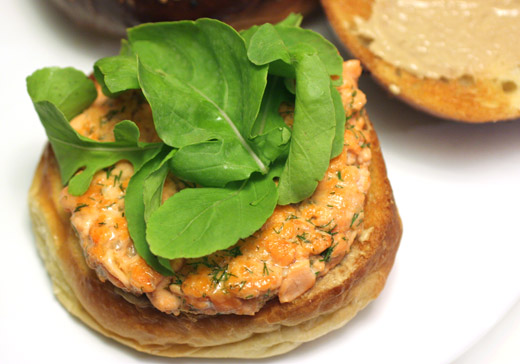
You saw this coming, didn’t you? I couldn’t rave about those brioche hamburger buns and then not tell you about a burger. The fact is that, probably, just about any burger would be delicious with one of those buns. I know this because I’ve used one of those buns for a completely boring, frozen, garden burger and quite enjoyed it. But, that was a later use of a brioche bun. For their debut, I wanted to whip up something special in the way of a burger that would be truly worthy of them. Just when I finally decided to try making those buns, this salmon burger recipe was on the top of my to-try stack. I couldn’t ignore that kind of coincidence. The burger is from the June issue of Living magazine, and it’s made from fresh salmon fillets, cold-smoked or cured salmon, and dill. They’re quick to make and hold together well. If you’d like to grill them though, you might want to use a fish or vegetable tray on top of the grill rack just in case. And, if you choose to brown them in a skillet, they cook in just a couple of minutes per side.

The recipe calls for one pound of fresh salmon and two and a half ounces of thinly sliced smoked salmon. The fresh salmon is cut into large chunks which are chilled before being pulsed in a food processor. The goal is to chop the big chunks but not to a smooth state. The smoked salmon was finely chopped by hand and then stirred into the chopped fresh salmon. Last, chopped fresh dill was added, and the patties were formed. It’s suggested that four patties be formed from the salmon mixture, but since I was dealing with some rather large buns, I divided the mixture into three portions for a better fit. After heating a little oil in a skillet, the burgers cooked for a scant two minutes per side. They just begin to brown, and the salmon barely cooks through. They were topped with mustard and arugula.

The mix of fresh and cured salmon gave these burgers a nice mix of flavors which the dill accented well. And, chopping the fresh salmon just enough but not too much is the key to great texture. For three simple ingredients, they combined perfectly for a very worthy burger.


Friday, February 11, 2011

Seaweed and Noodle Salad with Salmon Teriyaki

Do you remember that list of 50 best cookbooks of all time from The Observer last August? (The top 10 are listed here.) That list was the reason I had to add Nigella’s How to Eat to my collection. I had failed to collect any of her books for the longest time, and I have no idea why that was because I always enjoy her show when I catch it on the Food Network. I did buy Nigella Christmas last year when it was marked down some ridiculous amount right after the holidays, but I didn’t have any of her earlier classics. How to Eat is what I would call a conversational cookbook. It’s written exactly as Nigella speaks, and she conveys her ideas about eating, entertaining, and planning and executing all sorts of meals. The text moves from one topic to another, and sometimes the recipes are really just written descriptions of how she puts a dish together. Mostly though, the recipes appear throughout the text in the conventional way with ingredients listed followed by instructions. It was interesting to read what types of dishes she chose for weekend Sunday lunch parties as opposed dinner parties. The lunches were chicken, pasta, cold meats, or stews, and the dinners were always three courses with seasonally appropriate roasted meats, vegetables, and dessert that usually involved fruit. There were many potato dishes, and many dishes with peas, and most of the desserts were creamy, pillowy creations. Most of the menus seemed a little heavy. Maybe it was because I had read through the book over the course of a few days rather than dipping in and out at different times, but when I arrived at the low fat chapter, it was refreshing to see some lighter fare. Or, I was just in the mood for that. As soon as I read about the noodle salad with sea vegetables and simple teriyaki sauce for fish, I had a dinner plan.

The noodle salad included both dried arame and wakame seaweed. If you’re not sure if you’ll like these, I recommend starting with arame and letting that be your gateway seaweed. It’s very mild in flavor and looks like skinny black pasta once rehydrated. Wakame is only slightly less mild, but it does taste a little more of the sea. Rehydrated, it looks like thawed, frozen, chopped spinach. Both were rehydrated in cool water and then drained. A dressing was made for the noodles with soy sauce, sake, mirin, rice vinegar, sugar, dashi, and sesame oil. I didn’t locate any dashi with no MSG, so I bought some bonito flakes and made a simple broth with a little boiling water. And, speaking of sake, I branched out in an attempt to learn more and tried an unfiltered option. The flavor was lightly floral compared to the last sake I used, and it seemed like a kinder, gentler sort of sake. Next, soba noodles were boiled, drained, rinsed, and drained again. The noodles were tossed with the dressing, the seaweeds, some sliced scallions, and I added some sliced orange bell pepper just because I had it on hand. The noodles can sit at room temperature, or they can be served cold. As they sat, I made the teriyaki sauce for the salmon from soy sauce, sake, mirin, and a pinch of sugar. The sauce was cooked in a pan just to dissolve the sugar while the fish was seared in a skillet. After searing the fish on both sides, the sauce was added and was used to baste the fish. The fish was removed so as not to overcook, and the sauce was left to thicken.

I served the noodles topped by the fish with the thickened teriyaki sauce poured over top. I knew this was going to be a good meal. For me, these flavors never disappoint. I made extra noodles, and the next day I enjoyed them cold from the refrigerator for lunch with chunks of tofu instead of salmon. Next time, I’ll probably add broccoli or greens. It’s great to learn this kind of adaptable dish that you can make a little differently each time you serve it.


Monday, July 5, 2010

Grilled Salmon a la Nicoise

When I was looking for an interesting meal idea last week, I turned to the summer chapter of Sunday Suppers at Lucques. I found this Nicoise-style salad that could be made with several things I had on hand with just a few minor changes. First, in the book, it’s made with grilled halibut, but I used wild salmon instead. The dish also includes haricots verts, cherry tomatoes, and fingerling potatoes. I had different versions of each of those vegetables from my CSA and the farmers’ market. I received green beans last month, and they had been steamed and frozen, so I thawed them rather than buying haricots verts. I had bought local, yellow pear tomatoes, and I had just received some pretty, purple potatoes in my last CSA box. The tomatoes were to be sauteed in anchovy butter, and my stash of salt-packed anchovies came in handy as did my homegrown basil and thyme. This meal had all the components of a standard Nicoise salad, but the elements were tweaked in ways that added great flavor.

First, the fish was seasoned with lemon zest and thyme and then grilled which was flavor-boost one. Next, the potatoes were roasted rather than boiled, boost number two. The cooked green beans and roasted potatoes were sauteed in olive oil with shallots and then tossed with spinach, olives, and lemon juice. Eggs were soft-boiled here which left them extremely tender and lovely. Last, the tomatoes were warmed and softened with melted butter and minced anchovy. The buttery tomatoes became a sauce that was spooned over the grilled fish which sat on top of the spinach salad, and it was crowned with sliced green and opal basil.

Nicoise salad has always been a favorite meal kind of salad of mine, but this one was a cut above the usual. The roasted potatoes with bits of surface crunch and the added shallot, olive oil flavor and the sweet, salty bite of bursting tomatoes in warm anchovy butter elevated this version. And, the soft-boiled eggs were rich and a little delicate and just seemed special. Yes, this was a very good way to make a Nicoise salad.


Friday, May 21, 2010

Seared Salmon on Coconut Spinach

You know how food tastes better when you’re on vacation? I’ve had a lingering memory of a vacation meal for years now. It wasn’t even anything special or planned in advance or exotic. It was a meal at a restaurant we picked because it was the first place we found and we were hungry. I ordered a simple salmon dish served with spinach, and it was flavored with ginger, soy sauce, and sesame oil. That combination of ingredients is so meant to be that I still think about that meal and have hoped to experience it again. It was light but satisfying. Anytime I see salmon with spinach and ginger on a menu, I think, that’s it, but of course it’s not so simple. The sauce can’t be heavy and the salmon can’t be dry and the soy sauce can’t overpower the other flavors. With all of that in mind, when I saw this salmon and coconut spinach dish in Donna Hay’s Off the Shelf, I had a feeling it would be great. This is close to the meal I remember, but the coconut milk and red chiles are an added touch. All the other flavors are there, and as a bonus, this is really quick to prepare.

Wild salmon was marinated with grated ginger, sesame oil, and soy sauce, and then it was briefly seared on each side. Meanwhile, I cleaned some spinach I received from my CSA. Garlic, chopped red chiles, and chlli paste were cooked in a saucepan with a little oil. Coconut milk and lemon juice were added and simmered. Then, in went the spinach which cooked until it wilted. The end. Dinner was ready. This was possibly the fastest meal I’ve made in months.

I accept that being on vacation, being away from home, being in a place for the sole purpose of having fun does indeed make food taste great, and that’s why I remember that meal so fondly. It’s also true that some ingredients just go together really well, and salmon, spinach, and ginger fit that description. This version with coconut milk and red chiles built on that theme. I enjoyed it as much as I thought I might, and I like that it wasn’t an exact re-creation. Instead, it became that great salmon and spinach meal I made at home that reminded me of that vacation.


Monday, September 28, 2009

MangO Salmon Salad

The other day, I was contacted by Michelle of Bleeding Espresso about the O foods contest for Ovarian Cancer Awareness Month. The goal is to spread awareness by posting a recipe with a food that starts or ends with the letter O. I thought this sounded like a great idea for a great cause and started pondering what I could possibly submit. At the same time, I was perusing the Williams Sonoma Fish book and noticed an incredibly simple dish of pan-roasted salmon fillets in mango juice. I imagined that mango salmon could be placed on a crisp, fresh salad, and I realized that mango ends in O.

I wasn’t kidding about how simple this is, and there really isn’t much to the recipe. You simply place some salmon fillets in a glass dish and pour mango juice over them. Let the salmon sit in the mango juice for 20 minutes while you pre-heat the oven to 450 degrees F. Then, heat a tablespoon of olive oil in a non-stick skillet over medium-high heat, remove the salmon from the mango bath and dry each piece, and place the salmon flesh-side down in the skillet. Turn the heat down to medium and sear the salmon for five minutes. Carefully turn the fillets and place the skillet in the hot oven for about three minutes. Pour the mango juice from the glass dish into a saucepan and bring to a boil. Let the juice simmer for a few minutes to thicken slightly. Remove the skillet from the oven and pour the simmered juice over the salmon. Chopped garlic chives garnished the salmon, and since my garlic chive plants have flowers right now, I garnished with those as well.

For the salad, I made a lime shallot vinaigrette which was tossed with mixed baby lettuces. That formed a bed on each plate. While grocery shopping, I looked for something to sit in the center of the salad and found some delicate, little arugula micro greens that were locally grown at Bella Verdi Farms. Those were also tossed with some of the vinaigrette and were then placed in the center of the salad. Pieces of mango sauce-covered salmon were placed around the mound of micro greens. For contrast, flavor, and crunch, I sprinkled on thinly sliced red fresno chiles and green onions and some chopped cashews.


CONTEST RULES

O Foods Contest for Ovarian Cancer Awareness Month

September is Ovarian Cancer Awareness Month, and for the second year in a row, Sara of Ms Adventures in Italy and Michelle of Bleeding Espresso are hosting the O Foods Contest to raise awareness of this important health issue.

There are TWO WAYS to take part in the O Foods Contest:

ONE: Post a recipe to your blog using a food that starts or ends with the letter O (e.g., oatmeal, orange, okra, octopus, olive, onion, potato, tomato); include this entire text box in the post; and send your post url along with a photo (100 x 100) to ofoods[at]gmail[dot]com by 11:59 pm (Italy time) on Monday, September 28, 2009.


PRIZES for recipe posts:

OR

TWO: If you’re not into the recipe thing, simply post this entire text box in a post on your blog to help spread the word and send your post url to ofoods[at]gmail[dot]com by 11:59 pm (Italy time) on Monday, September 28, 2009.

Awareness posts PRIZE:

  • One winner chosen at random will receive a Teal Toes tote bag filled with ovarian cancer awareness goodies that you can spread around amongst your friends and family.

From the Ovarian Cancer Research Fund:

  • Ovarian cancer is the leading cause of death from gynecologic cancers in the United States and is the fifth leading cause of cancer death among U.S. women; a woman’s lifetime risk of ovarian cancer is 1 in 67.

  • The symptoms of ovarian cancer are often vague and subtle, making it difficult to diagnose, but include bloating, pelvic and/or abdominal pain, difficulty eating or feeling full quickly; and urinary symptoms (urgency or frequency).


  • There is no effective screening test for ovarian cancer but there are tests which can detect ovarian cancer when patients are at high risk or have early symptoms.

  • In spite of this, patients are usually diagnosed in advanced stages and only 45% survive longer than five years. Only 19% of cases are caught before the cancer has spread beyond the ovary to the pelvic region.

  • When ovarian cancer is detected and treated early on, the five-year survival rate is greater than 92%.

And remember, you can also always donate to the Ovarian Cancer Research Fund at our page through FirstGiving!

Please help spread the word about ovarian cancer.

Together we can make enough noise to kill this silent killer.


Tuesday, September 8, 2009

Big City Salmon with Martini Sauce

We were in the mood for a light-ish kind of meal involving fish and some salad, and I found some fresh and fabulous king salmon at Whole Foods. I could have simply seared and roasted it and left it at that, but then what are all those cookbooks doing here anyway? I found an interesting sauce to try in Crescent City Cooking by Susan Spicer. In introducing the recipe in the book, she explains that years ago she created a menu of regionally-themed dishes for a Fourth of July dinner. To represent Manhattan in that menu, she developed a martini sauce with olives for salmon. That sounded like a sauce worth trying. For a side dish, I tried the zucchini and fennel slaw from the July issue of Gourmet, and that recipe is on Epicurious.

The salmon could have been grilled, roasted, or even poached, but I did my usual quick sear in a saute pan, turn, and place in a 400 F degree oven for a few minute to cook not quite all the way through. The sauce was started by reducing gin and vermouth with chopped shallots and juniper berries. Once reduced to about three tablespoons, cream was added, and that was reduced again. It was then strained into a bowl and poured back into a saucepan so just a little butter could be incorporated. Sliced pimento-stuffed olives and lemon juice were added. Meanwhile, the slaw was very quickly assembled. I thinly sliced the zucchini and fennel with a Benriner, and they were dressed with a combination of mayonnaise, lemon juice, chives, and mustard.

The meal worked out great. The martini sauce was nicely flavored in a pleasantly boozy sort of way, and the juniper berries gave it a very subtle, wispy hint of pine. The olives took charge visually and brought little punches of brininess that went well with the salmon. And, even though the slaw just sat in the background, off to the side of the plate, it was more delicious than I expected. It was shown in Gourmet with salmon cakes, it was great with the salmon I made, and I can imagine it as a side with all sorts of other things too. It’s incredibly simple to prepare, and I definitely recommend it.


Sunday, May 24, 2009

Salsa Verde Salmon

The other night, I really needed to think of something quick and simple to prepare for dinner. Luckily for me, I remembered The Fast 50 from the February/March issue of Donna Hay Magazine. That was 50 grilling recipes in a row that were simple, straightforward, and as usual for Donna Hay, looked amazing. The salsa verde salmon skewers were perfect for a main course, and I decided to add some vegetables to make each one a complete meal on a stick. The only thinking ahead that’s really required here is to get a thick cut of salmon so that it can be chopped into cubes that will work well on a skewer. I added chunks of zucchini and parboiled, small yukon gold potatoes.

The salmon and zucchini required the same amount of grilling time, and since the potatoes got a head start on the stove, everything achieved doneness at the same time. For the salsa verde, the recommended ingredients were a cup of mint, one third cup of flat-leaf parsley and one third cup of chives, a tablespoon of rinsed capers, a minced clove of garlic, and two tablespoons of olive oil. That sounded like a lot of mint to me, and since my basil plants have been growing so well, I decided to use a little mint and mostly basil. The herbs were chopped and combined with the other ingredients, and the finished salsa was drizzled over the grilled salmon, zucchini, and potatoes.

It was a quick, fresh, flavorful meal lifted by the combination of herbs and the briny note of the capers. Such a simple sauce, but it brightened up and accented the grilled-in flavor nicely. This was another meal from Donna Hay that did not disappoint. And, there are 49 other quick, simple, grilled meals in that one article.


Thursday, April 16, 2009

Grilled Salmon Sandwiches with Pineapple-Mustard Glaze and Green Chile-Pickle Relish

I’m cheating a little with this post because I have, sort of, made this before. But, it was before I started this blog, and I changed things up this time. This is a Bobby Flay meal from way back, and I admit to being a long-time fan. Anybody else remember his early shows with Jackie Malouf and the always-present, odd tension between them? I’m not sure if this meal is old enough to be from that show, but it’s pretty old. Say what you will about Flay’s attitude, personality, whathaveyou, but I’ve always liked his food. I’ve made several of his dishes over the years, and they’re always fantastic. In true Flay form, this meal is all about big, bold flavors. And, there are a lot of those bold flavors going on, but they somehow manage to work together really well. The original meal, still posted on the Foodnetwork site, and what I made several years ago, was tuna burgers with great things mixed into the chopped tuna. The burgers were glazed as they were grilled and then topped with the relish. This time, I wanted to make a sandwich of grilled salmon filets, so I made some alterations.

This time, the mixture that was to have seasoned the tuna was used as a marinade for salmon. Dijon, chipotle puree, honey, oil, and green onions were combined with salt and pepper, and I spread that over the salmon and left it to rest in the refrigerator for 30 minutes. I made the glaze the same as before by combining pineapple juice, white wine vinegar, grated ginger, and soy sauce in a pan. This was brought to a boil and reduced to half its volume which took about 30 minutes. There was supposed to be some brown sugar in that mixture, but the pineapple juice was sweet enough for me, and I omitted it. For the relish, poblano chiles were roasted, peeled, seeded, and diced. They were combined with diced dill pickle, finely chopped red onion, lime juice, chopped cilantro, and olive oil. Honey should have been added, but there I go again not liking things too sweet. So, the honeyless relish was seasoned with salt and pepper and was ready to go.

The marinated salmon was grilled and glazed twice with the reduced pineapple elixir. The side dish for this meal was seasoned grilled fries, and they couldn’t be simpler. Potatoes were cooked on the stove until almost tender, then chopped into wedges, basted with oil mixed with ancho chile powder and salt, and then grilled. The best part is that they don’t stick to the grill. The potato surface instantly crisps and they finish cooking through quickly while acquiring that irresistible grill flavor. I served the marinated, grilled, pineapple glazed salmon topped with the green chile-pickle relish on toasted sesame-semolina sandwich rolls. Have you ever noticed how long the names of Bobby Flay dishes are? Long names, lots of components, bold flavors, but delicious food. This is a completely opposite food philosophy from that of allowing simple, fresh flavors to shine individually, but it has its place on my table. It’s a fun combination of spicy, sweet, sour, tangy, smoky, fresh, and I recommend it.


Blogging tips