



Showing posts with label potatoes. Show all posts

Tuesday, August 31, 2021

Roasted Potatoes with Apricot Harissa


I do enjoy reading a cookbook in which the author writes candidly about how she really prepares various dishes. That was the case with Cook, Eat, Repeat: Ingredients, Recipes, and Stories by Nigella Lawson of which I received a review copy. In this book, the chapters are divided not by breakfast, lunch, and dinner or by season or by category of food. Instead, the chapters are themes introduced by a written explanation that includes how Lawson approaches ingredients, how she cooks for herself versus for guests, and how she uses leftovers for instance. The themes may seem random, but the writing offers more information than recipes on their own ever could. And, each recipe includes more than a headnote. Before the ingredient list and instructions, there is a page or two of writing about how the dish came about, how it can be modified at different times of year or for different occasions, and sometimes meandering thoughts on similar dishes. Meandering isn’t a criticism here. I quite enjoyed the foray through variations and executions. The first chapter is A for Anchovy, and I was delighted by the description of ways to enjoy anchovies on bread. She carefully explains the quantity and temperature of butter for an ideal base for anchovies on bread before describing a version of this she had in Milan that came with roasted red pepper slices. Then, she goes on to discuss crostini with mozzarella, burrata, or stracciatella that’s topped with an anchovy fillet. By the end of this intro to the chapter and before even reading through the recipes, I was doing a search to order anchovies. In the chapter Pleasures, she wholeheartedly supports the seeking of pleasure in food and suggests guilty pleasures have no place in the world of eating since there should be no guilt in culinary joy. The recipes here include a Crab Mac ‘N’ Cheese, a Fried Chicken Sandwich, and Creme Caramel for One that I want to try. The book was finished during the pandemic, so the chapter Much Depends on Dinner took on a new meaning since dinner parties have become tricky or unadvisable depending on the current state of things. Here, you’ll find chicken dishes, lasagna, and roasted vegetables. I was inspired to try the Beet and Chickpea Dip recipe in this chapter. In its intro, there’s a discussion of dips to offer rather than complicated appetizers that includes an aside about a green salsa made with cilantro and jalapeno and the Burnt Onion and Eggplant dip included earlier in the book. This inspired me to whip up a chips and dip Friday with eggplant dip and roasted salsa. And, from later in that chapter, I had to try the Vegan Lemon Polenta Cake that I topped with a blueberry sauce. The dish I want to tell you more about, though, is the Roasted Potatoes with Apricot Harissa. The harissa appears a couple of times in the book. It’s used on a sheet pan chicken dish with sweet potatoes and again with roasted cauliflower and spinach. In the intro to the cauliflower recipe, there’s a mention of using the harissa on roasted potatoes with specific instructions for how to do that, and that’s what I did. 

I had local potatoes and sweet peppers from Boggy Creek Farm, so the time was right for this dish. Both were chopped into big chunks. The potatoes were coated with olive oil and some of the harissa before being spread on a baking sheet. A few tablespoons of water were added before the pan went into a hot oven. After 20 minutes or so, I added the pepper chunks and stirred the mixture around to distribute the harissa and oil. The mixture roasted another 20 minutes or so until the potatoes were crisp outside, tender inside, and the peppers were browned. For the harissa, I used the dried peppers I had on hand which on that day were pasillas and anchos. They were stemmed and seeded and rehydrated in boiling water. Coriander, cumin, and cardamom seeds were toasted. The softened chiles, spices, some garlic, dried apricots, turmeric, smoked paprika, olive oil, apple cider vinegar, and salt were all added to a food processor and pureed. I omitted the ginger that was part of the ingredient list. 

Happily, this made enough harissa for a few uses, and I have a jar in the freezer. The sweetness of the apricots plays nicely off the bitterness of the dried chiles. It was fantastic with the roasted potatoes and peppers, and I can’t wait to try it with cauliflower and/or chicken. Or, I might meander a bit myself and try it on fish or with roasted mushrooms. That might not happen until after I’ve tried all those options for anchovies on bread though.


I am a member of the Amazon Affiliate Program. 

Tuesday, November 12, 2019

Rosti with a Green Salad on Top

I’m all for encouraging more people to cook their own meals at home. So, I was delighted to see the newest book from the Canal House team: Cook Something: Recipes to Rely On of which I received a review copy. This book is full of simple, classic dishes that home cooks can learn from and use to build confidence in their cooking skills. Hirsheimer and Hamilton of Canal House describe themselves as “salt and pepper cooks.” They like to stick to the basics of great flavor pairings and highlighting the deliciousness of the season. While there is simplicity to their approach, the results of their recipes are always stellar. Over the years, I’ve accumulated several favorite recipes from Canal House books. I recall in the early days of reading their work, I noticed the frequent use of preserved lemon which I loved. A salmon salad and a lentil dish, both with preserved lemon, come to mind. I remember a lemon-butter sauce that was perfect for sockeye salmon. It was their recipe and technique for making a quick puff pastry that finally sold me on the concept. It’s the only way I make it now. I’m also a devoted fan of their quick cioppino, and it was their lasagne with fresh-made spinach pasta sheets that was one of our favorite Christmas Eve meals of all time. This new book sticks to their tried-and-true cooking point of view with recipes for all sorts of meals, sides, starters, and desserts and even a Grilling chapter that made me want to stock up on hardwood charcoal. Right away, you see their knack for flavor pairings with all the suggested toppings for deviled eggs like asparagus tips and preserved lemon(!); smoked salmon, black pepper, and fresh dill; and sliced cherry tomato, olive oil, pepper, and fresh basil. Likewise, there’s also a delectable list of toppings for small toasts or crackers to serve as appetizers such as roasted red peppers, capers, and currants; blue cheese and watercress mash; and lima bean and lemon mash. I should mention the photos show how deliciously lovely each of these looks. The soups chapter distracted me since we’ve had some chilly weather. I was pulled in by the description of a simple dinner involving the Hearty Squash and Bean Minestrone with a Green Sauce made from arugula served with warm bread and had to recreate it for a Sunday dinner at home. And, it was the photo of the Caramelized Apple Galette that made me try that recipe too. But, it’s the Salads chapter I want to tell you more about today. The Rosti with a Green Salad on Top was an ideal combination of flavors and textures with a lemony-anchovy dressing and a generous garnish of smoked salmon. 

If you just saw the photos of the salads in the book, you would think “those look so great with beautiful ingredients that have been simply plated.” But, when you read about how the salads are made and then look at the photos, the whole story becomes apparent. That straightforward tomato and fennel salad is actually a warm salad with peeled, fresh tomatoes that were briefly sauteed in olive oil just to warm them. The fennel was sauteed longer until tender and topped with lemon-anchovy vinaigrette, and the two were plated with a nice slab of feta. Little details of putting each salad together make each one special. For this salad on rosti, I had some local potatoes that I grated and mixed with chopped green onion and salt and pepper. The grated potato mixture was cooked in melted butter and pressed into flat cakes. Each cake cooked for a few minutes per side. I made the salad with arugula and opted for the Lemon-Anchovy Vinaigrette that’s made with supremed lemon segments. The lemon juice was caught in a bowl while cutting the segments. Chopped anchovies, olive oil, and crushed red pepper flakes were added, and the lemon pieces were broken up while stirring the vinaigrette. The option of adding a “flourish of silky smoked salmon” made this a meal. 


Like every Canal House recipe I’ve ever made, this one was a winner. I get excited to cook as I flip the pages, see the photos, and read the great ideas. I’m not surprised that the variations on Loose Ravioli have inspired me, but I didn’t expect to want to attempt Duck a L’Orange. There’s something for everyone and for every occasion here. 

Rosti with a Green Salad on Top 
Excerpted with publisher's permission from Cook Something: Recipes to Rely On Copyright © 2019 by Christopher Hirsheimer and Melissa Hamilton, photographs by Christopher Hirsheimer. Used with permission of Little, Brown and Company, New York. All rights reserved. 

Rosti is a Swiss potato pancake. A big russet potato on the kitchen counter was our inspiration. 

Grate 1 large, peeled, russet potato (about 1 pound), on the large holes of a box grater into a bowl. Add 4 chopped scallions, and season with salt and pepper. Melt 2 tablespoons butter in a nonstick skillet over medium-high heat. Add the potatoes, pressing them into a flat cake. Fry until golden, about 10 minutes. Cover the skillet with a large plate and flip the skillet and the plate over so that the rösti is cooked-side up on the plate. Add 2 tablespoons butter to the skillet and slide the rösti back into the skillet. Fry until golden, about 10 minutes. While the potato cake finishes browning, toss bibb lettuce, radicchio, and parsley leaves in Another Anchovy Vinaigrette. Divide the rosti between dinner plates and pile the salad on top. Add a flourish of silky smoked salmon for garnish. —serves 2–4 

Lemon-Anchovy Vinaigrette  
A lighter, brighter option for all Caesar salad lovers. This vinaigrette involves supreming the lemon, a French technique (they always know how to refine things) that removes the peel and the pith, then cuts the juicy fruit out from the membranes. This method works well with all citrus fruits. 

makes about 2/3 cup

2 lemons 
4 anchovy filets packed in oil, drained and finely chopped 
1/2 cup extra-virgin olive oil 
1/4 teaspoon crushed red pepper flakes 
Salt and freshly ground black pepper 

Using a sharp knife, cut off and discard all the peel and white pith from the lemons. Working over a medium bowl, cut lemons along sides of membranes to release the segments into the bowl. Squeeze the juice from the membranes into the bowl, and discard the membranes. Stir in the anchovies, oil, and crushed red pepper flakes, breaking up the lemon segments against the side of the bowl with a spoon. Season with salt and pepper to taste.


I am a member of the Amazon Affiliate Program. 

Tuesday, July 23, 2019

Tiny Baked Potatoes with Spiced Chickpeas

I feel like I’ve said this before, but it bears repeating: It’s always worthwhile to read a cookbook all the way to the end. I tend to find fascinating tidbits in those last pages. When the final chapter is about sauces or toppings or stocks, there’s always something interesting there that makes me like the book even more than I already did from reading the main sections. That just happened once again with The Way to Eat Now: Modern Vegetarian Food by Alice Hart of which I received a review copy. This new book is a paperback release of what was titled Good Veg as a hardcover in 2016, and it’s full of great ideas for vegetarian dishes for any time of day. Along with the recipes and photos, there are also added ideas and variations sprinkled throughout the chapter introductions and recipe head notes. For example, something I can’t wait to try isn’t written as a recipe but was just mentioned in the Mornings chapter intro. It’s a suggestion to make savory French toast by adding garlic or paprika to the custard and serving it with roasted tomatoes or wilted spinach and goat cheese. Some of the dishes include dairy or eggs, and some are vegan, and substitutions are offered. There’s also acknowledgement of time and cost, and when a step may take too long or an ingredient might be too pricey other options are suggested. Several dishes have southeast Asian influences, and vegetarian “fish” sauce is listed among the ingredients. You’ll find the recipe for the sauce in that last chapter I was praising, and I was delighted to see it’s not too time-consuming to make. You’ll also find a recipe for Vegetarian Nuoc Cham, Pickled Sour Cherries, Sweet Pepper and Chile Jam, and a Thai-Style Roasted Chile Paste. That last one sent me backwards in the book to revisit the recipe for Brown Rice Bibimbap Bowls with Smoky Peppers where it’s used, and that made me happy to have read all the way to the end. Back at the front of the book, I got a bit distracted by the Chia Jams. I’d seen this method before of using chia seeds to thicken a jam rather than adding as much sugar as usual. When I saw it here, I finally gave it a try and loved chia-thickened peach jam with a little honey. I also tried the Shaved Beets with Sprouts, Kefir and Dukkah but made a couple of changes by using vegan yogurt for the dressing rather than kefir and mixing the beets with arugula instead of sprouts. I have the page marked for the Chubby Polenta Fries with Almond Za’atar Salt, and I know I’ll love the Roasted Pineapple, Coconut and Makrut Lime Sorbet. But, I want to tell you all about the Tiny Baked Potatoes with Spiced Chickpeas. 

New potatoes are available from our local farms right now, but they’ll be gone for the season soon. They were simply roasted whole with a little olive oil and salt and pepper. At the same time, canned chickpeas that had been rinsed, drained, and left on a towel to dry were roasted with cumin, nigella, hot smoked paprika, and salt. I love crispy, roasted chickpeas, but there was a twist here in that before they were done lemon zest was added for the last 10 minutes or so. It smelled amazing and added great flavor. A little honey was to be added with the lemon zest, but I skipped it. A sauce was made with sour cream and finely chopped green onion. When the potatoes were cooked through and tender and then allowed to cool a bit, I cut each in half. Each half was topped with some sauce, crispy chickpeas, more finely chopped green onion, and more nigella seeds. 

These little potatoes would be great for a party. They’re just the right size to pick up with your fingers. The sauce works perfectly to keep the chickpeas in place on top of each potato, and the spices on the chickpeas give each bite a nice boost. There’s so much variety and so many ideas in this book, I suspect I’ll be spending a lot of time with it in the kitchen.

I am a member of the Amazon Affiliate Program. 

Tuesday, April 30, 2019

Grilled Potato and Leek Salad with Salsa Verde Vinaigrette

If you love to throw parties and are amazing at it or if you’d like to get better at doing it, I have a new book for you. Life Is a Party: Deliciously Doable Recipes to Make Every Day a Celebration from David Burtka is full of festive ideas, and I received a review copy. And, you can win a copy! Just leave a comment on this post before the end of Monday, May 6th including an email address where I can contact you. Two randomly selected winners in the US or Canada will each receive a copy of the book from the publisher. The book begins with handy party planning tips like setting the mood by testing lighting the day before, stocking up on plenty of ice and storing it in the bathtub or washing machine, checking with guests about any food allergies, and more. My favorite of the tips, and one that I live by, is getting as much done in advance as possible. You should enjoy the party too! Then, the party menus are grouped by season. But, there’s more than just menus and recipes. There are also suggestions for table decor, what to wear, how to take the theme to the next level, activities, and even a playlist for each occasion. Everything you need for an incredible party is here, but this is an easy-going book. You’re invited to pick and choose how much you want to do and how you want to shape your party. The recipes tend to serve six to eight, and you can scale up or down as needed. Each menu includes cocktails or mocktails, salads or sides, main dishes, and dessert. Of course, you could also mix and match recipes to create your own menus too. As soon as I opened the book, the Scallops with Peas and Green Oil got my full attention. It’s part of a spring party menu that starts with a Cucumber-Herb Cocktail and ends with a Flourless Chocolate Cake. The Mexican Fiesta looks like a lot of fun, and I would love to find big serving bowls of guacamole and ceviche at a party. I also loved the look of the Chocolate Chunk Hazelnut Bars and the pitcher of Fresh Blueberry Fizz at the Summer Picnic. It was the Sunday Funday menu that got me headed into the kitchen though. It starts with Mojito Slushies and includes Grilled Tofu Skewers with Coconut-Peanut Dipping Sauce, a DIY Sundae Bar, and the Grilled Potato and Leek Salad shown here. 

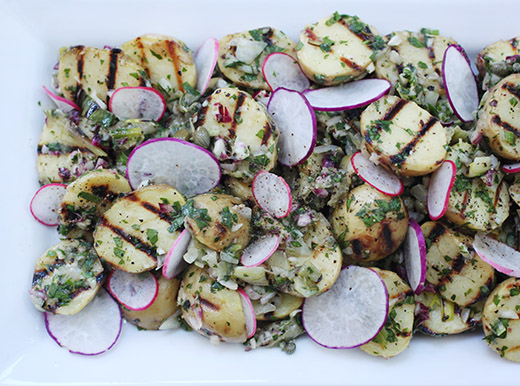
I did fall for the idea of grilling potatoes for a potato salad, but in truth, I can never pass up salsa verde of the Italian variety. The herby sauce with olive oil sounded like a perfect match for grilled potatoes. I used small, white potatoes, and they were boiled and allowed to cool before grilling. I opted for a grill pan on top of the stove for better heat control with the small potatoes and leeks and onions. I had a collection of local spring bulb onions and leeks, and I had just brought home some shallot scapes that I used here as well. The onions and leeks were halved lengthwise, brushed with oil, seasoned with salt and pepper and grilled on the pan until tender. The cooled potatoes were sliced in half, oiled, seasoned, and grilled for a few minutes on each side. The vinaigrette was made with mustard, white wine vinegar, olive oil, parsley, cilantro, and I added capers. I chopped the grilled onions and leeks because I prefer them finely chopped. They were added to a big bowl with the grilled potatoes to be tossed with the vinaigrette. The salad was garnished with sliced radishes. 

My instincts did not fail me in assuming the salsa verde vinaigrette would be great with potatoes. The mix of alliums with the herbs all worked together fabulously. I would definitely serve this to guests or bring it to a party. Whether your guest lists are family-friendly or grown-ups-only, your gatherings are formal or anything-goes, and you plan every detail to a T or just want some basic ideas, this book has it all for your next party. 

Grilled Potato and Leek Salad with Salsa Verde Vinaigrette 
Recipe reprinted with publisher’s permission from Life Is a Party: Deliciously Doable Recipes to Make Every Day a Celebration

Serves 6 to 8 

for the potatoes and leeks 
Kosher salt 
3 pounds fingerling potatoes 
1 tablespoon whole black peppercorns 
3 large leeks (about 11/2 pounds) 
1/4 cup plus 3 tablespoons olive oil 

for the salsa verde vinaigrette 
1/4 cup whole-grain mustard 
1/4 cup white wine vinegar 
1/2 cup extra-virgin olive oil 
1 1/2 teaspoons kosher salt, plus more for seasoning 
4 scallions, thinly sliced 
Leaves from 1 large bunch flat-leaf parsley, finely chopped 
1 bunch cilantro 
1/4 cup sliced radishes, for garnish 

special equipment 
outdoor grill or grill pan 

1. Cook the potatoes: Bring a large stockpot of heavily salted water to a boil (the water should taste like the sea). Add the potatoes and peppercorns, reduce the heat to medium-low, and simmer the potatoes until tender, about 20 minutes. 
2. While the potatoes are cooking, make the salsa verde vinaigrette: In a medium bowl, whisk together the mustard, vinegar, olive oil, and salt. Stir in the scallions, parsley, and cilantro. 
3. Grill the leeks: Heat the grill or grill pan to medium-high. 
4. Slice off the root ends and dark green tops of the leeks and discard. Halve the leeks lengthwise, then peel back the layers by the base so they are slightly separated. Immerse the leeks in a bowl of cold water and gently shake to dislodge any dirt and grit. Pat dry, then drizzle with 3 tablespoons of the olive oil and sprinkle liberally with salt. Grill the leeks cut-side down until dark grill marks form, about 4 minutes, then flip and cook until the leeks no longer feel stiff, about 4 minutes more. Transfer to a plate and let cool. 
5. When the potatoes are tender, drain them and spread them out on a baking sheet to cool, discarding the peppercorns. Once cool enough to touch, slice them in half lengthwise and toss with the remaining 1⁄4 cup olive oil and 2 teaspoons salt. Grill, cut-side down, until dark grill marks appear, 3 to 4 minutes, then flip and grill for 3 minutes more. 
6. Toss the potatoes, leeks, and salsa verde vinaigrette in a large bowl; garnish with the radishes. The salad can be served right away or allowed to sit on the counter for 2 to 3 hours before serving.

I am a member of the Amazon Affiliate Program. 

Wednesday, June 20, 2018

Potato Galette with Mexican Mint Marigold

Back in 1994, our very own Central Market grocery store opened in Austin, and it immediately became the place where I do a big part of my grocery shopping. In 1994, I was a graduate student, and my shopping list included more frozen food and quick-to-cook things than it does now. But, I remember walking into this brand-new store with the produce section that meanders on and on and discovering starfruit and taking it home to taste it for the first time. There was so much to explore and taste, and my grocery store expectations have never been the same since. I thought about that as I read my review copy of The Berkeley Bowl Cookbook: Recipes Inspired by the Extraordinary Produce of California's Most Iconic Market by Laura McLively. The Berkeley Bowl, in Berkeley California, began as a small, family-run produce shop that has evolved into “one of the nation’s most renowned retailers of exotic fruits and vegetables.” All of the produce continues to be selected by the original owner, Glenn Yasuda, who visits sellers and farmers personally to choose what to order for the store. The new book is a tribute to the variety of foods found there and a guide for using lots of the interesting and seasonal produce throughout the year. The recipes aren’t always traditional to the ingredients being highlighted. For instance, Asian greens may be given a Spanish flavor profile or purple cauliflower may find its way into tacos. But, the dishes are all intriguing. The chapters are grouped by type of produce such as Leaves, Spores and Succulents, and Roots and Tubers. The Spring Chickpea Tabbouleh made with raw chickpeas straight from the pod makes me want to grow my own. And, I want to track down some banana blossoms so I can try the Banana Blossom with Glass Noodles and Crispy Garlic that’s served in the sturdy, outer petals of the blossom. I have some locally-grown, purple snake beans that I’m going to use in a Thai curry tonight, but I can’t wait to bring home more of them to use in the Smokey Snake Beans involving tomatoes and a homemade bbq-style sauce with a recommended side of cornbread. I’ve also marked the pages for Sea Bean and Soba Salad, Aloe Vera and Mango Ceviche in which the texture of the aloe mimics that of fish, and Golden Beet Tamales with Red Pepper Sauce. These days I do still bring a lot home from Central Market, but I try to gather most of the produce I use from local farms. In the spring, potatoes and shallots appear, and I had to try the Potato Galette with Tarragon made with a layer of sauteed shallots. In the book, the galette is made with lovely purple potatoes, and I have found locally-grown purple potatoes here in the past. This time, I went with the red potatoes and shallots on offer at Boggy Creek Farm, and I used my home-grown Mexican mint marigold that has a flavor very similar to tarragon. 

The recipe suggested any homemade or store-bought pie dough, and I did a little searching through my books for a good olive oil dough. I decided to try the whole wheat, tahini, and olive oil dough found in A New Way to Bake: Classic Recipes Updated with Better-for-You Ingredients from the Modern Pantry. Olive oil doughs are so easy to make, and this one was very easy to roll out and shape for the galette. For the filling, shallots were thinly sliced and sauteed in olive oil until caramelized. Chopped tarragon, or Mexican mint marigold in my case, was added. I also added some chopped sage from my herb garden. The dough was rolled into a 13-inch circle, and the shallots were spread in the center. Potatoes were thinly sliced on a mandoline and placed on top of the shallots, overlapping slightly. The potatoes were brushed with some olive oil, sprinkled with salt and pepper, and topped with more herbs. The dough was folded over the edges and brushed with an egg wash. The galette baked for about 30 minutes. I crisped some sage leaves in olive oil to add on top of the baked galette. Sour cream is suggested for serving, but I loved the galette just as it was. 


This is a great make-ahead dish since the galette can sit at room temperature and holds up perfectly. You could serve thin slices with cocktails or larger slices as a meal with a salad. It’s the kind of simple dish that really puts the freshness of the ingredients into the spotlight. This book is going to come in handy for cooking with what’s locally grown and some store-bought, new-to-me produce. 

Purple Potato Galette with Tarragon 
Recipe reprinted with publisher’s permission from The Berkeley Bowl Cookbook: Recipes Inspired by the Extraordinary Produce of California's Most Iconic Market. 

Fanned out across a flaky pastry smeared with caramelized shallots, this deep royal purple potato is a showstopper. A sprinkling of fresh tarragon and a dollop of sour cream balance the galette’s richness. Serve for brunch or lunch alongside lightly dressed mixed greens. 

Serves 6 to 8 

2 tablespoons plus 1 teaspoon olive oil 
4 large shallots, peeled and thinly sliced 
1 tablespoon fresh chopped tarragon 
1/2 teaspoon salt 
Freshly ground black pepper 
10 ounces purple potatoes (about 4), unpeeled 
1 9-inch pie dough (homemade or store-bought) 
1 egg, beaten 
Sour cream for serving 

Heat 2 tablespoons of the olive oil in a skillet over low-medium heat. Add the shallots and sauté on low for 20 minutes, or until the shallots are soft and caramelized. Turn off the heat and stir in half of the tarragon, half of the salt, and some pepper. Set aside to cool slightly. Use a mandoline or a sharp knife to cut the potatoes into 1/16-inch-thick slices. Set aside. 

Preheat the oven to 375°F. Use a rolling pin to roll the pie crust thinner and into a 13-inch circle. Line a baking sheet with parchment paper and place the crust on it. Spread the shallots over the pie crust, leaving a border around the edge (about 1 1/2 inches). Starting from the outer edge of the shallots, place the potato slices on top the shallots in overlapping layers, spiraling inward. Use a pastry brush to brush the potatoes with the remaining olive oil and sprinkle the remaining salt. Fold the border of the dough up and over the potatoes, pressing down in loose pleats. 

Brush the exposed dough with the beaten egg and bake for 28 to 32 minutes, until the crust is golden and the potatoes are tender. Sprinkle the remaining tarragon over the galette and serve with dollops of cold sour cream.


I am a member of the Amazon Affiliate Program. 

Sunday, June 4, 2017

Seafood Salad with Lemon-Garlic-Herb Dressing

As soon as we have a hint of summery weather, seafood salad is on my mind. I really believe it’s an ideal meal when it’s hot outside. In fact, if I could spend every day of summer sitting poolside with a supply of such a salad in a nearby refrigerator, I’d be extremely happy. Sadly, there’s no pool in my backyard, but whipping up more seafood salad every few days is definitely doable. I had just read about a lovely-sounding version in Tartine All Day: Modern Recipes for the Home Cook, and the time was right. During this late spring-not-quite-summer yet season, the local farms have fennel, celery, onion, and new potatoes. And, all of those things happen to be perfect elements of a seafood salad. For the main attraction, the seafood, you can pick and choose whatever combination you prefer. This time, I kept it simple with just shrimp and squid, but chunks of halibut, some scallops, and clams would have been great mixed in as well. What I really liked was the preparation method of the recipe in the book. 

You begin my making a quick and easy court bouillon with water, bay leaves, thyme sprigs, sliced lemon, chopped shallot, a few peppercorns, and some salt. The seafood was cooked in batches in the simmering stock. By cooking the shrimp by itself before cooking the squid by itself, you have better control of the timing and can pull everything out of the stock with a slotted spoon at just the right moment. As the seafood drained and cooled a bit, new potatoes were then cooked in the same court bouillon. This was a great idea for adding flavor to the potatoes and for making the process efficient by only using one pot. After the potatoes were tender but not mushy, they were drained and allowed to cool. The dressing was a mixture of lemon juice, olive oil, minced garlic, chopped oregano, minced shallot, and salt and pepper. I wanted to give it just a bit of thickness, and so I added some mayonnaise. In the book, the salad is just those items: the seafood, potatoes, and dressing. I added thinly sliced raw fennel and chopped celery and served it with dressed arugula on the side. 

Two lessons I learned from this were: always cook some potatoes in a court bouillon after poaching seafood; and, when you have fresh, local celery, potatoes, and fennel, put them in a seafood salad. I just need to work on getting a pool into my backyard, and I’ll be set. 

I am a member of the Amazon Affiliate Program. 

Monday, December 5, 2016

Kale Potato Cakes

I thought I was fairly familiar with the styles of cuisine from different regions in the United States. I’ve read about Low Country and Southern foods and their differences and similarities. But, it wasn’t until I read my review copy of Victuals: An Appalachian Journey, with Recipes by Ronni Lundy that I was introduced to the foods of the Appalachian Mountain South. There was something familiar about the family recipes here. The use of home-grown vegetables, the mentions of the distinct flavors of fresh beans and just-dug potatoes, and the simplicity of the preparations reminded me of my grandparents’ cooking. I should mention, this is more than a cookbook. Ronnie Lundy grew up in eastern Kentucky and weaves the stories of this region with true understanding. The picturesque writing details the landscape along with the history of the towns and the people who have lived there. She writes: “I try to imagine what this journey was like on foot, as native people made it, and as many of the early settlers did, possessions stripped to not much more than tools for survival and seeds for planting. Switchbacks flanked by walls of rock and furiously rushing creeks are gorgeous, but equally perilous… I realize that while this was a passage of risk and hardship, it was also one of great possibility.” The book encourages travel as much as eating. She also writes of how things have changed over time and about some of the newly established restaurants in the area. The recipes represent traditional family fare as well as a few of the more recent restaurant dishes. There’s Shelley Cooper’s Speckled Butter Bean Cassoulet with Rabbit Confit from Dancing Bear Appalachian Bistro in Townsend, Tennessee alongside all the recipes for “the absolute best summer supper” including Mountain Green Beans and Taters, Skillet Corn, sliced tomatoes, and Buttermilk Cucumber Salad. You’ll also find Skillet Fried Chicken and Milk Gravy, Fried Apples, Buttermilk Brown Sugar Pie, and Colin Perry’s Sorghum and Apple Sticky Pudding. All the recipes come with a story and a place in time in this pocket of the country. 

Now that our weather has cooled off, I was ready for a good, comfort food kind of dish that makes use of fresh greens. I brought home a pretty bunch of kale from Boggy Creek Farm to make the Kale Potato Cakes. Yukon Golds were peeled, quartered, and boiled until tender. Meanwhile, the kale was washed, stemmed, and chopped. The kale was sauted in olive oil until wilted. The drained potatoes were mashed a bit before the cooked kale was added. Chopped green onions were added as was shredded Asiago cheese. Four beaten eggs were then mixed into the mashed potatoes. The mixture was formed into three-inch patties that were crisped on both sides in hot olive oil in a skillet. The potato cakes were served with Old-School Tomato Gravy made with sauteed onion, flour for thickening, and canned diced tomatoes. 

The crispy potato cake edges give way to tender, fluffy interiors, and the Asiago cheese flavors them well. The tomato gravy was delicious with them, but they were also perfectly lovely with no sauce at all. I’m inspired to find my way to this area of the country and drive along the mountain roads described in the book. I want to find the artisanal salts being made from newly revived salt mines and taste some of the many varieties of apples that grow there. Then, I want to bring home some sorghum syrup and make that Sticky Pudding. 

I am a member of the Amazon Affiliate Program. 

Monday, June 20, 2016

Poached and Pickled Salmon

The dish I’m showing today would be perfect for celebrating Midsummer. I’ve never been to Sweden or any part of the Nordic region, but I’d love to visit during the Midsummer festival and enjoy daylight all night long. As usual, I’ve been virtually traveling with a cookbook, and this time it’s The Nordic Cookbook by Magnus Nilsson. I received a review copy of this hefty book that covers traditional and contemporary foods from Finland, Sweden, Norway, Denmark, the Faroe Islands, Iceland, and Greenland. Nilsson set out to show the similarities as well as the differences between each part of the Nordic culture. Several dishes are found in multiple locations and go by different names in each place, and some are unique to one area. He accepted that the book could never be a complete record of all the recipes from this large area, but it was intended to inform the reader about this food culture and provide guidance in creating some of that food. It also includes beautiful photos of the areas that were visited during the research phase. There’s a simplicity to the ingredients and most preparations, and flavors are brightened by vinegars, horseradish, and herbs. I loved all the potato recipes including several potato salads, soups, creamed potatoes, gratins, potato cakes, and Potatoes Hasselbacken. Why have I never made those? I learned the dish was invented in the 1950s at a restaurant that became a cooking school called Hasselbacken. There are meat and poultry dishes, sausage and charcuterie, breads and waffles and dumplings, cakes and pastries, and a chapter for little cookies and other sweets that I imagine would be perfect on a holiday cookie tray. I really enjoyed reading about all the various fish dishes with fresh, pickled, smoked, and dried variations. I really like pickled shrimp, so I had to try the Poached and Pickled Salmon since fresh wild salmon season is in full swing. 

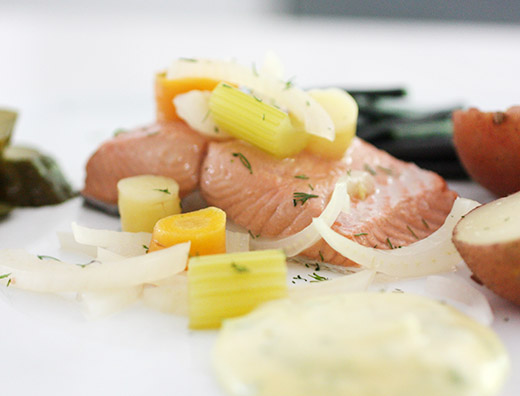
In the end, the dish is a bit of a decomposed salad, and you can mix and match whatever items you’d like to serve with the salmon. Making the salmon itself was as easy as it gets. Fresh salmon fillets were cut into portions and placed in a heat-proof dish. Water was brought to a boil with salt, red wine vinegar, white vinegar, chopped carrots, sliced fennel, sliced onion, chopped celery, thyme springs, bay leaves, parsley stalks, and peppercorns. I'm thrilled to finally get to use my own thyme growing right outside once again. After boiling for a minute, the hot water, with vegetables and herbs, was poured over the salmon, and it was left to cool to room temperature. This steeping step was how the salmon was cooked. Once cool, the salmon was left in the liquid with the vegetables and herbs and refrigerated overnight. The next day, I made a homemade mayonnaise with dill to serve with the salmon. Fresh, new potatoes and purple long beans from Boggy Creek Farm were my cooked accompaniments to the salmon. And, I sliced some lacto-fermented cucumber pickles I had in the refrigerator as well. The chilled salmon was served with the carrot and fennel alongside the boiled potatoes and blanched beans with a dollop of dill mayonnaise and some pickle slices. Each bite of salmon and potato was swiped through the rich mayonnaise. 

The flavor of the salmon was mildly pickled, and I might add more vinegar to the steeping liquid next time. But, the mayonnaise was bright and lively with the vinegar in it and the dill. Those fresh, boiled potatoes went so well with the other parts of the dish. And, it could be presented in different ways. The salmon could be flaked rather than left as a fillet, or all the parts could be combined for a less-deconstructed salad. However it’s served, it’s a great way to celebrate summer. 

Poached and Pickled Salmon 
Recipe reprinted from The Nordic Cookbook by Magnus Nilsson with publisher's permission (Phaidon, $49.95 US/$59.95 CAN, October 2015) 

This is a real summer dish, often served with Boiled Potatoes, Dill Mayonnaise, and Quick Pickled Cucumber. The pickled vegetables are delicious and should also be served with the fish. The salmon is not pickled in the sense that herrings are pickled and won’t keep for very long but should be eaten within a week if stored in the refrigerator. In a restaurant, where you would fillet a whole salmon to make this dish, it’s a good idea to cook the salmon bones and head together with the pickling liquor. If you do so, it will produce a light and very delicious jelly when it cools down. If you decide to try this at home, then add the bones, head and any salmon scraps you have to the pickling liquor, but leave out the vegetables. Bring it slowly to a simmer, then let it sit for 5 minutes before proceeding as described below. If you like the idea of the jelly, but you have no fish bones, then add 2 leaves of gelatin per 1 litre/34 fl oz (4 1/4 cups) of finished pickling syrup. 

Preparation and cooking time: 30 minutes 
Pickling time: overnight 
Serves: 4 

800 g/1 3/4 lb salmon fillet, cut into 4 pieces 
50 g/2 oz (1/4 cup) sugar 
2 tablespoons salt 
100 ml/3 1/2 fl oz (1/3 cup plus 1 tablespoon) red wine vinegar 
100 ml/3 1/2 fl oz (1/3 cup plus 1 tablespoon) Attika (12%) vinegar or white distilled vinegar 
2 carrots, cut into 5 mm/1/4 inch slices 
1 red onion, thinly sliced 
1 small fennel bulb, sliced 
1 celery stalk, chopped 
1 sprig thyme 
2 bay leaves 
12 white peppercorns 
1 handful parsley stalks 

Place the salmon pieces in a pot and keep at room temperature to warm up slightly. Pour 2 litres/3 1/2 UK pints (8 1/4 cups) water into another pot and add the sugar,salt and vinegars. (Remember that it needs to be saltier than you would think because it is supposed to season the salmon. 2 tablespoons fine salt could be a starting point point but you will have to taste your way forward.) Bring to the boil, then add the vegetables and aromatics and continue boiling for 1 minute. Pour the pickling liquor over the pieces of salmon in the other pot and leave to cool to room temperature. 

Refrigerate the salmon in the pickling liquor overnight. Serve the salmon cold. 

Dill Mayonnaise 
I hate mayo that is not thick enough; it should be stiff! If not, it goes very liquid from dilution as soon as it comes in contact with any type of moist food you are eating or mixing it with. Add more oil if it isn’t really thick. If you are using it in a sauce that has more liquids in it, or a salad, it could be on the verge of splitting from containing a lot of oil when you mix it with the remaining ingredients. The water content in the thing you are mixing the mayo with will make it perfect as it dilutes it a bit. 

Preparation time: 20 minutes 
Serves: 4 

2 egg yolks 
1 tablespoon Dijon mustard 
2 tablespoons white vinegar 
250 ml/8 fl oz (1 cup) neutral oil 
salt and white pepper, to taste 
a handful of chopped dill leaves 

Put the egg yolks in a bowl. Whisk in the mustard and vinegar then season with a pinch of salt and a little white pepper. Add the oil, a drop at a time, beating slowly but constantly, until no oil remains and the mayo is nice and thick. Stir in chopped dill. Season to taste. 

I am a member of the Amazon Affiliate Program. 

Monday, November 25, 2013

Sea Scallops with Saffron Potatoes and Orange-Meyer Lemon Salsa

I have go-to cookbooks for different purposes, different types of dishes, or different times of year. For instance every year when my birthday is approaching, the book I turn to for special dishes for celebrating with flavors that I love is Sunday Suppers at Lucques by Suzanne Goin published in 2008. It would be an understatement to say that I was a little excited when I learned she was releasing a new book. The A.O.C. Cookbook appeared at the end of last month, and I received a review copy. In a lot of ways, this new book feels like a continuation of Sunday Suppers. The seasonality, style of cooking, and flavors are consistent, but this time rather than menus for meals, the dishes are organized by starters, mains, vegetables, and desserts. The recipes are based on the menu from Goin’s restaurant A.O.C. which focuses on small plates, but in the book, the savory recipes are written to serve six as full courses or appetizers. Each section of the book is divided by season so you can turn to the appropriate time of year for what’s fresh and available at the markets. Also, in this book, Goin’s business partner, Caroline Styne offers wine pairing suggestions for every dish. And, there’s a cheese guide with descriptions of every type ever served at A.O.C. It was interesting to read that Goin has learned from her fans over the years. She knows that some cooks prefer simpler, streamlined recipes and others enjoy a bit of a challenge. In the headnotes, she mentions when a recipe fits that latter category so you know what to expect. I’ve flagged several pages including the ones for Dandelion and Roasted Carrot Salad with Black Olives and Ricotta Salata; Black Bass with Fennel Puree, Winter Citrus, and Green Olives in Green Harissa; Grilled Quail with Couscous, Walnuts, and Pomegranate Salsa; Turmeric-Spiced Root Vegetables with Kaffir Lime Yogurt and Mint Chutney; Torchio with Kabocha Squash, Radicchio, Walnuts, and Taleggio; and Ricotta Cheesecake with Dried Fruit Compote and Walnut Biscotti. And, those are just a few of the fall and winter dishes. 

I’ve tried two items from the book so far. The Butterscotch Pot de Creme with Salted Cashew Cookies was a comfort-food kind of dessert at its best. Sadly, butterscotch is never particularly photogenic, but it is delicious especially paired with a crunchy, nutty cookie. The second dish I made was the Sea Scallops with Saffron Potatoes and Orange-Meyer Lemon Salsa. This was a classic Suzanne Goin dish to my mind due to the lemon zest and herb seasoning applied to the scallops before cooking and the bright-tasting, citrus salsa. I took a couple of liberties with the recipe, and you can see the original version from the book below. Rather than skewering the scallops on trimmed rosemary sprigs and grilling, I seared the scallops in a hot pan. Also, even though blood oranges had appeared at the grocery store the week before I went looking for them, on the day I needed them there were none. I used Cara Cara navels instead which aren’t as deep red in color and are less bitter. It was the best option available, but I wish I could have used blood oranges. For the potatoes, I used fingerlings that I cut into thick chunks. They braised on top of the stove in a bath of saffron, water, and olive oil with onion, and chile de arbol. They absorbed all those lovely flavors while cooking until tender. The plate was assembled with potatoes topped with arugula, then the scallops, and finished with the citrus salsa on top. 

This dish was delightful in every way. The potatoes were both literally and figuratively the foundation. Earthy and mild with hints of saffron and onion in each bite, they countered the bitter, peppery greens while the scallops were sweet bites of the sea. And, the salsa punctuated everything just as it should. It’s going to be a lot of fun to cook from this book from season to season. 

Atlantic Sea Scallops with Saffron Potatoes and Blood Orange–Meyer Lemon Salsa 
Excerpted from The A.O.C. Cookbook by Suzanne Goin. Copyright © 2013 by Suzanne Goin. Excerpted by permission of Knopf, a division of Random House LLC. All rights reserved. No part of this excerpt may be reproduced or reprinted without permission in writing from the publisher. 

I love the colors of this Sicilian- inspired dish—the deep red, orange, and yellow tones of the salsa spooned over those white scallops and over the mounds of sienna- hued potatoes remind me of an Italian vacation. I was never a big fan of scallops until I tasted the super- sweet, succulent, meaty East Coast diver- caught ones we are lucky enough to get from Steve Connolly in Gloucester, Massachusetts. Seek them out—they are so worth it! This preparation would also work beautifully with halibut, sole, or other white flaky fish. 

NOTE Mexican diver-caught scallops are a good alternative to the Atlantic sea scallops. 

6 branches rosemary, about 7 to 8 inches long 
18 Atlantic sea scallops, each about 2 ounces 
1 tablespoon Meyer lemon zest 
2 tablespoons finely diced shallots 
1 tablespoon champagne vinegar 
2 Meyer lemons 
3 large blood oranges 
1 cup extra-virgin olive oil 
1 tablespoon sliced mint 
1 teaspoon saffron threads 
2 pounds Yukon Gold potatoes, peeled and cut into 1 1/2-inch chunks 
1 cup diced red onion 
1 tablespoon thyme leaves 
1 chile de arbol, crumbled 
2 ounces young dandelion greens or arugula 
Kosher salt and freshly ground black pepper 

Remove the rosemary leaves from the branches except for 2 inches at the bottom of each. Cut the leafless end of each branch at an angle with a sharpknife to make a point and coarsely chop the picked rosemary leaves. Season the scallops with the lemon zest and 1 1/2 tablespoons chopped rosemary. Skewer three scallops onto each rosemary branch. Cover and refrigerate. Place the shallots, champagne vinegar, and a healthy pinch of salt in a small bowl, and let sit for 5 minutes. 

Cut away the stem and blossom ends from the Meyer lemons. Stand the lemons on one end, and cut them vertically into 1/8-inch slices (keeping the rinds on). Stack the slices in small piles on a cutting board, and cut them lengthwise into 1/8-inch thick matchsticks. Line up the matchsticks, and cut them into 1/8-inch cubes. Cut away the stem and blossom ends from two blood oranges. Place the oranges cut- side down on a cutting board. Following the contour of the fruit with your knife, remove the peel and cottony white pith, working from top to bottom, and rotating the fruit as you go. Then hold the oranges in your hand, one at a time, and carefully slice between the membranes and the fruit to release the segments in between. Add the diced lemon, blood- orange segments, their juices, and the juice of the remaining orange to the shallot mixture. Stir in 1/2 cup olive oil, the mint, 1/2 teaspoon salt, and a few grinds of pepper. 

Light the grill 30 to 40 minutes before cooking, and take the scallops out of the refrigerator. Place the saffron in a small bowl, and pour 1 cup warm water over it. 

Heat a large Dutch oven over high heat for 1 minute. Swirl in 1/4 cup olive oil, and wait 1 minute. Add the onion, thyme, chile, 1/2 teaspoon salt, and a few grindings of black pepper. Reduce the heat to medium, and sauté for about 3 minutes, stirring often, until the onion is translucent. Turn up the heat to medium- high. Add the potatoes and 2 tablespoons of olive oil, and season with 1 teaspoon salt and a few grindings of pepper. Don’t stir the pan for a couple of minutes while the potato edges sear in the hot oil and form a nice crust. Lift and tilt the pan to distribute the oil evenly. After 3 to 4 minutes, firmly shake the pan to loosen the potatoes. Turn with a wooden spoon and cook for another 3 minutes, stirring to coat with the onions. Add the saffron water. Stir to combine, cover the pot, reduce the heat to low, and let simmer for about 25 minutes, until the potatoes are nicely glazed and tender when poked with a paring knife. If at any point the liquid starts to dry up, add a little more water. The saffron potatoes should be glazed, neither dry nor soupy. Turn off heat, and put the lid halfway on. When the coals are broken down, red, and glowing, brush the scallops with remaining 2 tablespoons olive oil, and season with salt and pepper on both sides. 

Place the skewered scallops on the grill, and cook for 4 minutes, rotating once to create crosshatch marks and a browned crust. Flip the scallops, move them to a cooler side of the grill, and cook for another 1 to 2 minutes, until they’re medium-rare. Spoon the hot saffron potatoes into the center of six dinner plates, scatter the dandelion, and place the scallop skewers on top. Spoon the blood orange-Meyer lemon salsa over the scallops. 

I am a member of the Amazon Affiliate Program.

Saturday, March 23, 2013

Chickpea Samosas with Spicy Mint Sauce

I’ve wanted to try making samosas for years. Those crispy, little nuggets full of fluffy, mashed potato, maybe some peas, and spices are a favorite of mine. I always have at least one with whatever else I order at Indian restaurants, but I’d never worked up the courage to make them at home. Then, I saw this version with chickpeas, carrots, and some minced green chile in the filling and the accompanying recipe for the dough that seemed easy enough, and I was inspired to give it a shot. This is from Savory Pies by Greg Henry. The book, of which I received a review copy, includes Appetizer Pies, Main Course Pies with both meat and seafood options as well as vegetarian, and Hand Pies. There’s an Asiago Mac-n-Cheese Pie with Potato Crust that sounds delightfully decadent, pretty little Tomato Caprese Tarts with Chive Oil, a Shaved Asparagus Galette with Mascarpone and Jarlsberg, and Baked Egg Shakshuka in dough-lined bowls that I want to try. I approached the samosas with a one-step-at-a-time mindset. I knew this was going to take some time, and I didn’t want to feel rushed. I made the dough and the filling a day in advance, and then I formed the samosas and fried them the next day. I realized right away that forming samosas is not a natural talent I possess. The dough is easy to work with, and the instructions for filling each piece of it are clear, but I wasn’t producing good results. My first few might have been the ugliest samosas of all time. I found this video which I replayed repeatedly as I continued filling pieces of dough and never got close to producing the tidy little packages seen in it. Thankfully, once fried and golden, the look of them doesn’t matter at all. 

The dough is a mix of flour, semolina, and salt that is stirred into a bowl with water and vegetable oil. After incorporating all the flour, the dough is then kneaded until smooth. It was wrapped in plastic and chilled. For the filling, peeled chunks of potatoes were boiled, drained, and returned to the pan to be heated again to remove excess water. Then, they were mashed and combined with curry powder and butter. In a large skillet, cumin seeds were added to hot oil followed by minced onion and finely diced carrots. Ginger and minced green chile were added and briefly cooked before that mixture was added to the potatoes. Last, rinsed and drained canned chickpeas, thawed frozen peas, and chopped chives were added to the filling. I refrigerated the filling overnight before proceeding. The next day, the dough was divided, rolled into little circles, each circle was cut in half, and each half was filled. The most important thing is to be sure the edges are sealed, and this dough is very easy to seal as it’s pinched together. The samosas were fried in batches and left to cool. The sauce was a quick puree of mint, cilantro, onion, lime juice, serrano chile, a pinch of sugar, and water. 

The recipe makes a lot, and I went ahead and fried them all at once. I’ve since pulled leftovers from the freezer and reheated them in the oven which worked very well. The crunchy crust and fluffy potato filling topped with the spicy, herby sauce were well worth the effort. I’ve learned I’ll never be a pro samosa maker, but I’m thrilled to have finally made these at home. 

Chickpea Samosas with Spicy Mint Sauce 
Recipe reprinted with publisher’s permission from Savory Pies

This is India’s version of street food perfection—a hand pie, of course. Every culture has one, but there’s something about Indian samosas that has led the way in a worldwide surge in street-food culture. 

makes 32 

Spicy Mint Sauce 
2 cups lightly packed fresh mint leaves 
1 cup lightly packed cilantro sprigs 
1/2 cup minced onion 
1 1/4 cups water, divided 
1 tablespoon fresh lime juice 
1 teaspoon minced serrano chile 
1 teaspoon sugar 

Dough 
1 1/2 cups all-purpose flour, plus more for rolling 
2 tablespoons semolina 
1 teaspoon kosher salt 
Pinch of ajwain seeds (optional, may be found in Indian markets or online) 
2 tablespoons vegetable oil 
3/4 cup water 

Filling 
2 medium Yukon Gold potatoes, peeled and cut into 2-inch chunks 
1 teaspoon kosher salt, plus more as needed 
1 teaspoon Madras-style curry powder, or more to taste 
2 tablespoons unsalted butter, melted 
1 teaspoon vegetable oil 
1 teaspoon cumin seeds 
1/2 cup minced onion 
1 small carrot, peeled and finely diced (about 1/2 cup) 
1 teaspoon peeled and grated fresh ginger 
1 teaspoon minced mild green chile 
1 cup canned chickpeas, drained 
1/2 cup frozen peas 
2 teaspoons minced fresh chives 
Freshly cracked black pepper, as needed 
Peanut or canola oil as needed for frying 

To make the mint sauce, combine the mint, cilantro, 1/2 cup minced onion, 1/2 cup water, lime juice, serrano chile, and sugar in a blender to form a rough purée. (The sauce may be made up to 2 days ahead and refrigerated, covered. Bring to room temperature to use.) 

For the dough, in a medium bowl mix together 1 1/2 cups all-purpose flour, semolina, 1 teaspoon salt, and ajwan seeds (if using). In another bowl mix together the oil and water. (Don’t try too hard—you know what they say about oil and water.) Stir the flour mixture into the oil mixture in 3 or 4 increments, mixing well between additions. On a lightly floured surface, knead the dough, using more flour as needed until you have a smooth but fairly stiff dough. Press your thumb in to check—there should be almost no bounce-back in the indentation. Wrap in plastic and set aside to rest at room temperature at least 1 hour. (The dough may be made up to 2 days ahead and refrigerated, covered. Bring back to room temperature before continuing.) 

For the filling, place the potato chunks and 1 teaspoon salt in a large saucepan. Add just enough water to cover by about 1 inch. Bring to a boil, then reduce to a simmer. Cover and cook until the potatoes fall apart when poked with a fork, about 20 minutes. Drain and return to the hot, dry pan. Turn the heat to low and cook, uncovered, shaking the pan often to evaporate as much water from the hot potatoes as you can, about 4 minutes. Let cool somewhat, then push through a ricer into a large bowl, or use a masher or fork. Stir in the curry powder and melted butter. Set aside. 

Heat the vegetable oil in a large cast-iron or other heavy-bottomed skillet over medium-high heat. Add the cumin seeds. Once they begin to pop, add the onions and carrots. Cook until softened, stirring often, about 6 minutes. Stir in the ginger and mild green chile; cook about 1 minute. Set aside to cool somewhat, then add to the potatoes. Stir in the chickpeas, peas, and chives. Adjust the seasoning with salt and pepper as needed. Set aside. (The filling may be made up to 2 days ahead and refrigerated, covered. Bring to room temperature before continuing.) 

To assemble the samosas, on a lightly floured surface form the dough into 16 balls, about 1 3/4 ounces each. Use a lightly floured rolling pin to roll into 6-inch rounds, a generous 1/8 inch thick; cut in half to create half-moons. Spoon a generous 2 tablespoons filling in the center of a half-moon; lightly moisten the dough edges with water, using your finger. Lift 1 corner and fold halfway over the filling at a 45-degree angle, aligning the straight edge down the center. Press lightly to seal the dough along the outer edge. Repeat with the other corner, creating a neat triangular packet. Pinch or crimp any openings shut. Repeat to form 32 small samosas. 

Fill a medium straight-sided pot with 4 inches of oil and heat to 365 degree F. Fry the samosas in batches, rolling them around in the oil until golden, about 3 to 4 minutes per side. Use a slotted heatproof spoon to transfer them to a paper towel–lined plate as they finish cooking. Serve hot (but not too hot) with the mint sauce. 

I am a member of the Amazon Affiliate Program.

Blogging tips